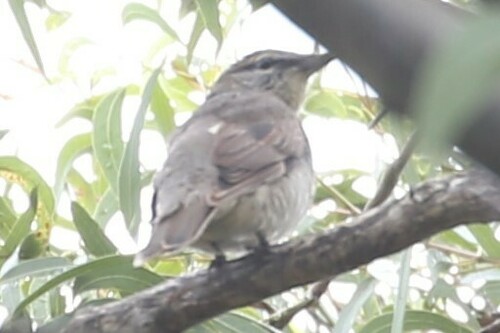
Banded Broadbill vs Sahul Cicadabird
Eurylaimus javanicus versus Edolisoma tenuirostre
Play a quiz with Banded Broadbill and Sahul Cicadabird
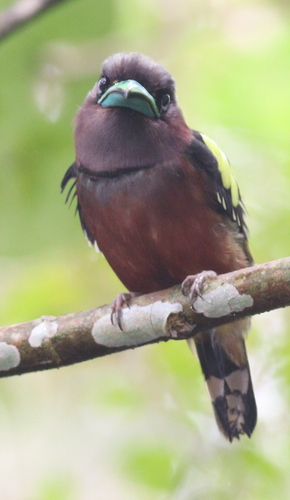
Banded Broadbill
Sahul Cicadabird
In short
The Banded Broadbill and Sahul Cicadabird are distinct in appearance and behavior, with the former showing vibrant plumage and the latter being more subdued in color. The Banded Broadbill is known for its striking purple-red and black-and-yellow plumage, while the Sahul Cicadabird is primarily gray with variable barring. Both species inhabit different regions, with the broadbill in Southeast Asia and the cicadabird in New Guinea and Australia.
Identification tips
1. Look for the Banded Broadbill's vibrant purple-red plumage and turquoise-blue bill, which are distinctive. 2. Note the Sahul Cicadabird's more subdued gray tones and potential barring on females. 3. Listen for the explosive song of the broadbill versus the mechanical notes of the cicadabird. 4. Consider habitat: broadbills in Southeast Asian forests, cicadabirds in New Guinea and Australia.
Size
The Banded Broadbill is generally more robust and larger in appearance compared to the more slender Sahul Cicadabird.
Plumage
The Banded Broadbill features bright purple-red plumage with black-and-yellow wing markings and a large turquoise-blue bill. In contrast, the Sahul Cicadabird is predominantly gray, with males ranging from pale to dark gray and females showing gray and white with variable barring.
Behaviour
The Banded Broadbill is often sluggish and inconspicuous despite its bright colors, while the Sahul Cicadabird is more active, especially during migration in southeastern Australia.
Habitat
The Banded Broadbill inhabits the forests of Southeast Asia, including the Malay Peninsula and Greater Sunda Islands. The Sahul Cicadabird is found in New Guinea, northern and eastern Australia, and migrates seasonally in southeastern Australia.
Voice
The Banded Broadbill has a remarkably loud song with an explosive start followed by a cicada-like trill. The Sahul Cicadabird's call is a fast series of mechanical-sounding, cicada-like notes, although not all subspecies produce this vocalization.