Birdr

Banded Martin vs Sand Martin

Neophedina cincta versus Riparia riparia

Play a quiz with Banded Martin and Sand Martin
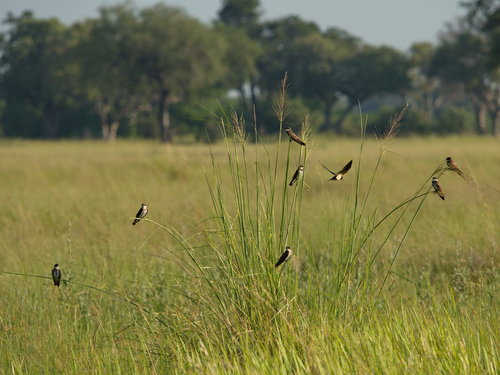
Banded Martin (Neophedina cincta) Banded Martin
Sand Martin (Riparia riparia) Sand Martin

Media

Loading…

In short

The Banded Martin and Sand Martin are both small swallows, but they can be distinguished by their plumage and habitat preferences. The Banded Martin has a distinctive band across its chest, whereas the Sand Martin is more uniformly brown with a less pronounced breast band. Both species are often seen in open areas, but the Sand Martin is more commonly associated with sandy banks and quarries.

Identification tips

Look for the distinctive chest band on the Banded Martin. Observe the habitat: Sand Martins are more likely to be seen near sandy banks. Note the colony behavior of Sand Martins, often nesting in large groups.

Size

Both species are similar in size, typical of small swallows, with slender bodies and pointed wings.

Plumage

The Banded Martin features a prominent dark band across its chest, contrasting with its lighter underparts. The Sand Martin has a more uniform brown plumage with a less distinct breast band, appearing more muted overall.

Behaviour

Both species exhibit typical swallow behavior, including agile flight and aerial insect hunting. The Sand Martin is often seen in large colonies, especially during breeding season.

Habitat

Banded Martins are found in open areas, often near water. Sand Martins prefer sandy banks and gravel quarries, where they nest in burrows.

Voice

Vocalizations are not a primary distinguishing feature between these two species, as both have typical swallow calls.

Submit a better description

Use the same sections as the comparison. Your text is published immediately.

The Banded Martin and Sand Martin are both small swallows, but they can be distinguished by their plumage and habitat preferences. The Banded Martin has a distinctive band across its chest, whereas the Sand Martin is more uniformly brown with a less pronounced breast band. Both species are often seen in open areas, but the Sand Martin is more commonly associated with sandy banks and quarries.

Look for the distinctive chest band on the Banded Martin. Observe the habitat: Sand Martins are more likely to be seen near sandy banks. Note the colony behavior of Sand Martins, often nesting in large groups.

Both species are similar in size, typical of small swallows, with slender bodies and pointed wings.

The Banded Martin features a prominent dark band across its chest, contrasting with its lighter underparts. The Sand Martin has a more uniform brown plumage with a less distinct breast band, appearing more muted overall.

Both species exhibit typical swallow behavior, including agile flight and aerial insect hunting. The Sand Martin is often seen in large colonies, especially during breeding season.

Banded Martins are found in open areas, often near water. Sand Martins prefer sandy banks and gravel quarries, where they nest in burrows.

Vocalizations are not a primary distinguishing feature between these two species, as both have typical swallow calls.

Discard your changes?

You have unsaved edits. If you leave now, those changes will be lost.

Banded Martin · Sand Martin · My Tricky Birds