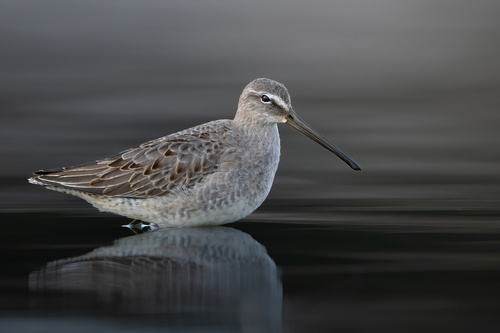
Bar-tailed Godwit vs Long-billed Dowitcher
Limosa lapponica versus Limnodromus scolopaceus
Play a quiz with Bar-tailed Godwit and Long-billed Dowitcher
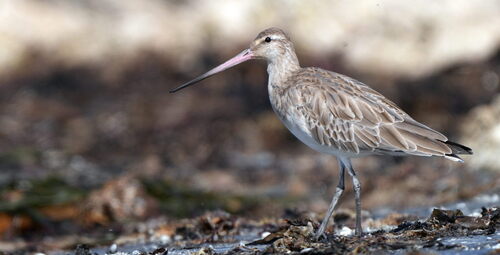
Bar-tailed Godwit
Long-billed Dowitcher
In short
The Long-billed Dowitcher and the Bar-tailed Godwit are two shorebirds that differ significantly in size, plumage, behavior, and habitat preferences. The Long-billed Dowitcher is characterized by its long, straight bill and distinctive feeding motion, while the Bar-tailed Godwit is larger, with a longer neck and a more pronounced bar on its tail. These distinctions can help birdwatchers accurately identify each species in the field.
Identification tips
- Birds of the World Similar-Species Diagnostics:
- "Although similar to the Short-billed Dowitcher in appearance, the Long-billed differs from that species ecologically." (Source: Birds of the World)
-
The Bar-tailed Godwit, in contrast, is noted for its "barred tail," which is visible in flight, as well as its larger size and more social behavior during migration.
-
AI Field Diagnostics:
- Size & Shape: Look for the overall larger size and longer neck of the Bar-tailed Godwit, which gives it a more elongated silhouette compared to the more compact Long-billed Dowitcher.
- Bill Shape: The Long-billed Dowitcher has a straight, long bill, while the Bar-tailed Godwit’s bill is longer but slightly curved.
- Feeding Behavior: Observe the Dowitcher's "sewing machine" feeding motion, which is unique and distinct from the more general pecking behavior of the Godwit.
- Habitat Preference: Pay attention to habitat; if you see a bird in freshwater wetlands, it’s likely a Long-billed Dowitcher, whereas the Bar-tailed Godwit is more often found in coastal mudflats.
- Plumage Features: Note the Long-billed Dowitcher’s rufous-brown plumage with streaking, and the Bar-tailed Godwit’s more uniform coloration and distinct barred tail in flight.
- Social Behavior: If you spot large flocks, they are likely Bar-tailed Godwits, while the Long-billed Dowitcher often remains solitary or in smaller groups.
By focusing on these key differences in size, plumage, behavior, habitat, and vocalization, birdwatchers can effectively distinguish between the Long-billed Dowitcher and the Bar-tailed Godwit in the field.
Size
- Long-billed Dowitcher: Medium-sized sandpiper, measuring approximately 10-11 inches (25-28 cm) in length, with a wingspan of about 20 inches (51 cm). It has a chunky body and relatively short legs compared to the Bar-tailed Godwit.
- Bar-tailed Godwit: Larger than the Long-billed Dowitcher, reaching lengths of 14-16 inches (36-41 cm) and a wingspan of about 30 inches (76 cm). This species has a longer neck and legs, which gives it a more elongated appearance.
Plumage
- Long-billed Dowitcher: During the breeding season, it has a rich rufous-brown coloration with darker streaks on the head and back, and a paler underbelly. Notably, its long bill, extending twice the length of its head, is straight and thin.
- Bar-tailed Godwit: Exhibits a more uniform coloration, with a warm brown back and a paler underbelly. Its most distinctive feature is the barred tail, which is visible during flight. The bill is also long, but slightly more curved than that of the Long-billed Dowitcher.
Behaviour
- Long-billed Dowitcher: Known for its characteristic "sewing machine" feeding motion, the Long-billed Dowitcher probes into mud and silt to find food. It often forages in freshwater wetlands and is more solitary or in small groups.
- Bar-tailed Godwit: Feeds by pecking at the surface or probing the mud, often seen in large flocks. This species has a more social behavior, especially during migration when it gathers in large numbers.
Habitat
- Long-billed Dowitcher: Prefers freshwater wetlands, small pools, and salt-marsh vegetation, often found in areas with abundant mudflats. Breeds primarily in coastal western and northern Alaska to eastern Siberia.
- Bar-tailed Godwit: Commonly found in intertidal zones of coastal habitats, including mudflats and beaches. It has a broader migratory range, breeding in subarctic and arctic tundra of Alaska and migrating to temperate and tropical coasts.
Voice
- Long-billed Dowitcher: Produces a distinctive call while flying and feeding, which can be described as a "pee-witch-er" sound, especially during its breeding display.
- Bar-tailed Godwit: Generally more silent but can emit soft calls, particularly during the breeding season.