Birdr

Bar-winged Flycatcher-shrike vs Sooty-capped Babbler

Hemipus picatus versus Malacopteron affine

Play a quiz with Bar-winged Flycatcher-shrike and Sooty-capped Babbler
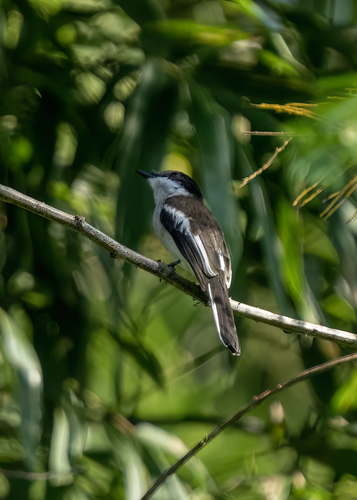
Bar-winged Flycatcher-shrike (Hemipus picatus) Bar-winged Flycatcher-shrike
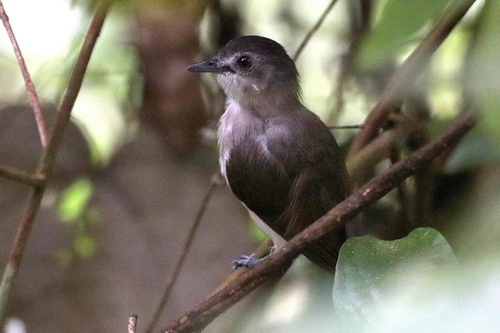
Sooty-capped Babbler (Malacopteron affine) Sooty-capped Babbler

Media

Loading…

In short

The Bar-winged Flycatcher-shrike and the Sooty-capped Babbler can be distinguished by their plumage and behavior. The Bar-winged Flycatcher-shrike is more likely to be seen in the open, often perched visibly, while the Sooty-capped Babbler prefers dense undergrowth and is more secretive.

Identification tips

Look for the white wing bar and contrasting black and white plumage of the Bar-winged Flycatcher-shrike. Note the sooty cap and uniform brownish plumage of the Sooty-capped Babbler. Observe behavior: the flycatcher-shrike is more active and visible, while the babbler is secretive and stays in dense undergrowth. Listen for distinct vocalizations: high-pitched whistles for the flycatcher-shrike and melodious notes for the babbler.

Size

Both species are small, but the Bar-winged Flycatcher-shrike is slightly more slender and streamlined compared to the more robust Sooty-capped Babbler.

Plumage

The Bar-winged Flycatcher-shrike has a distinctive white bar on its wings and a contrasting black and white plumage. In contrast, the Sooty-capped Babbler has a more uniform brownish plumage with a sooty cap and lacks the wing bars.

Behaviour

Bar-winged Flycatcher-shrikes are often seen in pairs or small groups, actively foraging in the canopy and making short sallies. Sooty-capped Babblers are more secretive, usually found in dense undergrowth, and often move in small, noisy groups.

Habitat

The Bar-winged Flycatcher-shrike is typically found in open forests and edges, while the Sooty-capped Babbler prefers dense, humid forest undergrowth.

Voice

The Bar-winged Flycatcher-shrike has a series of high-pitched, whistling calls, whereas the Sooty-capped Babbler produces a series of repetitive, melodious notes.

Submit a better description

Use the same sections as the comparison. Your text is published immediately.

The Bar-winged Flycatcher-shrike and the Sooty-capped Babbler can be distinguished by their plumage and behavior. The Bar-winged Flycatcher-shrike is more likely to be seen in the open, often perched visibly, while the Sooty-capped Babbler prefers dense undergrowth and is more secretive.

Look for the white wing bar and contrasting black and white plumage of the Bar-winged Flycatcher-shrike. Note the sooty cap and uniform brownish plumage of the Sooty-capped Babbler. Observe behavior: the flycatcher-shrike is more active and visible, while the babbler is secretive and stays in dense undergrowth. Listen for distinct vocalizations: high-pitched whistles for the flycatcher-shrike and melodious notes for the babbler.

Both species are small, but the Bar-winged Flycatcher-shrike is slightly more slender and streamlined compared to the more robust Sooty-capped Babbler.

The Bar-winged Flycatcher-shrike has a distinctive white bar on its wings and a contrasting black and white plumage. In contrast, the Sooty-capped Babbler has a more uniform brownish plumage with a sooty cap and lacks the wing bars.

Bar-winged Flycatcher-shrikes are often seen in pairs or small groups, actively foraging in the canopy and making short sallies. Sooty-capped Babblers are more secretive, usually found in dense undergrowth, and often move in small, noisy groups.

The Bar-winged Flycatcher-shrike is typically found in open forests and edges, while the Sooty-capped Babbler prefers dense, humid forest undergrowth.

The Bar-winged Flycatcher-shrike has a series of high-pitched, whistling calls, whereas the Sooty-capped Babbler produces a series of repetitive, melodious notes.

Discard your changes?

You have unsaved edits. If you leave now, those changes will be lost.

Bar-winged Flycatcher-shrike · Sooty-capped Babbler · My Tricky Birds