
Barn Swallow vs Western House Martin
Hirundo rustica versus Delichon urbicum
Play a quiz with Barn Swallow and Western House Martin
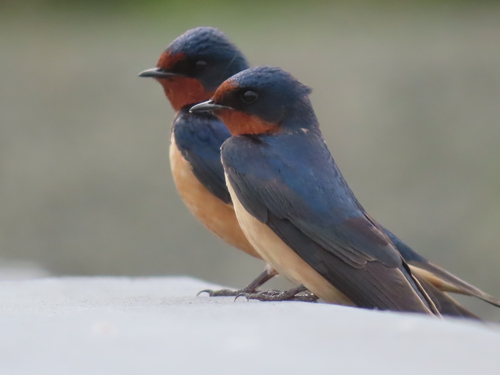 Barn Swallow
 Western House Martin
In short
The most reliable field mark to separate Barn Swallow from Western House Martin is the tail: Barn Swallow has a long, deeply forked tail with elongated streamers (especially in adults), while Western House Martin shows a much shorter, shallowly forked tail. In flight, House Martin’s bright white rump and pure white underparts contrast sharply with Barn Swallow’s off-white belly and rufous face. Juvenile Barn Swallows lack long tail streamers and can be confused with House Martins, but they still show a rufous face and a dark breast band, while House Martins never have a breast band and always show a white rump. Both species are similar in size and often occur together near human habitation, but their flight style and plumage differences are usually clear with good views.
Identification tips
- Tail shape and length (all ages): Barn Swallow has a long, deeply forked tail with elongated outer feathers (streamers), especially in adults. House Martin’s tail is much shorter and only shallowly forked. Juvenile Barn Swallows lack streamers but still have a longer tail than House Martin.
- Rump color (all ages): House Martin always shows a bright white rump, very obvious in flight and when perched. Barn Swallow’s rump is blue, matching the upperparts, never white.
- Breast band (all ages): Barn Swallow has a dark blue breast band separating the rufous throat from the off-white belly. House Martin never has a breast band; its white underparts are unbroken.
- Face color (all ages): Barn Swallow has a rufous (red) forehead, chin, and throat. House Martin’s face is blue with no rufous.
- Underparts (all ages): House Martin’s underparts are pure white, including the underwings. Barn Swallow’s are off-white to buff, sometimes with a peachy wash, and always separated from the throat by the breast band.
- Juvenile confusion: Juvenile Barn Swallows lack tail streamers and are browner above, with a pale rufous face and a faint breast band. Juvenile House Martins are sooty black above with white-tipped wing coverts and always have a white rump and pure white underparts. The presence of a breast band and rufous face points to Barn Swallow.
- Flight style: Barn Swallow flies with slower, more graceful wingbeats and glides, trailing its long tail. House Martin’s flight is faster and more fluttery, with a compact jizz and rapid wingbeats.
- Perched posture: Barn Swallow looks longer and sleeker, often showing the tail streamers even when perched. House Martin appears shorter, chunkier, and the white rump may be visible above the tail.
- Colony size: House Martins often nest in large, dense colonies on buildings. Barn Swallows are more likely to nest singly or in small groups.
- Legs and feet: House Martin’s legs and toes are feathered white and pinkish, but this is rarely visible in the field.
- Bill: Both have small black bills, not a useful field mark.
- Voice: Barn Swallow’s calls are sharper and more varied; House Martin’s are quieter and less distinctive, but this is not usually a primary field mark.
- Habitat: Both species use similar habitats, so context is not usually helpful for separation.
- Size: Barn Swallow is longer mainly due to its tail; body size is similar. Use tail length and shape, not overall size, for ID.
- Pitfalls: Juvenile Barn Swallow can be confused with House Martin due to short tail, but always check for the breast band and rufous face. House Martin never shows a breast band or rufous on the face, and always has a white rump.
Size
Barn Swallow is slightly larger overall: adults measure 17–19 cm in length (including 2–7 cm of tail streamers) with a wingspan of 32–34.5 cm and a weight of 16–22 g [wikipedia]. Western House Martin is more compact, at 13 cm long, wingspan 26–29 cm, and average weight 18.3 g [wikipedia]. The difference in length is mainly due to the Barn Swallow’s much longer tail streamers; body mass is similar. In the field, Barn Swallow appears longer and more slender, while House Martin looks shorter and chunkier.
Plumage
Juvenile Barn Swallows are browner above, with a pale rufous face, off-white underparts, and lack the long tail streamers of adults. They always show a dark breast band, though it is less crisp than in adults. Juvenile Western House Martins are sooty black above, with white-tipped wing coverts and quills, and always have a bright white rump and pure white underparts, including the underwings. Adults of both species are steel-blue above, but House Martin has a striking white rump and no breast band, while Barn Swallow has a rufous forehead, chin and throat, a blue breast band, and no white rump. In all ages, House Martin’s underparts are pure white, while Barn Swallow’s are off-white to buff, sometimes with a peachy wash. In flight, House Martin’s white rump flashes distinctly, while Barn Swallow’s tail streamers and breast band stand out.
Behaviour
Both species are aerial insectivores and often forage together over open country and near buildings. Barn Swallow typically flies with slower, more graceful, gliding wingbeats and long tail streamers trailing behind. Western House Martin has a faster, more fluttery wingbeat (5.3 beats/sec vs 4.4 for Barn Swallow [wikipedia]), and appears more compact and less elongated in flight. Both species nest on buildings, but House Martins are more colonial, often with many nests clustered together. Barn Swallows may nest singly or in small groups, sometimes under Osprey nests for protection [wikipedia].
Habitat
Both species breed in open country and near human habitation, often using buildings for nesting. House Martins are more likely to form dense colonies on buildings, while Barn Swallows may nest singly or in loose groups. Both migrate long distances and can be seen together during migration and in wintering areas, though House Martin’s range is more restricted to Europe, North Africa, and west-central Asia, while Barn Swallow is cosmopolitan [wikipedia].
Voice
Barn Swallow’s calls include a sharp 'witt' or 'witt-witt', a loud 'splee-plink' when excited, and sharp alarm calls ('siflitt' for mammals, 'flitt-flitt' for raptors). Both sexes sing, but the song is not a key field mark. House Martin’s vocalizations are not detailed in the provided notes, but their calls are generally quieter and less varied than Barn Swallow’s. Vocal differences are subtle and not usually diagnostic in the field.