
Barnacle Goose vs Red-breasted Goose
Branta leucopsis versus Branta ruficollis
Play a quiz with Barnacle Goose and Red-breasted Goose
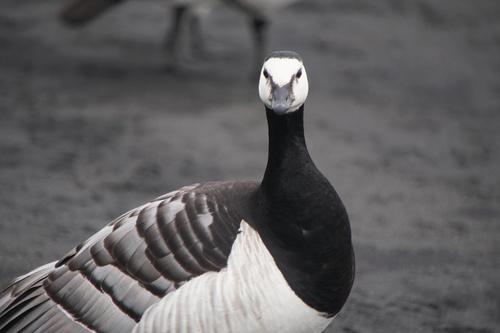 Barnacle Goose
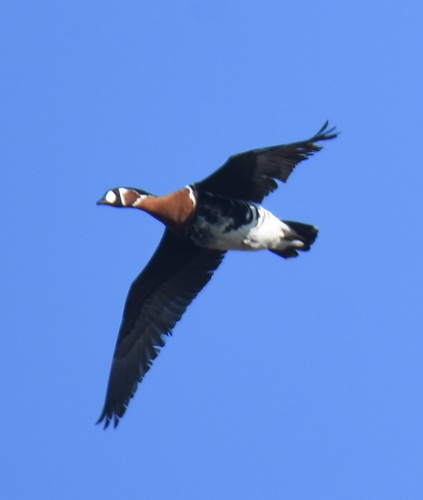 Red-breasted Goose
In short
The most reliable field mark separating Barnacle Goose from Red-breasted Goose is the presence of a bold, white face and black neck on Barnacle Goose, versus the striking chestnut-red breast and neck patch on Red-breasted Goose. Both are black-and-white Branta geese, but Red-breasted Goose’s unique reddish coloration is diagnostic at any distance if visible. In flight, Barnacle Goose shows a silvery-grey back and underwing with a prominent white rump, while Red-breasted Goose’s upperparts are darker with bold white stripes and red highlights. Juveniles of both species resemble adults closely, so age is less likely to cause confusion than distance or poor light. Bill size and overall structure also differ, with Barnacle Goose being heavier and more robust.
Identification tips
- Face and neck pattern: Barnacle Goose always shows a crisp white face with a black cap and neck; Red-breasted Goose has a black face with a bold white cheek patch and a deep chestnut-red neck and breast, bordered by white stripes. This is the single most reliable mark at any age or season.
- Breast color: Red-breasted Goose’s rich red breast and neck patch is unique; Barnacle Goose has a clean white belly and black upper breast with no red.
- Upperwing and back in flight: Barnacle Goose shows silvery-grey upperwings and back with black-and-white barring, and a prominent white rump patch; Red-breasted Goose’s upperparts are darker, with less silvery contrast and more black, plus white stripes on the wing coverts and scapulars.
- Underwing: Barnacle Goose has paler, silvery-grey underwing linings, visible in flight; Red-breasted Goose’s underwing is darker and less contrasting.
- Bill structure: Barnacle Goose has a small, stubby black bill; Red-breasted Goose’s bill is even shorter and more delicate, but this is subtle and best used in direct comparison.
- Size and shape: Barnacle Goose is bulkier and heavier, with a more robust jizz; Red-breasted Goose is smaller, more compact, and appears shorter-necked and lighter on the water or ground.
- Juvenile plumage: Both species’ juveniles resemble adults closely, but Barnacle Goose juveniles have rounded mantle and flank feather tips (not square-ended as in adults); this is subtle and rarely diagnostic at distance.
- White rump in flight: Barnacle Goose shows a V-shaped white rump patch in flight, contrasting with the black tail and back; Red-breasted Goose lacks this feature, showing a more uniformly dark rear.
- White stripes: Red-breasted Goose has bold white stripes on the sides of the neck and along the flanks, which are visible even at some distance; Barnacle Goose lacks these stripes.
- Red color visibility: At long range or in poor light, Red-breasted Goose’s red can appear dark or blackish, making it possible to overlook; always check for the white stripes and cheek patch to confirm.
- Leg color: Both have black legs, so this is not a useful field mark.
- Vocalizations: Red-breasted Goose gives higher-pitched, more rapid honks and hisses; Barnacle Goose’s calls are deeper and more typical of Branta geese.
- Flock behavior: Red-breasted Goose often stays in tight, wary groups, sometimes associating with raptors for protection; Barnacle Goose is more relaxed and often in larger flocks.
- Habitat context: If seen in Eurasia, especially in winter at a known Red-breasted Goose site, check carefully for the red and white pattern; Barnacle Goose is more widespread in the North Atlantic and coastal western Europe.
- Pitfalls: Poor light or distance can obscure the red of Red-breasted Goose, making it appear more like a dark Branta; always look for the white stripes and cheek patch, and use size and structure as supporting clues.
Size
Barnacle Goose is noticeably larger and heavier, with an average mass of about 1687 g compared to Red-breasted Goose’s 1235 g. Barnacle Goose measures 55–70 cm in length and has a wingspan of 120–145 cm, while Red-breasted Goose is smaller at 53–56 cm long and a wingspan of 116–135 cm. In the field, Barnacle Goose appears bulkier and more solid, with a stubbier bill, while Red-breasted Goose is more compact and delicate, especially in mixed flocks.
Plumage
Juvenile and adult Barnacle Geese both have a distinctive white face, black head, neck, and upper breast, with a silvery-grey back and barred wings. In flight, Barnacle Goose shows a V-shaped white rump patch and pale underwing linings. Juveniles can be told by the rounded tips to mantle and flank feathers, but otherwise resemble adults. Red-breasted Goose, in all plumages, is much more colorful: it has a deep chestnut-red breast and neck patch bordered by bold white stripes, with a black belly and flanks. At distance, the red can appear dark, but the pattern of white stripes and black is unique. Red-breasted Goose’s upperwing is darker overall, with less silvery contrast than Barnacle Goose. Both species have black legs and short, dark bills, but the face pattern is always diagnostic if seen well.
Behaviour
Both species are social and graze in open areas, but Red-breasted Goose is more likely to be found in tight, wary flocks and often associates with birds of prey for protection during nesting. Barnacle Goose is more robust and less secretive, often seen in larger, more relaxed groups. In flight, Barnacle Goose’s heavier build gives it a steadier, slower wingbeat compared to the more agile, compact Red-breasted Goose.
Habitat
Both species are found in open tundra or coastal grasslands in their breeding range and in agricultural fields or wetlands in winter. Red-breasted Goose is more restricted, with most of the population wintering at a few sites, and is more likely to be seen in Eurasia. Barnacle Goose is widespread in the North Atlantic region and more likely to occur as a vagrant in Western Europe. Habitat overlap is possible in wintering grounds, especially in mixed Branta flocks.
Voice
Red-breasted Goose gives high-pitched honking and hissing calls, especially in aggressive or alarmed contexts. Barnacle Goose has a more typical Branta honk, deeper and less piercing. Vocalizations are not the most reliable field mark, but the higher-pitched, more rapid calls of Red-breasted Goose can be a supporting clue in mixed flocks.