Birdr

Barred Eagle Owl vs Brown Wood-Owl

Ketupa sumatrana versus Strix leptogrammica

Play a quiz with Barred Eagle Owl and Brown Wood-Owl

Barred Eagle Owl (Ketupa sumatrana) Barred Eagle Owl
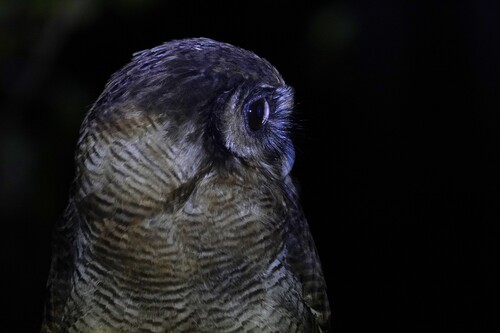
Brown Wood-Owl (Strix leptogrammica) Brown Wood-Owl

Media

Loading…

In short

The Barred Eagle Owl and Brown Wood-Owl can be distinguished by their facial features and plumage patterns. The Barred Eagle Owl has a more pronounced facial disk with prominent ear tufts, while the Brown Wood-Owl lacks these tufts and has a more uniform facial appearance. Both species share similar habitats, but their vocalizations differ significantly.

Identification tips

  1. Look for prominent ear tufts on the Barred Eagle Owl. 2. Check for barring on the underparts of the Barred Eagle Owl versus the more uniform brown of the Brown Wood-Owl. 3. Listen for the deep, booming call of the Barred Eagle Owl compared to the soft hoots of the Brown Wood-Owl. 4. Note habitat: Barred Eagle Owls prefer lowland forests, while Brown Wood-Owls can be found in higher elevations.

Size

Both species are large owls, but the Barred Eagle Owl is generally more robust with a bulkier build compared to the more slender Brown Wood-Owl.

Plumage

The Barred Eagle Owl features distinctive barring on its underparts and a more contrasting facial disk with striking white eyebrows. In contrast, the Brown Wood-Owl has a more uniform brown plumage with less contrast and lacks the prominent barring.

Behaviour

Both species are primarily nocturnal and can be seen roosting during the day. The Barred Eagle Owl tends to be more solitary, while the Brown Wood-Owl may be seen in pairs.

Habitat

Both owls inhabit dense forests, but the Barred Eagle Owl is more often found in lowland forests, whereas the Brown Wood-Owl can also be found in montane forests.

Voice

The Barred Eagle Owl has a deep, booming call, while the Brown Wood-Owl produces a series of soft hoots. These vocal differences are useful for identification at night.

Submit a better description

Use the same sections as the comparison. Your text is published immediately.

The Barred Eagle Owl and Brown Wood-Owl can be distinguished by their facial features and plumage patterns. The Barred Eagle Owl has a more pronounced facial disk with prominent ear tufts, while the Brown Wood-Owl lacks these tufts and has a more uniform facial appearance. Both species share similar habitats, but their vocalizations differ significantly.

  1. Look for prominent ear tufts on the Barred Eagle Owl. 2. Check for barring on the underparts of the Barred Eagle Owl versus the more uniform brown of the Brown Wood-Owl. 3. Listen for the deep, booming call of the Barred Eagle Owl compared to the soft hoots of the Brown Wood-Owl. 4. Note habitat: Barred Eagle Owls prefer lowland forests, while Brown Wood-Owls can be found in higher elevations.

Both species are large owls, but the Barred Eagle Owl is generally more robust with a bulkier build compared to the more slender Brown Wood-Owl.

The Barred Eagle Owl features distinctive barring on its underparts and a more contrasting facial disk with striking white eyebrows. In contrast, the Brown Wood-Owl has a more uniform brown plumage with less contrast and lacks the prominent barring.

Both species are primarily nocturnal and can be seen roosting during the day. The Barred Eagle Owl tends to be more solitary, while the Brown Wood-Owl may be seen in pairs.

Both owls inhabit dense forests, but the Barred Eagle Owl is more often found in lowland forests, whereas the Brown Wood-Owl can also be found in montane forests.

The Barred Eagle Owl has a deep, booming call, while the Brown Wood-Owl produces a series of soft hoots. These vocal differences are useful for identification at night.

Discard your changes?

You have unsaved edits. If you leave now, those changes will be lost.

Barred Eagle Owl · Brown Wood-Owl · My Tricky Birds