
Barred Owl vs Great Grey Owl
Strix varia versus Strix nebulosa
Play a quiz with Barred Owl and Great Grey Owl
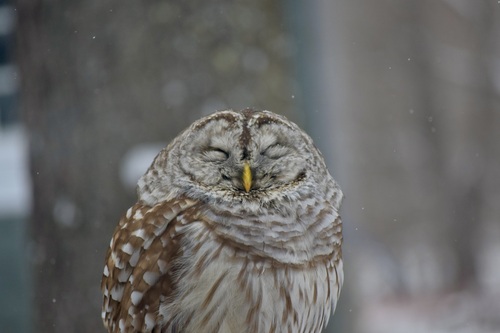 Barred Owl
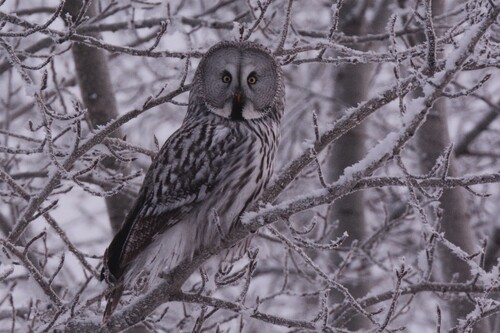 Great Grey Owl
In short
Great Grey Owl is much larger and longer-tailed than Barred Owl, with a strikingly pale, round face marked by concentric circles and yellow eyes, versus the Barred Owl's darker, brown-eyed look. In flight or perched, Great Grey shows a long, broad tail and a white 'bow-tie' below the bill, while Barred Owl is more compact, with a shorter tail and brown-barred underparts. Juvenile Barred Owls look like duller adults, but Great Grey juveniles are very pale and fluffy. If you see a massive, ghostly grey owl with a huge facial disc and yellow eyes, it's Great Grey; a smaller, browner, dark-eyed bird with horizontal chest bars and vertical belly streaks is Barred. Both lack ear tufts, but size and facial features are the best field clues.
Identification tips
- Size and bulk: Great Grey Owl is much larger and longer-tailed than Barred Owl. If the owl looks truly massive, especially when perched, it's likely Great Grey.
- Facial disc: Great Grey has a huge, pale, round face with sharply defined dark concentric rings and yellow eyes. Barred Owl's face is smaller, less contrasting, and the eyes are dark brown (almost black in the field).
- Eye color: Yellow in Great Grey, dark brown in Barred Owl. This is a key mark at close range or in photos.
- 'Bow-tie' mark: Great Grey Owl has a distinctive white 'bow-tie' or throat patch below the bill, often with a black center. Barred Owl lacks this feature.
- Tail shape and length: Great Grey's tail is very long and rounded at the tip, often extending well past the wingtips when perched. Barred Owl's tail is shorter and less prominent.
- Underpart pattern: Barred Owl shows horizontal barring on the upper chest and bold vertical streaks on the belly. Great Grey has lighter underparts with fine dark streaks, lacking the strong barred/streaked contrast of Barred.
- Upperpart pattern: Barred Owl is brownish with white bars and some spotting; Great Grey is overall grey with paler bars and a more uniform appearance.
- Juvenile differences: Young Barred Owls are duller, buffier versions of adults, sometimes with remnant down and more pale bands on the tail. Juvenile Great Greys are very pale, fluffy, and ghostlike, with minimal streaking but still a huge facial disc.
- Bill color: Barred Owl has a pale straw-yellow bill, sometimes with a greenish tint; Great Grey's bill is less conspicuous but generally yellowish.
- Feet and tarsi: Both have feathered legs and toes, but this is not a practical field mark.
- Flight style: Great Grey flies with slow, buoyant wingbeats and a long tail; Barred Owl is more compact and direct in flight.
- Habitat context: Barred Owl is common in mature, often lowland forests (sometimes near water); Great Grey prefers boreal or montane forests with adjacent open areas, often in wilder, less disturbed settings.
- Perched posture: Great Grey often appears upright and elongated, emphasizing its size and long tail. Barred Owl is more compact and rounded.
- Ear tufts: Neither species has ear tufts, so this is not a separating feature.
- Vocalization: Not diagnostic here, but Barred Owl is famous for its 'who cooks for you' hoots, while Great Grey's calls are deeper and less often heard.
Size
Great Grey Owl is the world's longest owl, with females averaging 72 cm (28 in) and males 67 cm (26 in) in length, and wingspans over 140 cm (4 ft 7 in). Barred Owl is large for North America but much smaller, with a more compact build and shorter tail. Great Grey's size is accentuated by its fluffy plumage and especially its long tail, but its body mass is actually less than some other large owls. In the field, Great Grey appears truly massive, especially when perched or in flight, while Barred Owl is noticeably smaller and less imposing.
Plumage
- Juvenile/immature Barred Owl: Looks like a duller adult, with less distinct head/neck markings, more buff overall, some down, and a pale blue-green cere. The tail may show up to seven pale bands (adults usually have four or five).
- Juvenile Great Grey Owl: Very pale and fluffy, with a large, rounded head and minimal streaking, but still shows the huge facial disc and yellow eyes.
- Adult Barred Owl: Grey-brown overall, with white bars on the back and mantle, brown-barred wings, and a pale face with subtle concentric lines. The underparts have horizontal barring on the chest and bold vertical streaks on the belly. Eyes are dark brown, appearing almost black in the field.
- Adult Great Grey Owl: Overall grey, with pale bars on the upperparts, a huge pale face with dark concentric circles, yellow eyes, and a white 'bow-tie' below the bill. Underparts are light with dark streaks, and the long tail is grey and rounded at the tip. No ear tufts in either species, but Great Grey's facial disc is much larger and more contrasting.
Behaviour
Both species are typically perched quietly in forested habitats, often at dusk or dawn. Great Grey Owl often hunts from exposed perches over open meadows or forest edges, using its long wings and tail for buoyant, silent flight. Barred Owl is more likely to be found in dense woods, moving with a more compact, direct flight. Great Grey's hunting style is more reliant on listening for prey under snow or grass, while Barred Owl hunts a wider variety of prey in more closed-canopy settings.
Habitat
Barred Owl is native to eastern North America but has expanded to the West Coast, favoring mature forests, often near water. Great Grey Owl has a circumpolar distribution across the Northern Hemisphere, preferring dense boreal forests with nearby open meadows for hunting. In North America, Great Grey is more northern and montane, while Barred Owl is common in lowland forests. Overlap is limited, but where both occur, Great Grey is found in wilder, less disturbed, and more open habitats.