Birdr

Bendire's Thrasher vs Grey Thrasher

Toxostoma bendirei versus Toxostoma cinereum

Play a quiz with Bendire's Thrasher and Grey Thrasher
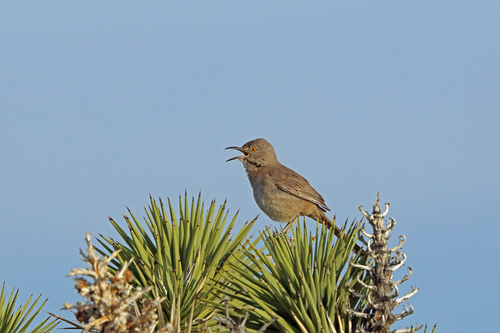
Bendire's Thrasher (Toxostoma bendirei) Bendire's Thrasher
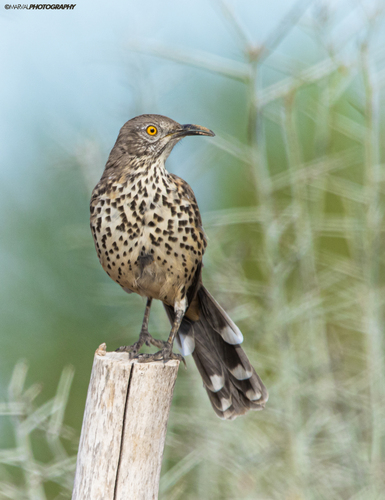
Grey Thrasher (Toxostoma cinereum) Grey Thrasher

Media

Loading…

In short

Bendire's Thrasher and Grey Thrasher can be distinguished by their habitat preferences and subtle plumage differences. Bendire's Thrasher is typically found in sparse desert habitats, while Grey Thrasher is associated with cacti-dominated areas. Observing their behavior and habitat can provide key identification clues.

Identification tips

  1. Habitat: Look for Bendire's Thrasher in open desert areas; Grey Thrasher is more likely near cacti. 2. Plumage: Note the more muted tones and less distinct facial pattern of Bendire's Thrasher. 3. Behavior: Observe feeding habits; Grey Thrasher may be seen feeding on cactus fruit. 4. Location: Consider geographic range; Bendire's Thrasher is more widespread in the U.S., while Grey Thrasher is more localized.

Size

Both species are similar in size, typical of thrashers, with no significant size difference noted.

Plumage

Bendire's Thrasher has a more muted, brownish-gray plumage with a less distinct facial pattern, while Grey Thrasher exhibits a slightly grayer tone with more pronounced streaking on the breast.

Behaviour

Bendire's Thrasher forages primarily on the ground, often probing the soil for insects. Grey Thrasher also forages on the ground but is more likely to be seen around cacti, feeding on fruit and nectar.

Habitat

Bendire's Thrasher inhabits sparse desert regions in the southwestern U.S. and northwestern Mexico. In contrast, Grey Thrasher is closely tied to areas with cacti, particularly cholla and garambullo, in its range.

Voice

Vocalizations are not well-documented for both species, but thrashers generally have complex, varied songs. Specific differences in calls are not highlighted in available sources.

Submit a better description

Use the same sections as the comparison. Your text is published immediately.

Bendire's Thrasher and Grey Thrasher can be distinguished by their habitat preferences and subtle plumage differences. Bendire's Thrasher is typically found in sparse desert habitats, while Grey Thrasher is associated with cacti-dominated areas. Observing their behavior and habitat can provide key identification clues.

  1. Habitat: Look for Bendire's Thrasher in open desert areas; Grey Thrasher is more likely near cacti. 2. Plumage: Note the more muted tones and less distinct facial pattern of Bendire's Thrasher. 3. Behavior: Observe feeding habits; Grey Thrasher may be seen feeding on cactus fruit. 4. Location: Consider geographic range; Bendire's Thrasher is more widespread in the U.S., while Grey Thrasher is more localized.

Both species are similar in size, typical of thrashers, with no significant size difference noted.

Bendire's Thrasher has a more muted, brownish-gray plumage with a less distinct facial pattern, while Grey Thrasher exhibits a slightly grayer tone with more pronounced streaking on the breast.

Bendire's Thrasher forages primarily on the ground, often probing the soil for insects. Grey Thrasher also forages on the ground but is more likely to be seen around cacti, feeding on fruit and nectar.

Bendire's Thrasher inhabits sparse desert regions in the southwestern U.S. and northwestern Mexico. In contrast, Grey Thrasher is closely tied to areas with cacti, particularly cholla and garambullo, in its range.

Vocalizations are not well-documented for both species, but thrashers generally have complex, varied songs. Specific differences in calls are not highlighted in available sources.

Discard your changes?

You have unsaved edits. If you leave now, those changes will be lost.

Bendire's Thrasher · Grey Thrasher · My Tricky Birds