Birdr

Bicoloured Antbird vs Chestnut-crested Antbird

Gymnopithys bicolor versus Rhegmatorhina cristata

Play a quiz with Bicoloured Antbird and Chestnut-crested Antbird
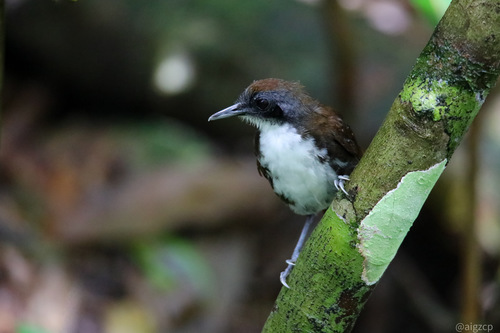
Bicoloured Antbird (Gymnopithys bicolor) Bicoloured Antbird
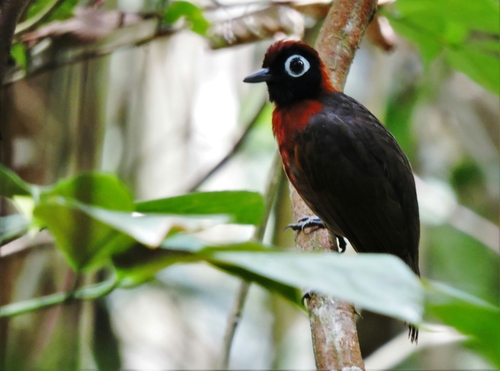
Chestnut-crested Antbird (Rhegmatorhina cristata) Chestnut-crested Antbird

Media

Loading…

In short

The Bicoloured Antbird (Gymnopithys bicolor) and the Chestnut-crested Antbird (Rhegmatorhina cristata) can be distinguished by their head markings and habitat preferences. The Bicoloured Antbird has a distinctive white face mask, while the Chestnut-crested Antbird features a chestnut crown. Both species are part of the antbird family but differ in their preferred environments and subtle plumage details.

Identification tips

  1. Look for the white face mask on the Bicoloured Antbird. 2. Note the chestnut crown on the Chestnut-crested Antbird. 3. Observe habitat: Bicoloured Antbirds are more likely near water. 4. Watch for behavior: Bicoloured Antbirds often join mixed-species flocks. 5. Use vocalizations cautiously, as they are not distinctively different.

Size

Both species are similar in size, typical of small antbirds.

Plumage

The Bicoloured Antbird has a striking white face mask and a generally darker body, whereas the Chestnut-crested Antbird is notable for its chestnut-colored crown and more uniform plumage.

Behaviour

Both species are known to follow army ant swarms, but the Bicoloured Antbird is more frequently observed in mixed-species flocks.

Habitat

The Bicoloured Antbird is typically found in lowland forests, often near water, while the Chestnut-crested Antbird prefers terra firme forests and is less associated with water.

Voice

Vocalizations are not well-documented for field differentiation, but both species have typical antbird calls.

Submit a better description

Use the same sections as the comparison. Your text is published immediately.

The Bicoloured Antbird (Gymnopithys bicolor) and the Chestnut-crested Antbird (Rhegmatorhina cristata) can be distinguished by their head markings and habitat preferences. The Bicoloured Antbird has a distinctive white face mask, while the Chestnut-crested Antbird features a chestnut crown. Both species are part of the antbird family but differ in their preferred environments and subtle plumage details.

  1. Look for the white face mask on the Bicoloured Antbird. 2. Note the chestnut crown on the Chestnut-crested Antbird. 3. Observe habitat: Bicoloured Antbirds are more likely near water. 4. Watch for behavior: Bicoloured Antbirds often join mixed-species flocks. 5. Use vocalizations cautiously, as they are not distinctively different.

Both species are similar in size, typical of small antbirds.

The Bicoloured Antbird has a striking white face mask and a generally darker body, whereas the Chestnut-crested Antbird is notable for its chestnut-colored crown and more uniform plumage.

Both species are known to follow army ant swarms, but the Bicoloured Antbird is more frequently observed in mixed-species flocks.

The Bicoloured Antbird is typically found in lowland forests, often near water, while the Chestnut-crested Antbird prefers terra firme forests and is less associated with water.

Vocalizations are not well-documented for field differentiation, but both species have typical antbird calls.

Discard your changes?

You have unsaved edits. If you leave now, those changes will be lost.

Bicoloured Antbird · Chestnut-crested Antbird · My Tricky Birds