Birdr

Black-and-red Broadbill vs Banded Broadbill

Cymbirhynchus macrorhynchos versus Eurylaimus javanicus

Play a quiz with Black-and-red Broadbill and Banded Broadbill
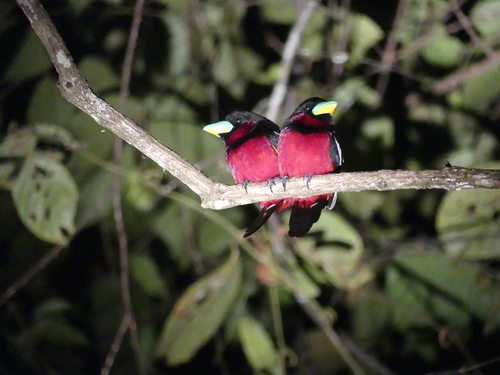
Black-and-red Broadbill (Cymbirhynchus macrorhynchos) Black-and-red Broadbill
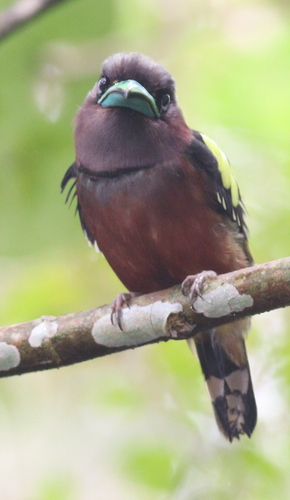
Banded Broadbill (Eurylaimus javanicus) Banded Broadbill

Media

Loading…

In short

The Black-and-red Broadbill is unmistakable with its striking black and red plumage and large blue bill, while the Banded Broadbill features a distinctive purple-red body with black-and-yellow wing markings and a similar blue bill. Both species have large, untidy nests, but their plumage and vocalizations are key to differentiation.

Identification tips

  1. Look for the bold black and red plumage of the Black-and-red Broadbill. 2. Note the purple-red body with black-and-yellow wing markings of the Banded Broadbill. 3. Listen for the loud, explosive song of the Banded Broadbill. 4. Observe the habitat: Black-and-red Broadbills are often near water, while Banded Broadbills are found in taller forest trees.

Size

Both species are similar in size, typical of broadbills, with no significant size difference to aid identification.

Plumage

The Black-and-red Broadbill has a bold black and red plumage, while the Banded Broadbill displays a purple-red body with black-and-yellow wing markings. Both have large, comical-looking blue bills.

Behaviour

The Black-and-red Broadbill is often found near water, while the Banded Broadbill is more inconspicuous due to its sluggish behavior, despite its bright plumage.

Habitat

The Black-and-red Broadbill is typically found in lowland forests below 300 meters, often near water. The Banded Broadbill inhabits forests across Southeast Asia, including higher trees, and is not as restricted by elevation.

Voice

The Banded Broadbill is known for its loud, explosive song followed by a cicada-like trill, making it more easily detected by sound than the Black-and-red Broadbill.

Submit a better description

Use the same sections as the comparison. Your text is published immediately.

The Black-and-red Broadbill is unmistakable with its striking black and red plumage and large blue bill, while the Banded Broadbill features a distinctive purple-red body with black-and-yellow wing markings and a similar blue bill. Both species have large, untidy nests, but their plumage and vocalizations are key to differentiation.

  1. Look for the bold black and red plumage of the Black-and-red Broadbill. 2. Note the purple-red body with black-and-yellow wing markings of the Banded Broadbill. 3. Listen for the loud, explosive song of the Banded Broadbill. 4. Observe the habitat: Black-and-red Broadbills are often near water, while Banded Broadbills are found in taller forest trees.

Both species are similar in size, typical of broadbills, with no significant size difference to aid identification.

The Black-and-red Broadbill has a bold black and red plumage, while the Banded Broadbill displays a purple-red body with black-and-yellow wing markings. Both have large, comical-looking blue bills.

The Black-and-red Broadbill is often found near water, while the Banded Broadbill is more inconspicuous due to its sluggish behavior, despite its bright plumage.

The Black-and-red Broadbill is typically found in lowland forests below 300 meters, often near water. The Banded Broadbill inhabits forests across Southeast Asia, including higher trees, and is not as restricted by elevation.

The Banded Broadbill is known for its loud, explosive song followed by a cicada-like trill, making it more easily detected by sound than the Black-and-red Broadbill.

Discard your changes?

You have unsaved edits. If you leave now, those changes will be lost.

Black-and-red Broadbill · Banded Broadbill · My Tricky Birds