Birdr

Black-and-white Owl vs Black-banded Owl

Strix nigrolineata versus Strix huhula

Play a quiz with Black-and-white Owl and Black-banded Owl
Black-and-white Owl (Strix nigrolineata) Black-and-white Owl
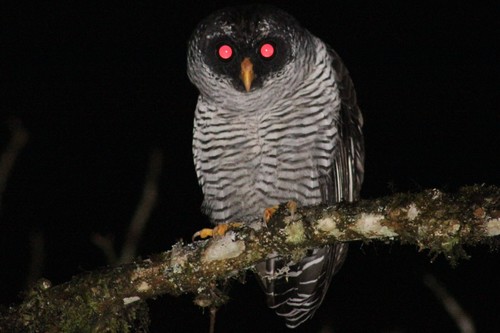
Black-banded Owl (Strix huhula) Black-banded Owl

Media

Loading…

In short

The Black-and-white Owl (Strix nigrolineata) and the Black-banded Owl (Strix huhula) can be distinguished by their contrasting underpart patterns. The Black-and-white Owl is largely white below with thin, dark bars, while the Black-banded Owl is black with narrow white barring. Both species have similar structure and size, but their plumage is the key differentiator.

Identification tips

Size

Both species are similar in size, typical of medium-sized owls.

Plumage

The Black-and-white Owl has a predominantly white underside with thin, dark bars, contrasting with its black upperparts. In contrast, the Black-banded Owl is black both above and below, with prominent white barring.

Behaviour

Both species are nocturnal and may be observed hunting around street lights. The Black-and-white Owl is known to prey on insects and small mammals, including bats.

Habitat

The Black-and-white Owl is found in Central America, often in forested areas, while the Black-banded Owl is native to eastern South America, also favoring forest habitats.

Voice

The Black-and-white Owl's call includes a series of 'hu, hu, hu, hóo-ah' and a cat-like scream. The Black-banded Owl's vocalizations are not detailed here, but differences in calls could aid identification.

Submit a better description

Use the same sections as the comparison. Your text is published immediately.

The Black-and-white Owl (Strix nigrolineata) and the Black-banded Owl (Strix huhula) can be distinguished by their contrasting underpart patterns. The Black-and-white Owl is largely white below with thin, dark bars, while the Black-banded Owl is black with narrow white barring. Both species have similar structure and size, but their plumage is the key differentiator.

  • Look for the white underparts with dark bars in the Black-and-white Owl.
  • Note the black underparts with white barring in the Black-banded Owl.
  • Observe behavior around street lights, which can help locate these owls.
  • Listen for the distinct calls of the Black-and-white Owl if vocalizations are heard.

Both species are similar in size, typical of medium-sized owls.

The Black-and-white Owl has a predominantly white underside with thin, dark bars, contrasting with its black upperparts. In contrast, the Black-banded Owl is black both above and below, with prominent white barring.

Both species are nocturnal and may be observed hunting around street lights. The Black-and-white Owl is known to prey on insects and small mammals, including bats.

The Black-and-white Owl is found in Central America, often in forested areas, while the Black-banded Owl is native to eastern South America, also favoring forest habitats.

The Black-and-white Owl's call includes a series of 'hu, hu, hu, hóo-ah' and a cat-like scream. The Black-banded Owl's vocalizations are not detailed here, but differences in calls could aid identification.

Discard your changes?

You have unsaved edits. If you leave now, those changes will be lost.

Black-and-white Owl · Black-banded Owl · My Tricky Birds