Birdr

Black-and-yellow Silky-flycatcher vs Bananaquit

Phainoptila melanoxantha versus Coereba flaveola

Play a quiz with Black-and-yellow Silky-flycatcher and Bananaquit
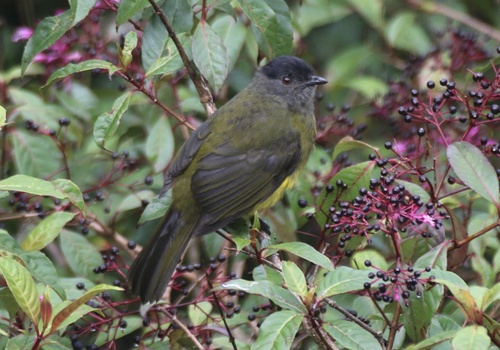
Black-and-yellow Silky-flycatcher (Phainoptila melanoxantha) Black-and-yellow Silky-flycatcher
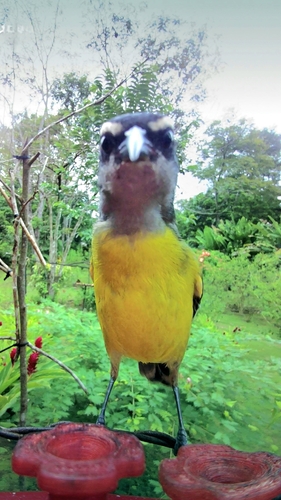
Bananaquit (Coereba flaveola) Bananaquit

Media

Loading…

In short

The Black-and-yellow Silky-flycatcher and Bananaquit differ significantly in structure and behavior. The Silky-flycatcher has a more robust body and a straight bill, while the Bananaquit is smaller with a distinctive down-curved bill. Both species have bright yellow underparts, but their habitats and feeding behaviors are distinct.

Identification tips

1. Bill Shape: Look for the straight bill of the Silky-flycatcher versus the down-curved bill of the Bananaquit. 2. Eyebrow: The Bananaquit has a distinctive white eyebrow, absent in the Silky-flycatcher. 3. Behavior: Note the feeding behavior; Bananaquits are often seen clinging to flowers for nectar, unlike the Silky-flycatcher. 4. Habitat: Consider the habitat; Silky-flycatchers prefer montane forests, while Bananaquits are more versatile in their habitat choice.

Size

The Black-and-yellow Silky-flycatcher is generally larger and more robust than the smaller Bananaquit.

Plumage

Both species feature bright yellow underparts, but the Silky-flycatcher has black upperparts, while the Bananaquit has black upperparts with a conspicuous white eyebrow.

Behaviour

The Silky-flycatcher is often seen alone or in pairs, while Bananaquits are bold, active feeders often found in pairs or small family groups.

Habitat

The Silky-flycatcher is found in montane forests, whereas the Bananaquit inhabits a wide range of environments from scrubland to tropical lowland forest edges.

Submit a better description

Use the same sections as the comparison. Your text is published immediately.

The Black-and-yellow Silky-flycatcher and Bananaquit differ significantly in structure and behavior. The Silky-flycatcher has a more robust body and a straight bill, while the Bananaquit is smaller with a distinctive down-curved bill. Both species have bright yellow underparts, but their habitats and feeding behaviors are distinct.

1. Bill Shape: Look for the straight bill of the Silky-flycatcher versus the down-curved bill of the Bananaquit. 2. Eyebrow: The Bananaquit has a distinctive white eyebrow, absent in the Silky-flycatcher. 3. Behavior: Note the feeding behavior; Bananaquits are often seen clinging to flowers for nectar, unlike the Silky-flycatcher. 4. Habitat: Consider the habitat; Silky-flycatchers prefer montane forests, while Bananaquits are more versatile in their habitat choice.

The Black-and-yellow Silky-flycatcher is generally larger and more robust than the smaller Bananaquit.

Both species feature bright yellow underparts, but the Silky-flycatcher has black upperparts, while the Bananaquit has black upperparts with a conspicuous white eyebrow.

The Silky-flycatcher is often seen alone or in pairs, while Bananaquits are bold, active feeders often found in pairs or small family groups.

The Silky-flycatcher is found in montane forests, whereas the Bananaquit inhabits a wide range of environments from scrubland to tropical lowland forest edges.

Discard your changes?

You have unsaved edits. If you leave now, those changes will be lost.

Black-and-yellow Silky-flycatcher · Bananaquit · My Tricky Birds