Birdr

Black Antshrike vs Russet Antshrike

Thamnophilus nigriceps versus Thamnistes anabatinus

Play a quiz with Black Antshrike and Russet Antshrike
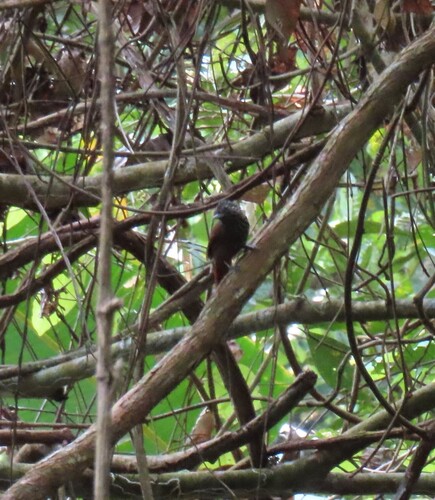
Black Antshrike (Thamnophilus nigriceps) Black Antshrike
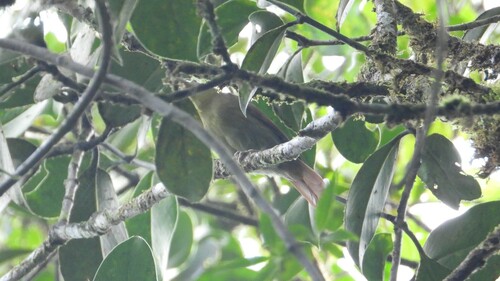
Russet Antshrike (Thamnistes anabatinus) Russet Antshrike

Media

Loading…

In short

The Black Antshrike (Thamnophilus nigriceps) is typically found in the understory of humid forests, while the Russet Antshrike (Thamnistes anabatinus) is more often seen in the canopy or subcanopy. The Black Antshrike has a distinctive blackish head with buff-white streaks, whereas the Russet Antshrike has a more uniform russet coloration that can resemble a foliage-gleaner.

Identification tips

  1. Look for the blackish head with buff-white streaks on the Black Antshrike. 2. Note the uniform russet coloration of the Russet Antshrike, which can resemble a foliage-gleaner. 3. Observe the foraging height: Black Antshrikes are near the ground, while Russet Antshrikes are in the canopy. 4. Consider the habitat: Black Antshrikes prefer lowland forest understory, while Russet Antshrikes are more common in foothill forests.

Size

Both species are similar in size, typical of small to medium antbirds.

Plumage

The Black Antshrike features a blackish head to breast with buff-white shaft-streaks and rufous-brown upperparts. In contrast, the Russet Antshrike has a more uniform russet plumage, lacking the distinctive streaked head of the Black Antshrike.

Behaviour

Black Antshrikes are usually observed foraging close to the ground, often in pairs or singles, and may jerk their tails upwards. Russet Antshrikes forage at various heights, mostly in the canopy and subcanopy, and are less likely to be seen on the ground.

Habitat

Black Antshrikes inhabit the understory of humid evergreen forests below 600 m in eastern Panama and northern Colombia. Russet Antshrikes are found in evergreen foothill forests from sea level to 1,500 m, often between 400 m and 1,000 m.

Voice

Vocalizations are not detailed in the notes, but differences in calls may exist and could be useful for identification.

Submit a better description

Use the same sections as the comparison. Your text is published immediately.

The Black Antshrike (Thamnophilus nigriceps) is typically found in the understory of humid forests, while the Russet Antshrike (Thamnistes anabatinus) is more often seen in the canopy or subcanopy. The Black Antshrike has a distinctive blackish head with buff-white streaks, whereas the Russet Antshrike has a more uniform russet coloration that can resemble a foliage-gleaner.

  1. Look for the blackish head with buff-white streaks on the Black Antshrike. 2. Note the uniform russet coloration of the Russet Antshrike, which can resemble a foliage-gleaner. 3. Observe the foraging height: Black Antshrikes are near the ground, while Russet Antshrikes are in the canopy. 4. Consider the habitat: Black Antshrikes prefer lowland forest understory, while Russet Antshrikes are more common in foothill forests.

Both species are similar in size, typical of small to medium antbirds.

The Black Antshrike features a blackish head to breast with buff-white shaft-streaks and rufous-brown upperparts. In contrast, the Russet Antshrike has a more uniform russet plumage, lacking the distinctive streaked head of the Black Antshrike.

Black Antshrikes are usually observed foraging close to the ground, often in pairs or singles, and may jerk their tails upwards. Russet Antshrikes forage at various heights, mostly in the canopy and subcanopy, and are less likely to be seen on the ground.

Black Antshrikes inhabit the understory of humid evergreen forests below 600 m in eastern Panama and northern Colombia. Russet Antshrikes are found in evergreen foothill forests from sea level to 1,500 m, often between 400 m and 1,000 m.

Vocalizations are not detailed in the notes, but differences in calls may exist and could be useful for identification.

Discard your changes?

You have unsaved edits. If you leave now, those changes will be lost.

Black Antshrike · Russet Antshrike · My Tricky Birds