
Birdr

Black-backed Dwarf-Kingfisher vs Collared Kingfisher

Ceyx erithaca versus Todiramphus chloris

Play a quiz with Black-backed Dwarf-Kingfisher and Collared Kingfisher

Black-backed Dwarf-Kingfisher (Ceyx erithaca) Black-backed Dwarf-Kingfisher
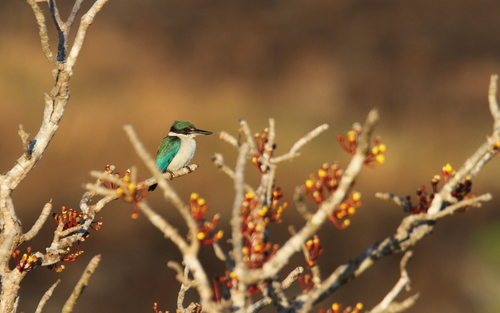
Collared Kingfisher (Todiramphus chloris) Collared Kingfisher

Media

Loading…

In short

The Black-backed Dwarf-Kingfisher is a small, vibrant bird with a striking ultramarine-blue mantle and lilac-rufous crown, while the Collared Kingfisher is larger with a more uniform blue-green upperparts and a distinct white collar. The Dwarf-Kingfisher is often seen darting through dense forests, whereas the Collared Kingfisher is more commonly found in open coastal areas.

Identification tips

Size

The Black-backed Dwarf-Kingfisher is smaller and more compact compared to the larger and more robust Collared Kingfisher.

Plumage

The Black-backed Dwarf-Kingfisher has a lilac-rufous crown, coral-red bill, and ultramarine-blue mantle with glossy blue-black wings. In contrast, the Collared Kingfisher features blue-green upperparts, a white collar, and a more uniform appearance.

Behaviour

The Black-backed Dwarf-Kingfisher is shy, often seen whizzing low through forests, while the Collared Kingfisher is more conspicuous, often perching openly in coastal areas.

Habitat

The Black-backed Dwarf-Kingfisher prefers dense forests and is often found far from water, whereas the Collared Kingfisher is typically found in open coastal areas and mangroves.

Voice

Vocalizations are not detailed in the sources, but the Collared Kingfisher is generally more vocal and conspicuous.

Submit a better description

Use the same sections as the comparison. Your text is published immediately.

The Black-backed Dwarf-Kingfisher is a small, vibrant bird with a striking ultramarine-blue mantle and lilac-rufous crown, while the Collared Kingfisher is larger with a more uniform blue-green upperparts and a distinct white collar. The Dwarf-Kingfisher is often seen darting through dense forests, whereas the Collared Kingfisher is more commonly found in open coastal areas.

  • Size and Structure: Note the smaller size and more compact shape of the Black-backed Dwarf-Kingfisher.
  • Plumage: Look for the ultramarine-blue mantle and lilac-rufous crown of the Dwarf-Kingfisher versus the blue-green upperparts and white collar of the Collared Kingfisher.
  • Habitat: Observe the habitat; Dwarf-Kingfishers are in dense forests, while Collared Kingfishers are in coastal areas.
  • Behavior: Watch for the shy, low-flying behavior of the Dwarf-Kingfisher compared to the more open perching of the Collared Kingfisher.

The Black-backed Dwarf-Kingfisher is smaller and more compact compared to the larger and more robust Collared Kingfisher.

The Black-backed Dwarf-Kingfisher has a lilac-rufous crown, coral-red bill, and ultramarine-blue mantle with glossy blue-black wings. In contrast, the Collared Kingfisher features blue-green upperparts, a white collar, and a more uniform appearance.

The Black-backed Dwarf-Kingfisher is shy, often seen whizzing low through forests, while the Collared Kingfisher is more conspicuous, often perching openly in coastal areas.

The Black-backed Dwarf-Kingfisher prefers dense forests and is often found far from water, whereas the Collared Kingfisher is typically found in open coastal areas and mangroves.

Vocalizations are not detailed in the sources, but the Collared Kingfisher is generally more vocal and conspicuous.

Discard your changes?

You have unsaved edits. If you leave now, those changes will be lost.

Black-backed Dwarf-Kingfisher · Collared Kingfisher · My Tricky Birds