
Birdr

Black-backed Dwarf-Kingfisher vs Rufous-backed Dwarf-Kingfisher

Ceyx erithaca versus Ceyx rufidorsa

Play a quiz with Black-backed Dwarf-Kingfisher and Rufous-backed Dwarf-Kingfisher
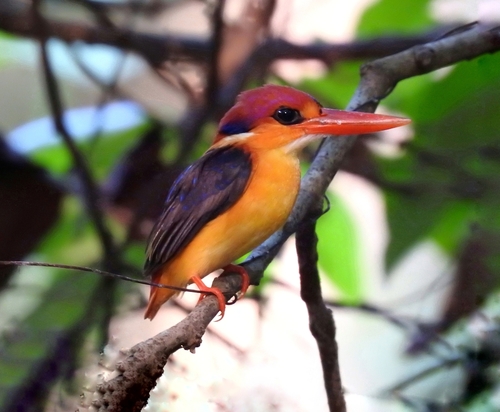
Black-backed Dwarf-Kingfisher (Ceyx erithaca) Black-backed Dwarf-Kingfisher
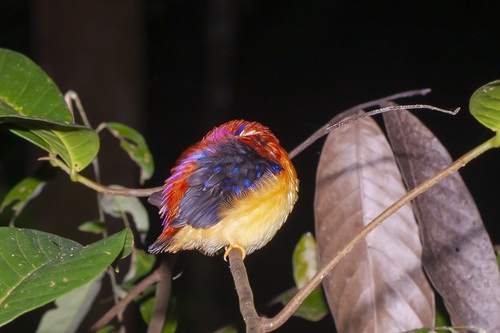
Rufous-backed Dwarf-Kingfisher (Ceyx rufidorsa) Rufous-backed Dwarf-Kingfisher

Media

Loading…

In short

The Black-backed Dwarf-Kingfisher and Rufous-backed Dwarf-Kingfisher are visually similar but can be differentiated by their back color: the Black-backed has an ultramarine-blue mantle, while the Rufous-backed features a rufous mantle. Both species are shy and often seen flying rapidly through forests, far from water.

Identification tips

Look for the color of the mantle: ultramarine-blue for the Black-backed and rufous for the Rufous-backed. Both species can be seen flying rapidly through forests, so a quick glimpse of the back color can be crucial. Note that some individuals may appear intermediate, complicating identification.

Size

Both species are similar in size, typical of dwarf kingfishers, and are small and compact.

Plumage

The Black-backed Dwarf-Kingfisher has an ultramarine-blue mantle and a lilac rump, while the Rufous-backed Dwarf-Kingfisher has a rufous mantle. Both species share a coral-red bill, white throat, and yellowish-orange underparts.

Behaviour

Both species are shy and often seen whizzing low through the forest. They are not always associated with water and frequently forage on terrestrial prey.

Habitat

Both species inhabit forests and are often found far from water. They overlap in range in parts of Southeast Asia, particularly during migration.

Voice

Both species are known for high-pitched call notes, but specific differences in vocalization are not well-documented.

Submit a better description

Use the same sections as the comparison. Your text is published immediately.

The Black-backed Dwarf-Kingfisher and Rufous-backed Dwarf-Kingfisher are visually similar but can be differentiated by their back color: the Black-backed has an ultramarine-blue mantle, while the Rufous-backed features a rufous mantle. Both species are shy and often seen flying rapidly through forests, far from water.

Look for the color of the mantle: ultramarine-blue for the Black-backed and rufous for the Rufous-backed. Both species can be seen flying rapidly through forests, so a quick glimpse of the back color can be crucial. Note that some individuals may appear intermediate, complicating identification.

Both species are similar in size, typical of dwarf kingfishers, and are small and compact.

The Black-backed Dwarf-Kingfisher has an ultramarine-blue mantle and a lilac rump, while the Rufous-backed Dwarf-Kingfisher has a rufous mantle. Both species share a coral-red bill, white throat, and yellowish-orange underparts.

Both species are shy and often seen whizzing low through the forest. They are not always associated with water and frequently forage on terrestrial prey.

Both species inhabit forests and are often found far from water. They overlap in range in parts of Southeast Asia, particularly during migration.

Both species are known for high-pitched call notes, but specific differences in vocalization are not well-documented.

Discard your changes?

You have unsaved edits. If you leave now, those changes will be lost.

Black-backed Dwarf-Kingfisher · Rufous-backed Dwarf-Kingfisher · My Tricky Birds