
Black-bellied Storm-Petrel vs European Storm-Petrel
Fregetta tropica versus Hydrobates pelagicus
Play a quiz with Black-bellied Storm-Petrel and European Storm-Petrel
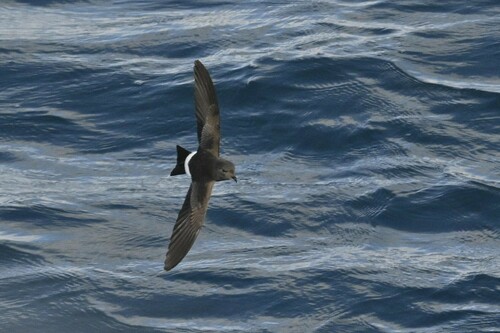 Black-bellied Storm-Petrel
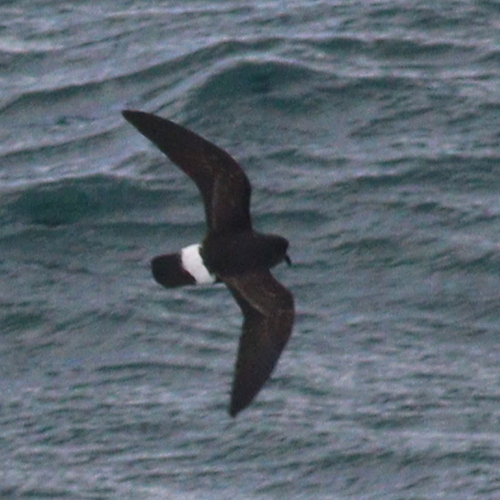 European Storm-Petrel
In short
The most reliable field mark between Black-bellied Storm-Petrel and European Storm-Petrel is the presence of a broad black belly stripe on most Black-bellied Storm-Petrels, versus the all-black underparts of European Storm-Petrel. In flight, Black-bellied Storm-Petrel often shows feet projecting well beyond the tail, while European Storm-Petrel’s feet are hidden. Both have a white rump and white underwing band, but European Storm-Petrel is distinctly smaller and has a square tail, compared to the longer-legged, slightly larger Black-bellied. Juvenile European Storm-Petrels may show a narrow white upperwing bar, which is absent in Black-bellied. Flight style and leg projection are critical for separation at sea.
Identification tips
- Belly pattern: Black-bellied Storm-Petrel usually shows a broad black stripe down the center of the belly (all ages), though this may be broken or absent in some individuals or subspecies. European Storm-Petrel always has plain dark underparts with no belly stripe.
- Leg projection: In flight, Black-bellied Storm-Petrel’s long legs mean the feet project well beyond the tail—often obvious even at a distance. European Storm-Petrel’s feet do not extend past the tail and are not visible in flight.
- Size and bulk: Black-bellied Storm-Petrel is significantly larger and bulkier than European Storm-Petrel. If seen together, the size difference is clear, but can be subtle at sea without direct comparison.
- Tail shape: European Storm-Petrel has a square tail, while Black-bellied’s tail is less distinctly square and may appear slightly more rounded in some views.
- Upperwing bar (juveniles): Juvenile European Storm-Petrels in fresh plumage can show a narrow white bar on the upperwing, a feature not seen in Black-bellied Storm-Petrel of any age.
- Underwing pattern: Both species have a white underwing bar, so this is not a useful separator.
- Rump patch: Both have a white rump, but in European Storm-Petrel the white extends to the sides of the tail base. In Black-bellied, the white rump is also prominent, so this is not a key separator.
- Flight style: Black-bellied Storm-Petrel has a distinctive, bounding flight with frequent changes of direction, often slapping the belly on the water and kicking with its feet. European Storm-Petrel’s flight is fluttery, weak, and bat-like, with short glides.
- Feeding behavior: Black-bellied often bounces off the waves using one foot, while European Storm-Petrel hovers and patters with both feet but does not appear to walk on water.
- Plumage wear: European Storm-Petrel’s black plumage fades to dark brown as it wears, while Black-bellied remains blacker, but this is subtle and unreliable at sea.
- Bill and head: Both have similar small, black bills; not a reliable field mark.
- Sex and age: No obvious sexual dimorphism in the field for either species. Juvenile European Storm-Petrel may show a white upperwing bar; Black-bellied juveniles do not.
- Habitat and range: In the North Atlantic and Mediterranean, European Storm-Petrel is expected; Black-bellied is a vagrant. In southern oceans, Black-bellied is expected; European is absent.
- Vocalizations: Both are silent at sea; calls at colonies are not useful for field separation.
- Pitfalls: Some Black-bellied Storm-Petrels (notably F. t. melanoleuca) may lack the black belly stripe, making them resemble European Storm-Petrel. In these cases, rely on leg projection, size, and flight style for separation.
Size
Black-bellied Storm-Petrel is noticeably heavier (average 52 g) than European Storm-Petrel (average 28 g), and this size difference is often apparent in direct comparison. European Storm-Petrel is also shorter in length (14–18 cm) and has a shorter wingspan (36–39 cm). In the field, Black-bellied appears bulkier and longer-legged, while European Storm-Petrel is small and compact.
Plumage
Juvenile European Storm-Petrels in fresh plumage may show a narrow white bar on the upperwing, a feature not present in Black-bellied Storm-Petrel at any age. Both species show a white rump and white underwing band, but Black-bellied Storm-Petrel typically has a broad black belly stripe running down the center of the otherwise white belly—though this stripe can be broken or even absent, especially in some subspecies (notably F. t. melanoleuca). European Storm-Petrel is otherwise all black except for the white rump and underwing bar, lacking any belly stripe. Both species can show white on the flanks, but only Black-bellied may have a white belly with a black central stripe. As plumage wears, European Storm-Petrel becomes dark brownish rather than jet black. Sexes are not reliably separable in the field for either species.
Behaviour
Black-bellied Storm-Petrel has a distinctive feeding behavior, often slapping its belly against the water and changing direction by kicking its feet, with a unique asymmetrical bounding motion using one foot. Its long legs mean the feet project well beyond the tail in flight. European Storm-Petrel has a fluttering, bat-like flight, with short glides and a weak appearance. When feeding, it hovers with wings raised and patters on the water, but does not appear to walk on the surface. European Storm-Petrel’s feet are not visible beyond the tail in flight. On land, European Storm-Petrel walks slowly, plantigrade, using its whole foot.
Habitat
Black-bellied Storm-Petrel prefers more southern, colder waters, breeding on subantarctic islands, while European Storm-Petrel breeds on islands off northern Europe and is found in the North Atlantic and Mediterranean. Overlap at sea is rare, but both can occur far offshore. European Storm-Petrel is much more likely in temperate and northern European waters, while Black-bellied is a southern ocean specialist.
Voice
Both species are mostly silent at sea. Black-bellied Storm-Petrel gives a drawn-out shrill whistle at breeding colonies, while European Storm-Petrel has nocturnal flight calls at colonies, but neither is likely to be heard at sea. Voice is not a reliable field mark for separation in most birding contexts.
Black-bellied Storm-Petrel · European Storm-Petrel · My Tricky Birds