Birdr

Black-browed Albatross vs Grey-backed Storm-Petrel

Thalassarche melanophris versus Garrodia nereis

Play a quiz with Black-browed Albatross and Grey-backed Storm-Petrel
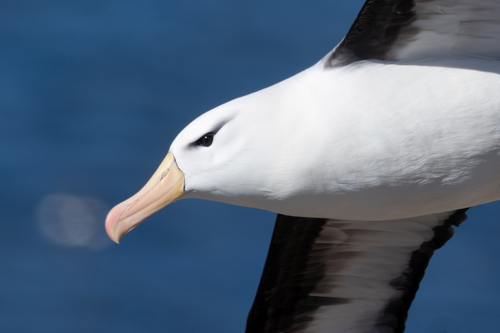
Black-browed Albatross (Thalassarche melanophris) Black-browed Albatross
Grey-backed Storm-Petrel (Garrodia nereis) Grey-backed Storm-Petrel

Media

Loading…

In short

The Black-browed Albatross is a large seabird with a distinctive black eyebrow and white body, while the Grey-backed Storm-Petrel is much smaller with a grey back and white underparts. These species are unlikely to be confused due to their significant size difference and distinct plumage patterns.

Identification tips

  1. Size: Use size as the primary differentiator; the albatross is much larger. 2. Plumage: Look for the black eyebrow on the albatross. 3. Flight style: Note the albatross's gliding flight versus the storm-petrel's fluttering. 4. Habitat: Consider the distance from shore; albatrosses are typically further out.

Size

The Black-browed Albatross is significantly larger, with a wingspan of over 2 meters, compared to the much smaller Grey-backed Storm-Petrel, which has a wingspan of about 50 cm.

Plumage

The Black-browed Albatross has a white head with a striking black eyebrow and a pale bill, while the Grey-backed Storm-Petrel has a grey back and white underparts with no distinct facial markings.

Behaviour

Black-browed Albatrosses glide effortlessly over the ocean with slow wingbeats, whereas Grey-backed Storm-Petrels exhibit fluttering flight close to the water surface.

Habitat

Both species are pelagic, but Black-browed Albatrosses are often seen further offshore, while Grey-backed Storm-Petrels are more likely to be found closer to coastal waters.

Voice

Vocalizations are not a primary distinguishing feature in the field for these species.

Submit a better description

Use the same sections as the comparison. Your text is published immediately.

The Black-browed Albatross is a large seabird with a distinctive black eyebrow and white body, while the Grey-backed Storm-Petrel is much smaller with a grey back and white underparts. These species are unlikely to be confused due to their significant size difference and distinct plumage patterns.

  1. Size: Use size as the primary differentiator; the albatross is much larger. 2. Plumage: Look for the black eyebrow on the albatross. 3. Flight style: Note the albatross's gliding flight versus the storm-petrel's fluttering. 4. Habitat: Consider the distance from shore; albatrosses are typically further out.

The Black-browed Albatross is significantly larger, with a wingspan of over 2 meters, compared to the much smaller Grey-backed Storm-Petrel, which has a wingspan of about 50 cm.

The Black-browed Albatross has a white head with a striking black eyebrow and a pale bill, while the Grey-backed Storm-Petrel has a grey back and white underparts with no distinct facial markings.

Black-browed Albatrosses glide effortlessly over the ocean with slow wingbeats, whereas Grey-backed Storm-Petrels exhibit fluttering flight close to the water surface.

Both species are pelagic, but Black-browed Albatrosses are often seen further offshore, while Grey-backed Storm-Petrels are more likely to be found closer to coastal waters.

Vocalizations are not a primary distinguishing feature in the field for these species.

Discard your changes?

You have unsaved edits. If you leave now, those changes will be lost.

Black-browed Albatross · Grey-backed Storm-Petrel · My Tricky Birds