Birdr

Black Bustard vs Black-bellied Bustard

Afrotis afra versus Lissotis melanogaster

Play a quiz with Black Bustard and Black-bellied Bustard
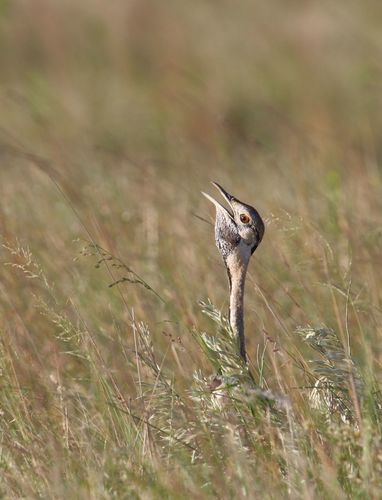
Black Bustard (Afrotis afra) Black Bustard
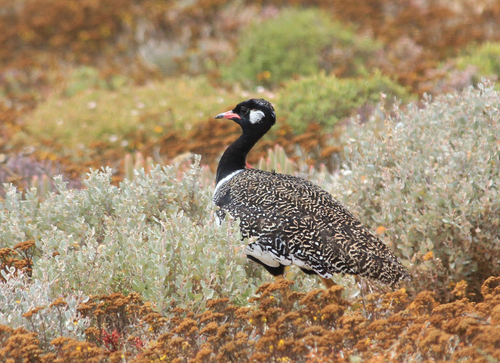
Black-bellied Bustard (Lissotis melanogaster) Black-bellied Bustard

Media

Loading…

In short

The Black Bustard and Black-bellied Bustard can be distinguished by their plumage and habitat preferences. The Black Bustard is notable for its black head and underparts with a white cheek patch and collar, while the Black-bellied Bustard has a distinctive black belly and lacks the white cheek patch. Habitat preferences also differ, with the Black Bustard favoring fynbos biomes and the Black-bellied Bustard preferring open savannas.

Identification tips

Size

Both species are similar in size, typical of medium-sized bustards.

Plumage

The Black Bustard male has a largely black head and underparts, a white cheek patch, and a white collar, with upperparts in golden-brown, gray, and darker brown. Females lack the white cheek patch and collar. The Black-bellied Bustard has a black belly, but lacks the white cheek patch and collar seen in Black Bustard males.

Behaviour

The Black Bustard is conspicuous during its aerial displays and harsh calls, while the Black-bellied Bustard is more often seen walking through grasslands.

Habitat

The Black Bustard inhabits renosterveld and strandveld in the fynbos biome, occasionally in cultivated areas with natural vegetation. The Black-bellied Bustard prefers open savannas and grasslands.

Voice

The Black Bustard is known for its harsh calls, which can be heard year-round. The Black-bellied Bustard's vocalizations are not detailed here, but are generally less harsh.

Submit a better description

Use the same sections as the comparison. Your text is published immediately.

The Black Bustard and Black-bellied Bustard can be distinguished by their plumage and habitat preferences. The Black Bustard is notable for its black head and underparts with a white cheek patch and collar, while the Black-bellied Bustard has a distinctive black belly and lacks the white cheek patch. Habitat preferences also differ, with the Black Bustard favoring fynbos biomes and the Black-bellied Bustard preferring open savannas.

  • Look for the white cheek patch and collar in Black Bustard males.
  • Note the black belly in Black-bellied Bustard.
  • Consider habitat: fynbos for Black Bustard, savannas for Black-bellied Bustard.
  • Observe behavior: aerial displays are typical of Black Bustard.

Both species are similar in size, typical of medium-sized bustards.

The Black Bustard male has a largely black head and underparts, a white cheek patch, and a white collar, with upperparts in golden-brown, gray, and darker brown. Females lack the white cheek patch and collar. The Black-bellied Bustard has a black belly, but lacks the white cheek patch and collar seen in Black Bustard males.

The Black Bustard is conspicuous during its aerial displays and harsh calls, while the Black-bellied Bustard is more often seen walking through grasslands.

The Black Bustard inhabits renosterveld and strandveld in the fynbos biome, occasionally in cultivated areas with natural vegetation. The Black-bellied Bustard prefers open savannas and grasslands.

The Black Bustard is known for its harsh calls, which can be heard year-round. The Black-bellied Bustard's vocalizations are not detailed here, but are generally less harsh.

Discard your changes?

You have unsaved edits. If you leave now, those changes will be lost.

Black Bustard · Black-bellied Bustard · My Tricky Birds