Birdr

Black-capped Flycatcher vs Northern Scrub-Flycatcher

Empidonax atriceps versus Sublegatus arenarum

Play a quiz with Black-capped Flycatcher and Northern Scrub-Flycatcher
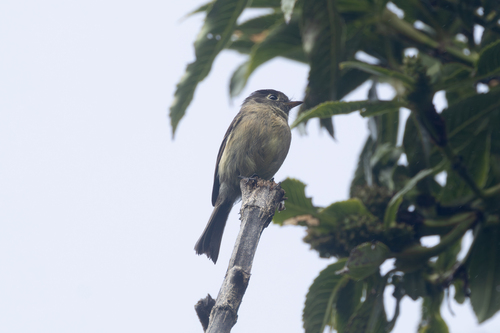
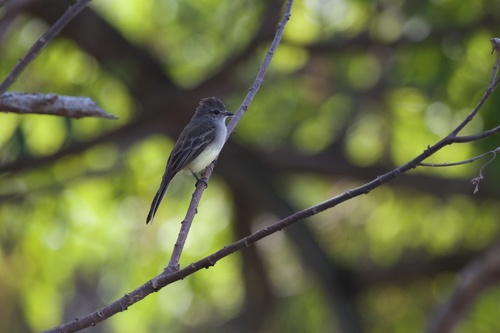
Black-capped Flycatcher (Empidonax atriceps) Black-capped Flycatcher
Northern Scrub-Flycatcher (Sublegatus arenarum) Northern Scrub-Flycatcher

Media

Loading…

In short

The Black-capped Flycatcher (Empidonax atriceps) and the Northern Scrub-Flycatcher (Sublegatus arenarum) are both small tyrant flycatchers, but they differ in habitat preference and plumage details. The Black-capped Flycatcher is typically found in highland forests, whereas the Northern Scrub-Flycatcher prefers lowland scrub habitats.

Identification tips

Look for the black cap and white throat of the Black-capped Flycatcher in highland forests. In contrast, the Northern Scrub-Flycatcher will be in lowland scrub without a black cap. If uncertain, consider the habitat and altitude as key factors.

Size

Both species are small flycatchers, but the Black-capped Flycatcher may appear slightly more compact due to its shorter tail.

Plumage

The Black-capped Flycatcher has a distinct black cap and a contrasting white throat, whereas the Northern Scrub-Flycatcher lacks a black cap and has a more uniform, duller plumage overall.

Behaviour

Both species exhibit typical flycatcher behavior, such as sallying from perches to catch insects, but the Black-capped Flycatcher is more likely to be seen in the understory of montane forests.

Habitat

The Black-capped Flycatcher is found in highland forests, often above 2,000 meters, while the Northern Scrub-Flycatcher inhabits lowland scrub and open areas.

Voice

Vocalizations can be a useful differentiator if known, but specific details on calls are not provided here.

Submit a better description

Use the same sections as the comparison. Your text is published immediately.

The Black-capped Flycatcher (Empidonax atriceps) and the Northern Scrub-Flycatcher (Sublegatus arenarum) are both small tyrant flycatchers, but they differ in habitat preference and plumage details. The Black-capped Flycatcher is typically found in highland forests, whereas the Northern Scrub-Flycatcher prefers lowland scrub habitats.

Look for the black cap and white throat of the Black-capped Flycatcher in highland forests. In contrast, the Northern Scrub-Flycatcher will be in lowland scrub without a black cap. If uncertain, consider the habitat and altitude as key factors.

Both species are small flycatchers, but the Black-capped Flycatcher may appear slightly more compact due to its shorter tail.

The Black-capped Flycatcher has a distinct black cap and a contrasting white throat, whereas the Northern Scrub-Flycatcher lacks a black cap and has a more uniform, duller plumage overall.

Both species exhibit typical flycatcher behavior, such as sallying from perches to catch insects, but the Black-capped Flycatcher is more likely to be seen in the understory of montane forests.

The Black-capped Flycatcher is found in highland forests, often above 2,000 meters, while the Northern Scrub-Flycatcher inhabits lowland scrub and open areas.

Vocalizations can be a useful differentiator if known, but specific details on calls are not provided here.

Discard your changes?

You have unsaved edits. If you leave now, those changes will be lost.

Black-capped Flycatcher · Northern Scrub-Flycatcher · My Tricky Birds