Birdr

Black-capped Pygmy-Tyrant vs Slate-headed Tody-Flycatcher

Myiornis atricapillus versus Poecilotriccus sylvia

Play a quiz with Black-capped Pygmy-Tyrant and Slate-headed Tody-Flycatcher
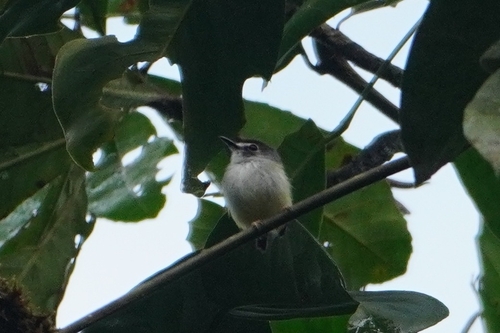
Black-capped Pygmy-Tyrant (Myiornis atricapillus) Black-capped Pygmy-Tyrant
Slate-headed Tody-Flycatcher (Poecilotriccus sylvia) Slate-headed Tody-Flycatcher

Media

Loading…

In short

To distinguish the Black-capped Pygmy-Tyrant from the Slate-headed Tody-Flycatcher, focus on the head coloration: the male Black-capped Pygmy-Tyrant has a distinctive black crown, while the Slate-headed Tody-Flycatcher features a dark gray head with a pale loral mark. Both species are small, but their plumage and habitats offer additional clues.

Identification tips

  1. Look for the black crown on male Black-capped Pygmy-Tyrants. 2. Note the dark gray head with a pale loral mark on the Slate-headed Tody-Flycatcher. 3. Observe the yellow wingbars on the Slate-headed Tody-Flycatcher. 4. Consider habitat: dense shrubbery may indicate the presence of the Slate-headed Tody-Flycatcher.

Size

Both species are very small, but the Black-capped Pygmy-Tyrant is among the smallest passerines, slightly smaller than the Slate-headed Tody-Flycatcher.

Plumage

The male Black-capped Pygmy-Tyrant has a black crown, while females have a gray head. The Slate-headed Tody-Flycatcher has a dark gray head with a pale loral mark and olive-green upperparts with two bold yellow wingbars.

Behaviour

The Slate-headed Tody-Flycatcher is known to take small fruits in addition to insects, which might be observed during feeding.

Habitat

The Slate-headed Tody-Flycatcher prefers dense shrubbery and vine tangles, while the Black-capped Pygmy-Tyrant is often found in similar forested environments.

Voice

The Slate-headed Tody-Flycatcher's vocalizations are described as insect- or frog-like, but specific differences in calls are not detailed for the Black-capped Pygmy-Tyrant.

Submit a better description

Use the same sections as the comparison. Your text is published immediately.

To distinguish the Black-capped Pygmy-Tyrant from the Slate-headed Tody-Flycatcher, focus on the head coloration: the male Black-capped Pygmy-Tyrant has a distinctive black crown, while the Slate-headed Tody-Flycatcher features a dark gray head with a pale loral mark. Both species are small, but their plumage and habitats offer additional clues.

  1. Look for the black crown on male Black-capped Pygmy-Tyrants. 2. Note the dark gray head with a pale loral mark on the Slate-headed Tody-Flycatcher. 3. Observe the yellow wingbars on the Slate-headed Tody-Flycatcher. 4. Consider habitat: dense shrubbery may indicate the presence of the Slate-headed Tody-Flycatcher.

Both species are very small, but the Black-capped Pygmy-Tyrant is among the smallest passerines, slightly smaller than the Slate-headed Tody-Flycatcher.

The male Black-capped Pygmy-Tyrant has a black crown, while females have a gray head. The Slate-headed Tody-Flycatcher has a dark gray head with a pale loral mark and olive-green upperparts with two bold yellow wingbars.

The Slate-headed Tody-Flycatcher is known to take small fruits in addition to insects, which might be observed during feeding.

The Slate-headed Tody-Flycatcher prefers dense shrubbery and vine tangles, while the Black-capped Pygmy-Tyrant is often found in similar forested environments.

The Slate-headed Tody-Flycatcher's vocalizations are described as insect- or frog-like, but specific differences in calls are not detailed for the Black-capped Pygmy-Tyrant.

Discard your changes?

You have unsaved edits. If you leave now, those changes will be lost.

Black-capped Pygmy-Tyrant · Slate-headed Tody-Flycatcher · My Tricky Birds