Birdr

Black-crowned Night Heron vs Little Egret

Nycticorax nycticorax versus Egretta garzetta

Play a quiz with Black-crowned Night Heron and Little Egret
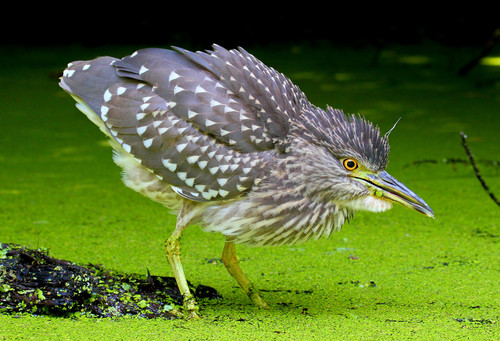
Black-crowned Night Heron (Nycticorax nycticorax) Black-crowned Night Heron
Little Egret (Egretta garzetta) Little Egret

Media

Loading…

In short

The Black-crowned Night Heron (Nycticorax nycticorax) and the Little Egret (Egretta garzetta) can be distinguished by their structure and plumage. The Night Heron is stockier with a shorter neck and thicker bill, while the Little Egret is more slender with a longer neck and thin, pointed bill. Plumage differences are notable in adults, with the Night Heron having a distinctive black crown and back, contrasting with the Little Egret's all-white plumage.

Identification tips

  1. Structure: Look for the stockier build and shorter neck of the Night Heron versus the slender, long-necked Little Egret. 2. Plumage: Note the black crown and back of the adult Night Heron; Little Egrets are all white. 3. Behavior: Observe feeding times; Night Herons are more active at dusk and night. 4. Habitat: Consider the environment; Little Egrets are more likely in open, human-modified wetlands. 5. Vocalization: Listen for the harsh croak of the Night Heron compared to the softer calls of the Little Egret.

Size

The Black-crowned Night Heron is more robust and shorter-necked compared to the more slender and long-necked Little Egret.

Plumage

Adult Black-crowned Night Herons have a black crown and back with gray wings, while Little Egrets are entirely white. Juvenile Night Herons are brown with streaks, which can be confused with immature egrets but generally appear more mottled.

Behaviour

Black-crowned Night Herons are primarily nocturnal and crepuscular feeders, often seen alone or in small groups. Little Egrets are more diurnal, often seen actively foraging in shallow waters during the day.

Habitat

Both species inhabit wetlands, but Little Egrets are more adaptable to anthropogenic environments like rice fields and fish ponds. Night Herons prefer secluded wetlands and are less frequently seen in human-modified areas.

Voice

The Black-crowned Night Heron has a harsh, croaking call, while the Little Egret's calls are softer and less distinctive.

Submit a better description

Use the same sections as the comparison. Your text is published immediately.

The Black-crowned Night Heron (Nycticorax nycticorax) and the Little Egret (Egretta garzetta) can be distinguished by their structure and plumage. The Night Heron is stockier with a shorter neck and thicker bill, while the Little Egret is more slender with a longer neck and thin, pointed bill. Plumage differences are notable in adults, with the Night Heron having a distinctive black crown and back, contrasting with the Little Egret's all-white plumage.

  1. Structure: Look for the stockier build and shorter neck of the Night Heron versus the slender, long-necked Little Egret. 2. Plumage: Note the black crown and back of the adult Night Heron; Little Egrets are all white. 3. Behavior: Observe feeding times; Night Herons are more active at dusk and night. 4. Habitat: Consider the environment; Little Egrets are more likely in open, human-modified wetlands. 5. Vocalization: Listen for the harsh croak of the Night Heron compared to the softer calls of the Little Egret.

The Black-crowned Night Heron is more robust and shorter-necked compared to the more slender and long-necked Little Egret.

Adult Black-crowned Night Herons have a black crown and back with gray wings, while Little Egrets are entirely white. Juvenile Night Herons are brown with streaks, which can be confused with immature egrets but generally appear more mottled.

Black-crowned Night Herons are primarily nocturnal and crepuscular feeders, often seen alone or in small groups. Little Egrets are more diurnal, often seen actively foraging in shallow waters during the day.

Both species inhabit wetlands, but Little Egrets are more adaptable to anthropogenic environments like rice fields and fish ponds. Night Herons prefer secluded wetlands and are less frequently seen in human-modified areas.

The Black-crowned Night Heron has a harsh, croaking call, while the Little Egret's calls are softer and less distinctive.

Discard your changes?

You have unsaved edits. If you leave now, those changes will be lost.

Black-crowned Night Heron · Little Egret · My Tricky Birds