
Black-crowned Night Heron vs Western Cattle-Egret
Nycticorax nycticorax versus Ardea ibis
Play a quiz with Black-crowned Night Heron and Western Cattle-Egret
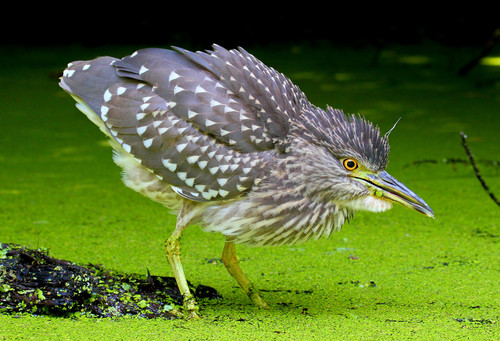 Black-crowned Night Heron
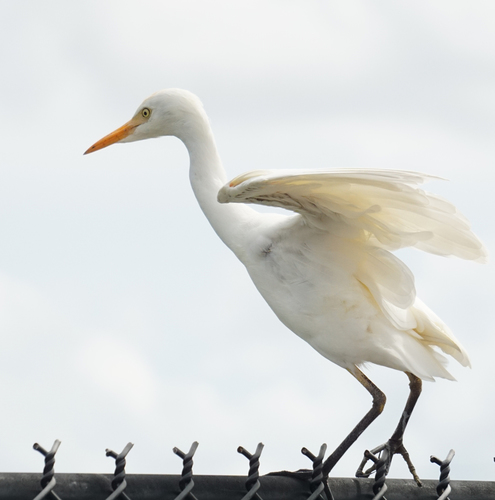 Western Cattle-Egret
In short
The most reliable field mark between Black-crowned Night Heron and Western Cattle-Egret is the presence of a black crown and back on adult night herons, versus the all-white body of cattle egrets outside the brief breeding season. Immature night herons are brown and heavily spotted, while juvenile cattle egrets are plain white with a dark bill. Night herons are stockier and shorter-necked, often seen hunched, while cattle egrets are more upright and frequently forage in open fields. In flight, night herons show broad, rounded wings and a short tail, while cattle egrets have longer, narrower wings and a more egret-like silhouette. Leg and bill color also differ, especially in non-breeding birds.
Identification tips
- Juvenile/immature plumage: If you see a brown, heavily spotted/streaked heron, it's a juvenile Black-crowned Night Heron; cattle egret juveniles are plain white with a dark bill.
- Adult crown and back: Black-crowned Night Heron adults have a jet-black crown and back, sharply contrasting with pale grey wings and white underparts. Cattle egrets are all white except for brief orange-buff plumes in breeding season.
- Bill color: Non-breeding cattle egrets have a yellow bill; night herons have a blackish bill year-round. Juvenile cattle egrets have a black bill, while night heron juveniles have a paler, horn-colored bill.
- Leg color: Night herons have yellow legs (turning salmon-pink in breeding season); cattle egrets have greyish-yellow legs, briefly turning red in breeding.
- Eye color: Adult night herons have striking red eyes; cattle egrets have yellow irises except for a brief red flush in peak breeding.
- Head plumes: Adult night herons show long, slender white head plumes in breeding season; cattle egrets have orange-buff plumes on the crown, back, and breast.
- Structure/posture: Night herons are stocky, with a short neck and legs, and often appear hunched when perched. Cattle egrets are more upright, with a proportionally longer neck and legs.
- Flight silhouette: Night herons have broad, rounded wings and a short tail, giving a compact look in flight. Cattle egrets have longer, narrower wings and a more stretched, egret-like profile.
- Behavior: Night herons are most active at dusk or night, often roosting by day. Cattle egrets are active by day, foraging in open fields, often with livestock.
- Habitat: Night herons are rarely far from water; cattle egrets are commonly seen in dry fields and pastures, sometimes far from wetlands.
- Vocalizations: Listen for harsh 'quok' calls from night herons, especially at dusk or in colonies; cattle egrets are usually silent except for a soft 'rick-rack' at colonies.
- Breeding season confusion: Both species change leg and bill color in breeding, but only cattle egrets develop orange-buff plumes on the body; night herons' breeding plumes are long and white, restricted to the head.
- Second/third-year night herons: These birds may lack head plumes but still show a dark crown and back, unlike any cattle egret.
- Mixed colonies: Both may nest with other herons, but check for habitat (water vs field edge) and structure to separate them.
- Common pitfalls: Immature night herons are often mistaken for other brown herons, but never for cattle egrets if you note the heavy spotting and streaking. Cattle egrets in non-breeding plumage are all white and lack any dark or patterned areas.
Size
Black-crowned Night Heron is heavier (body mass ~636g) than Western Cattle-Egret (270–512g). Cattle egrets are longer (46–56 cm) with a larger wingspan (88–96 cm), but night herons are more robust and compact, with a distinctly stocky build and shorter neck and legs. In the field, cattle egrets often look taller and more elongated, while night herons appear squat and thickset.
Plumage
- Juvenile/immature birds: Black-crowned Night Heron immatures are brownish with many pale teardrop-shaped spots on the upperparts and streaked underparts, plus orange eyes and dull yellow-green legs. Juvenile Western Cattle-Egrets are plain white overall with a black bill, lacking any spots or streaks.
- Adults (non-breeding): Adult night herons have a black crown and back, pale grey wings, white underparts, red eyes, and yellow legs. Cattle egrets are all white with a yellow bill and greyish-yellow legs.
- Adults (breeding): Night herons develop long white head plumes, and their legs turn salmon-pink with blue facial skin. Cattle egrets gain orange-buff plumes on crown, back, and breast, and their bill, legs, and irises briefly become bright red.
- Second/third year night herons: These birds look increasingly like adults but lack the white head plumes and retain duller legs and eyes.
Behaviour
Black-crowned Night Herons are crepuscular or nocturnal, often seen hunched and motionless at water edges or roosting in trees during the day. They extend their necks when hunting but otherwise appear squat. Western Cattle-Egrets are diurnal, foraging actively in open fields, often following livestock or tractors, and are much more terrestrial. Their posture is more upright, and they are less likely to be seen at water margins than night herons.
Habitat
Night herons are typically found near water—lakes, rivers, swamps, or wetlands—often roosting in trees or dense vegetation. Cattle egrets are more terrestrial, frequently seen in open grasslands, pastures, and agricultural fields, often far from water, especially when following grazing animals. Both may nest in colonies, sometimes with other herons, but cattle egrets are less tied to aquatic habitats.
Voice
Black-crowned Night Herons are very noisy at colonies, giving harsh, barking calls like 'quok' or 'woc.' Western Cattle-Egrets are mostly silent away from colonies, but at breeding sites they give a quiet, throaty 'rick-rack' call. In the field, night herons are much more likely to be heard.
Black-crowned Night Heron · Western Cattle-Egret · My Tricky Birds