
Birdr

Black-crowned Scimitar-Babbler vs Red-billed Scimitar-Babbler

Pomatorhinus ferruginosus versus Pomatorhinus ochraceiceps

Play a quiz with Black-crowned Scimitar-Babbler and Red-billed Scimitar-Babbler

Black-crowned Scimitar-Babbler (Pomatorhinus ferruginosus) Black-crowned Scimitar-Babbler
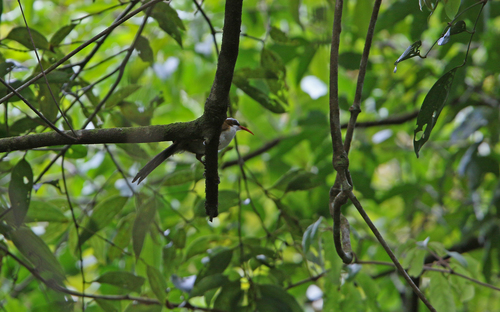
Red-billed Scimitar-Babbler (Pomatorhinus ochraceiceps) Red-billed Scimitar-Babbler

Media

Loading…

In short

The bill color is the most reliable field mark: the Black-crowned Scimitar-Babbler has a dark bill, while the Red-billed Scimitar-Babbler features a distinct red bill. Both species share a similar body shape and long, curved bills typical of scimitar-babblers, but their plumage and vocalizations offer additional clues.

Identification tips

  1. Check bill color: Black-crowned has a dark bill, Red-billed has a red bill. 2. Observe plumage: Look for the dark crown of the Black-crowned versus the lighter body of the Red-billed. 3. Note habitat and behavior: Both are found in dense undergrowth; listen for any vocal differences.

Size

Both species are similar in size, typical of scimitar-babblers, with no significant size difference noted.

Plumage

The Black-crowned Scimitar-Babbler has a dark crown and a more uniform brown body, while the Red-billed Scimitar-Babbler displays a lighter, more ochraceous body with a contrasting red bill.

Behaviour

Both species exhibit similar foraging behavior, often seen moving through dense undergrowth or low vegetation.

Habitat

Both species inhabit similar environments, favoring dense forest undergrowth, but specific range details may vary regionally.

Voice

Vocalizations are not well-documented for field differentiation, but any differences in song or call should be noted if heard.

Submit a better description

Use the same sections as the comparison. Your text is published immediately.

The bill color is the most reliable field mark: the Black-crowned Scimitar-Babbler has a dark bill, while the Red-billed Scimitar-Babbler features a distinct red bill. Both species share a similar body shape and long, curved bills typical of scimitar-babblers, but their plumage and vocalizations offer additional clues.

  1. Check bill color: Black-crowned has a dark bill, Red-billed has a red bill. 2. Observe plumage: Look for the dark crown of the Black-crowned versus the lighter body of the Red-billed. 3. Note habitat and behavior: Both are found in dense undergrowth; listen for any vocal differences.

Both species are similar in size, typical of scimitar-babblers, with no significant size difference noted.

The Black-crowned Scimitar-Babbler has a dark crown and a more uniform brown body, while the Red-billed Scimitar-Babbler displays a lighter, more ochraceous body with a contrasting red bill.

Both species exhibit similar foraging behavior, often seen moving through dense undergrowth or low vegetation.

Both species inhabit similar environments, favoring dense forest undergrowth, but specific range details may vary regionally.

Vocalizations are not well-documented for field differentiation, but any differences in song or call should be noted if heard.

Discard your changes?

You have unsaved edits. If you leave now, those changes will be lost.

Black-crowned Scimitar-Babbler · Red-billed Scimitar-Babbler · My Tricky Birds