Birdr

Black Cuckooshrike vs Southern Masked-Weaver

Campephaga flava versus Ploceus velatus

Play a quiz with Black Cuckooshrike and Southern Masked-Weaver
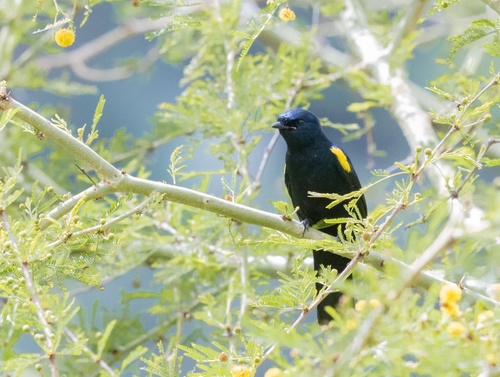
Black Cuckooshrike (Campephaga flava) Black Cuckooshrike
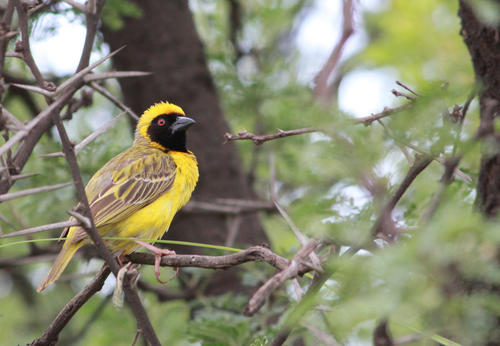
Southern Masked-Weaver (Ploceus velatus) Southern Masked-Weaver

Media

Loading…

In short

The Black Cuckooshrike and Southern Masked-Weaver can be distinguished by their size, bill shape, and plumage. The Black Cuckooshrike is larger with a slender bill, while the Southern Masked-Weaver is smaller with a short, conical bill. Plumage differences are also notable, especially in males during breeding season.

Identification tips

  1. Check bill shape: Black Cuckooshrike has a slender bill, while Southern Masked-Weaver has a short, conical bill. 2. Observe plumage: Look for the black plumage of the male Black Cuckooshrike versus the bright yellow and black face of the male Southern Masked-Weaver. 3. Consider behavior: If seen weaving nests in colonies, it's likely a Southern Masked-Weaver. 4. Note size: Larger birds are likely Black Cuckooshrikes.

Size

The Black Cuckooshrike is larger than the Southern Masked-Weaver.

Plumage

Male Black Cuckooshrikes are mostly black, while male Southern Masked-Weavers in breeding plumage have a black face and throat, red eyes, and bright yellow head and underparts. Female and non-breeding male weavers are dull greenish-yellow with streaked upperparts.

Behaviour

Southern Masked-Weavers are colonial nesters and often seen weaving nests in groups, while Black Cuckooshrikes are more solitary.

Habitat

Both species inhabit sub-Saharan Africa, but the Southern Masked-Weaver is more likely found in open areas with reeds or grasses for nesting, while Black Cuckooshrikes prefer wooded areas.

Voice

Vocalizations differ, but specific calls are not detailed in the sources. Observers should note that weavers are generally more vocal in colonies.

Submit a better description

Use the same sections as the comparison. Your text is published immediately.

The Black Cuckooshrike and Southern Masked-Weaver can be distinguished by their size, bill shape, and plumage. The Black Cuckooshrike is larger with a slender bill, while the Southern Masked-Weaver is smaller with a short, conical bill. Plumage differences are also notable, especially in males during breeding season.

  1. Check bill shape: Black Cuckooshrike has a slender bill, while Southern Masked-Weaver has a short, conical bill. 2. Observe plumage: Look for the black plumage of the male Black Cuckooshrike versus the bright yellow and black face of the male Southern Masked-Weaver. 3. Consider behavior: If seen weaving nests in colonies, it's likely a Southern Masked-Weaver. 4. Note size: Larger birds are likely Black Cuckooshrikes.

The Black Cuckooshrike is larger than the Southern Masked-Weaver.

Male Black Cuckooshrikes are mostly black, while male Southern Masked-Weavers in breeding plumage have a black face and throat, red eyes, and bright yellow head and underparts. Female and non-breeding male weavers are dull greenish-yellow with streaked upperparts.

Southern Masked-Weavers are colonial nesters and often seen weaving nests in groups, while Black Cuckooshrikes are more solitary.

Both species inhabit sub-Saharan Africa, but the Southern Masked-Weaver is more likely found in open areas with reeds or grasses for nesting, while Black Cuckooshrikes prefer wooded areas.

Vocalizations differ, but specific calls are not detailed in the sources. Observers should note that weavers are generally more vocal in colonies.

Discard your changes?

You have unsaved edits. If you leave now, those changes will be lost.

Black Cuckooshrike · Southern Masked-Weaver · My Tricky Birds