Birdr

Black-faced Grosbeak vs Blue-black Grosbeak

Caryothraustes poliogaster versus Cyanoloxia cyanoides

Play a quiz with Black-faced Grosbeak and Blue-black Grosbeak
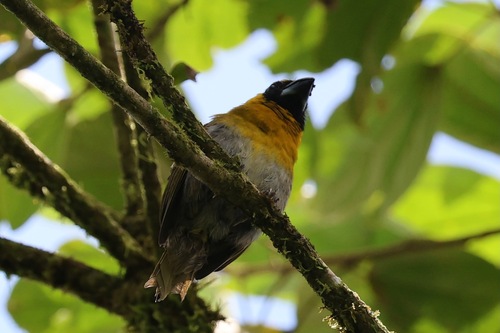
Black-faced Grosbeak (Caryothraustes poliogaster) Black-faced Grosbeak
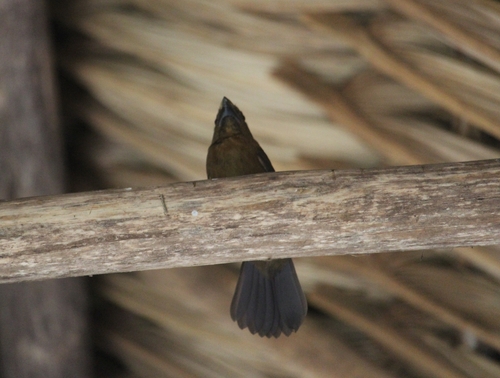
Blue-black Grosbeak (Cyanoloxia cyanoides) Blue-black Grosbeak

Media

Loading…

In short

The Black-faced Grosbeak (Caryothraustes poliogaster) and the Blue-black Grosbeak (Cyanoloxia cyanoides) are both members of the Cardinalidae family, but they can be distinguished by their distinct plumage colors and facial patterns. The Black-faced Grosbeak has a striking black face and yellow-green body, while the Blue-black Grosbeak is primarily dark blue with no black face.

Identification tips

Size

Both species are similar in size, typical of grosbeaks, with robust bodies and thick bills.

Plumage

The Black-faced Grosbeak has a black face and a yellow-green body, while the Blue-black Grosbeak is uniformly dark blue with no contrasting facial markings.

Behaviour

Both species are known to forage in the mid-levels of forests, often in pairs or small groups, but specific behavioral differences are not well-documented.

Habitat

Both species inhabit tropical forests, but the Black-faced Grosbeak is more often found in the canopy and edges, whereas the Blue-black Grosbeak prefers dense undergrowth.

Voice

The vocalizations of these species differ, with the Black-faced Grosbeak having a varied song that includes whistles and trills, while the Blue-black Grosbeak's song is less documented but is known to be a series of melodious notes.

Submit a better description

Use the same sections as the comparison. Your text is published immediately.

The Black-faced Grosbeak (Caryothraustes poliogaster) and the Blue-black Grosbeak (Cyanoloxia cyanoides) are both members of the Cardinalidae family, but they can be distinguished by their distinct plumage colors and facial patterns. The Black-faced Grosbeak has a striking black face and yellow-green body, while the Blue-black Grosbeak is primarily dark blue with no black face.

  • Look for the black face and yellow-green body of the Black-faced Grosbeak.
  • Note the uniform dark blue plumage of the Blue-black Grosbeak.
  • Observe habitat preference: Black-faced Grosbeaks are often in canopy and edges, while Blue-black Grosbeaks are in dense undergrowth.
  • Listen for differences in song: Black-faced Grosbeaks have a varied song with whistles and trills.

Both species are similar in size, typical of grosbeaks, with robust bodies and thick bills.

The Black-faced Grosbeak has a black face and a yellow-green body, while the Blue-black Grosbeak is uniformly dark blue with no contrasting facial markings.

Both species are known to forage in the mid-levels of forests, often in pairs or small groups, but specific behavioral differences are not well-documented.

Both species inhabit tropical forests, but the Black-faced Grosbeak is more often found in the canopy and edges, whereas the Blue-black Grosbeak prefers dense undergrowth.

The vocalizations of these species differ, with the Black-faced Grosbeak having a varied song that includes whistles and trills, while the Blue-black Grosbeak's song is less documented but is known to be a series of melodious notes.

Discard your changes?

You have unsaved edits. If you leave now, those changes will be lost.

Black-faced Grosbeak · Blue-black Grosbeak · My Tricky Birds