Birdr

Black-faced Ibis vs Andean Ibis

Theristicus melanopis versus Theristicus branickii

Play a quiz with Black-faced Ibis and Andean Ibis
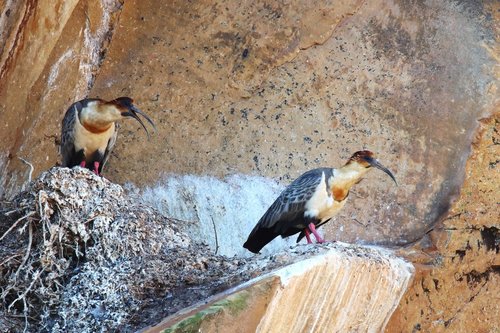
Black-faced Ibis (Theristicus melanopis) Black-faced Ibis
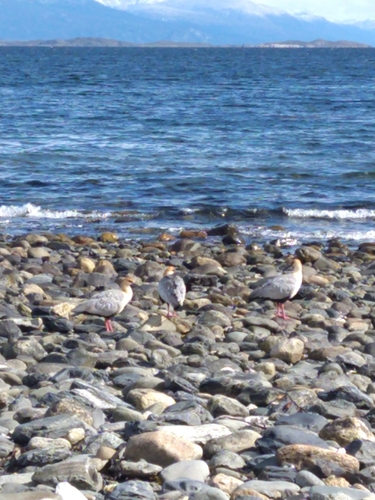
Andean Ibis (Theristicus branickii) Andean Ibis

Media

Loading…

In short

The Black-faced Ibis and Andean Ibis are similar in structure but can be distinguished by their facial markings and habitat preferences. The Black-faced Ibis has a distinctive black face and throat, while the Andean Ibis lacks this stark contrast. Both species share a similar body shape and bill structure.

Identification tips

  1. Look for the black face and throat on the Black-faced Ibis. 2. Observe the habitat: Black-faced Ibis in lowland areas, Andean Ibis in high-altitude regions. 3. Note the uniform buff and grayish tones of the Andean Ibis compared to the contrasting plumage of the Black-faced Ibis.

Size

Both species are similar in size, typical of large ibises.

Plumage

The Black-faced Ibis has a black face and throat, contrasting with its buff neck. The Andean Ibis lacks the black facial markings, presenting a more uniform appearance with its buff and grayish tones.

Behaviour

Both species exhibit similar foraging behavior, often seen probing in wetlands or grasslands.

Habitat

The Black-faced Ibis is more commonly found in open grasslands and wetlands at lower elevations, while the Andean Ibis is typically found in high-altitude Andean regions.

Voice

Vocalizations are not prominently distinct between the two species, and both are generally silent or make similar honking calls.

Submit a better description

Use the same sections as the comparison. Your text is published immediately.

The Black-faced Ibis and Andean Ibis are similar in structure but can be distinguished by their facial markings and habitat preferences. The Black-faced Ibis has a distinctive black face and throat, while the Andean Ibis lacks this stark contrast. Both species share a similar body shape and bill structure.

  1. Look for the black face and throat on the Black-faced Ibis. 2. Observe the habitat: Black-faced Ibis in lowland areas, Andean Ibis in high-altitude regions. 3. Note the uniform buff and grayish tones of the Andean Ibis compared to the contrasting plumage of the Black-faced Ibis.

Both species are similar in size, typical of large ibises.

The Black-faced Ibis has a black face and throat, contrasting with its buff neck. The Andean Ibis lacks the black facial markings, presenting a more uniform appearance with its buff and grayish tones.

Both species exhibit similar foraging behavior, often seen probing in wetlands or grasslands.

The Black-faced Ibis is more commonly found in open grasslands and wetlands at lower elevations, while the Andean Ibis is typically found in high-altitude Andean regions.

Vocalizations are not prominently distinct between the two species, and both are generally silent or make similar honking calls.

Discard your changes?

You have unsaved edits. If you leave now, those changes will be lost.

Black-faced Ibis · Andean Ibis · My Tricky Birds