
Black-faced Monarch vs Australian Spectacled Monarch
Monarcha melanopsis versus Symposiachrus trivirgatus
Play a quiz with Black-faced Monarch and Australian Spectacled Monarch
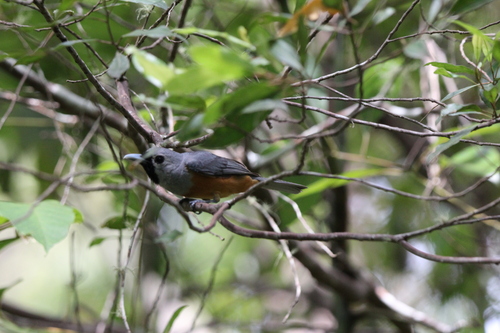 Black-faced Monarch
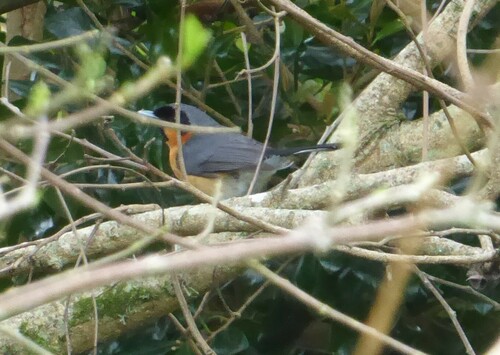 Australian Spectacled Monarch
In short
The most reliable way to separate Black-faced Monarch from Australian Spectacled Monarch is by focusing on the face pattern: Black-faced Monarch shows a distinctive black face mask, while Australian Spectacled Monarch has a pale spectacle or eyering, lacking the solid black mask. Both species can occur in overlapping habitats in eastern Australia and New Guinea, and both are Monarchidae flycatchers with similar size and shape, so close attention to facial markings is critical. Juvenile and immature plumages are not well detailed in available sources, so adults and older immatures are most reliably separated by face pattern. Structure and general coloration are similar, so misidentifications often result from overlooking the subtle but diagnostic facial contrast.
Identification tips
- Face pattern is diagnostic in adults: Black-faced Monarch always shows a solid black mask covering the face, while Australian Spectacled Monarch has a pale spectacle or eyering and lacks the black mask. This is the single most reliable mark in all visible plumages.
- Check the lores and cheeks: On Black-faced Monarch, the black mask extends through the lores and around the eye, giving a hooded look. On Australian Spectacled Monarch, the lores are pale and the pale spectacle is obvious, especially at close range.
- Crown and nape color: Both species have greyish or blue-grey crowns, but on Black-faced Monarch this contrasts sharply with the black mask, while on Australian Spectacled Monarch the transition is more gradual and the face is paler overall.
- Underparts color is similar: Both species have orangey or rufous underparts, so this is not a reliable separator.
- Upperparts and wings: Both are greyish above, with no strong contrast or wing markings noted for either species; do not rely on wing pattern for separation.
- Juvenile/immature separation is uncertain: No detailed information is available for immature or juvenile wing or face patterns, so caution is needed with young birds. Use face pattern when visible, but be aware that very young birds may be less distinctive.
- Bill and structure: Both species have similar bill shape and size, typical of monarch flycatchers; do not use bill structure for separation.
- Perched vs. in flight: Both species often perch upright and sally for insects. Face pattern is visible both perched and in flight at close range.
- Habitat overlap: Both can occur in the same forests and woodlands in eastern Australia and New Guinea, so do not rely on habitat alone for identification.
- Seasonal movement: Black-faced Monarch migrates to New Guinea in austral winter (May–August), but Australian Spectacled Monarch is also present in New Guinea, so timing is not a reliable separator.
- Voice not described: No distinguishing vocalizations are detailed in the available sources; do not rely on calls or song for separation.
- Sexes similar: Both species are sexually monomorphic in plumage; do not use sex for identification.
- Size is not helpful: Both are medium-sized monarchs with similar proportions; do not use size as a primary field mark.
- Common pitfalls: The main confusion arises from overlooking the face pattern, especially in poor light or at a distance. Always look for the presence or absence of the black mask.
- When in doubt: If the face is not clearly visible, be cautious and avoid making a firm identification based on general coloration or habitat alone.
Size
Black-faced Monarch has a recorded body mass of 23g [wikidata], while no direct measurement is available for Australian Spectacled Monarch, but both are medium-sized monarch flycatchers and appear similar in size in the field. There is no evidence for a strong size difference that would aid field separation.
Plumage
For both species, adult plumage is most reliably separated by the face: Black-faced Monarch shows a solid black mask that covers the lores, cheeks, and often the throat, sharply contrasting with a paler grey or blue-grey crown and nape. Australian Spectacled Monarch, in contrast, lacks this mask and instead has a pale spectacle or eyering that stands out against a generally paler face. No detailed information is available on juvenile or immature upperwing patterns for either species, so separation in flight relies on face pattern and overall coloration. Both species have greyish upperparts and orangey or rufous underparts, but the face pattern is the key field mark in all plumages described.
Behaviour
Both species are active, insectivorous flycatchers that move through the mid to upper levels of forest and woodland, often sallying out to catch insects. Their foraging behavior and flight style are very similar and not reliably diagnostic in the field.
Habitat
Both species occur in eastern Australia and New Guinea, often in overlapping habitats such as moist forests, woodlands, and mangroves. Australian Spectacled Monarch may be more closely associated with mangroves and lowland forests, but Black-faced Monarch is also found in similar environments. Habitat alone is not a reliable separator where ranges overlap.
Black-faced Monarch · Australian Spectacled Monarch · My Tricky Birds