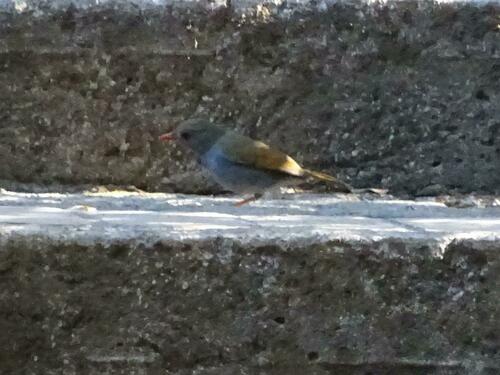
Black-faced Solitaire vs Orange-billed Nightingale-Thrush
Myadestes melanops versus Catharus aurantiirostris
Play a quiz with Black-faced Solitaire and Orange-billed Nightingale-Thrush
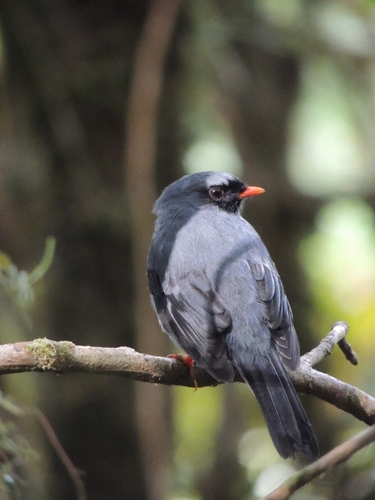
Black-faced Solitaire
Orange-billed Nightingale-Thrush
In short
The Black-faced Solitaire is best identified by its striking black face and bright orange legs, while the Orange-billed Nightingale-Thrush features a distinctive orange bill and lacks the black facial markings. Both species are part of the thrush family but differ in key structural and plumage characteristics.
Identification tips
- Look for the black face and orange legs of the Black-faced Solitaire. 2. Note the orange bill of the Orange-billed Nightingale-Thrush. 3. Observe the habitat: Black-faced Solitaires are more likely at higher elevations. 4. Listen for the song: Black-faced Solitaires have a more melodious song compared to the drier notes of the Orange-billed Nightingale-Thrush.
Size
Both species are similar in size, typical of medium-sized thrushes.
Plumage
The Black-faced Solitaire has a notable black face and gray body, whereas the Orange-billed Nightingale-Thrush has a more uniform brown or gray plumage without the black facial markings. The Orange-billed Nightingale-Thrush also has a prominent orange bill.
Behaviour
The Black-faced Solitaire often forages in flocks, especially outside the breeding season, while the Orange-billed Nightingale-Thrush is frequently seen hopping on the ground or singing from low perches.
Habitat
Black-faced Solitaires are found at higher elevations (750-3000 m) and may migrate downslope in non-breeding seasons. Orange-billed Nightingale-Thrushes prefer dense thickets and are often found at lower elevations.
Voice
The Black-faced Solitaire is known for its melodious song, while the Orange-billed Nightingale-Thrush has a less musical, drier song with a nasal, upslurred call note.
Black-faced Solitaire · Orange-billed Nightingale-Thrush · My Tricky Birds