Birdr

Black-faced Tanager vs Black-cowled Saltator

Schistochlamys melanopis versus Saltator nigriceps

Play a quiz with Black-faced Tanager and Black-cowled Saltator
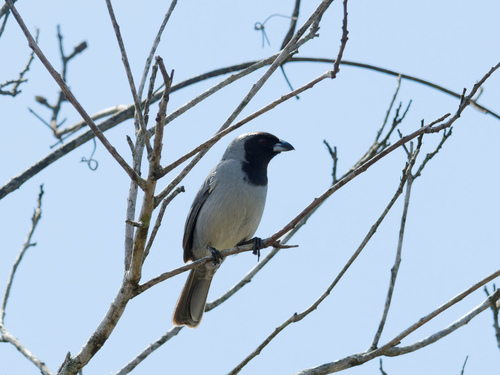
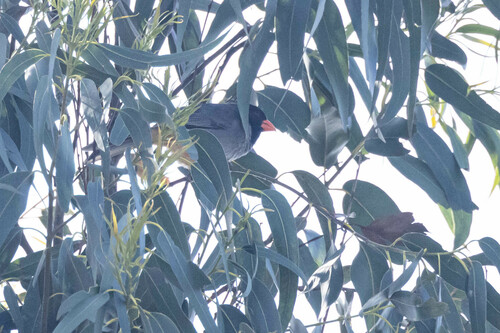
Black-faced Tanager (Schistochlamys melanopis) Black-faced Tanager
Black-cowled Saltator (Saltator nigriceps) Black-cowled Saltator

Media

Loading…

In short

The Black-faced Tanager and Black-cowled Saltator can be differentiated by their head markings and bill color. The Black-faced Tanager has a distinctive black face and bib with a black bill, while the Black-cowled Saltator features a black head with a contrasting white throat and a more robust bill.

Identification tips

  1. Look for the black face and bib of the Black-faced Tanager versus the black head and white throat of the Black-cowled Saltator. 2. Note the bill color and shape: Black-faced Tanager has a black bill with a bluish-gray base, while the Saltator's bill is more robust. 3. Consider habitat: Black-faced Tanagers avoid dense forests, whereas Saltators may be found in more forested areas. 4. Listen for the Black-faced Tanager's melodic song as a potential clue.

Size

Both species are similar in size, typical of medium-sized passerines, but the Saltator may appear slightly bulkier due to its heavier bill.

Plumage

The Black-faced Tanager is gray overall with a black face and bib, while the Black-cowled Saltator has a black head, white throat, and gray body. The tanager's bill is black with a bluish-gray base, contrasting with the Saltator's more robust bill.

Behaviour

Black-faced Tanagers often occur in small groups and may join mixed-species flocks, whereas Black-cowled Saltators are more solitary or found in pairs.

Habitat

Black-faced Tanagers prefer habitats with a mix of trees and grass throughout northern South America, avoiding dense forests and open grasslands. Black-cowled Saltators are typically found in more forested areas.

Voice

The Black-faced Tanager has a rich, melodic song often delivered from an isolated tree or shrub. The vocalizations of the Black-cowled Saltator are less documented, making this a less reliable field mark.

Submit a better description

Use the same sections as the comparison. Your text is published immediately.

The Black-faced Tanager and Black-cowled Saltator can be differentiated by their head markings and bill color. The Black-faced Tanager has a distinctive black face and bib with a black bill, while the Black-cowled Saltator features a black head with a contrasting white throat and a more robust bill.

  1. Look for the black face and bib of the Black-faced Tanager versus the black head and white throat of the Black-cowled Saltator. 2. Note the bill color and shape: Black-faced Tanager has a black bill with a bluish-gray base, while the Saltator's bill is more robust. 3. Consider habitat: Black-faced Tanagers avoid dense forests, whereas Saltators may be found in more forested areas. 4. Listen for the Black-faced Tanager's melodic song as a potential clue.

Both species are similar in size, typical of medium-sized passerines, but the Saltator may appear slightly bulkier due to its heavier bill.

The Black-faced Tanager is gray overall with a black face and bib, while the Black-cowled Saltator has a black head, white throat, and gray body. The tanager's bill is black with a bluish-gray base, contrasting with the Saltator's more robust bill.

Black-faced Tanagers often occur in small groups and may join mixed-species flocks, whereas Black-cowled Saltators are more solitary or found in pairs.

Black-faced Tanagers prefer habitats with a mix of trees and grass throughout northern South America, avoiding dense forests and open grasslands. Black-cowled Saltators are typically found in more forested areas.

The Black-faced Tanager has a rich, melodic song often delivered from an isolated tree or shrub. The vocalizations of the Black-cowled Saltator are less documented, making this a less reliable field mark.

Discard your changes?

You have unsaved edits. If you leave now, those changes will be lost.

Black-faced Tanager · Black-cowled Saltator · My Tricky Birds