
Black Guillemot vs Common Guillemot
Cepphus grylle versus Uria aalge
Play a quiz with Black Guillemot and Common Guillemot
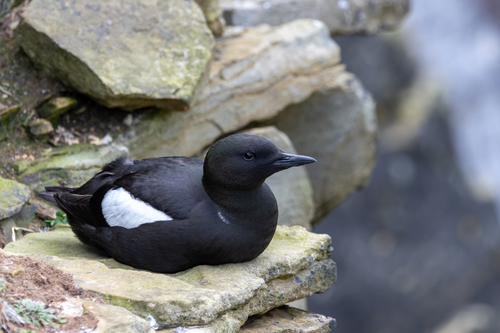 Black Guillemot
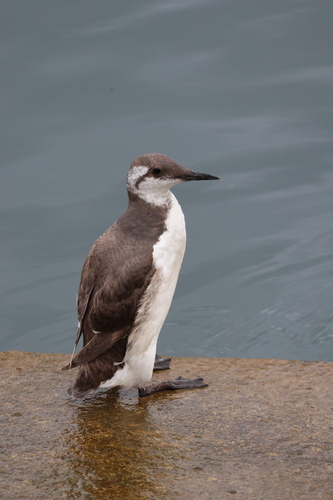 Common Guillemot
In short
The most reliable field mark between Black Guillemot and Common Guillemot is the bold white wing patch of Black Guillemot, which is present in all ages and seasons and stands out in flight or at rest. Juvenile and immature Black Guillemots show grey or brown spotting within this white patch, while Common Guillemots never show a solid white wing patch at any age. Structurally, Black Guillemot is much smaller and more compact, with bright coral-red legs and feet (especially in summer), versus the much larger, longer-bodied, and darker-legged Common Guillemot. In winter, Black Guillemot becomes pale and mottled above but always keeps the white wing patch, while Common Guillemot shows a white face and throat with a dark eye-stripe but no white on the wings. Both species may be seen on rocky coasts, but Black Guillemot is more often solitary or in pairs, while Common Guillemot forms dense colonies.
Identification tips
- White wing patch (all ages, all seasons): Black Guillemot always shows a large, bold white patch on the upperwing, visible in flight and at rest. Common Guillemot never shows this mark at any age.
- Juvenile/immature Black Guillemot: Look for grey or brown spotting within the white wing patch—this is unique and visible even at a distance. Common Guillemot juveniles have uniformly dark wings.
- Size and shape: Black Guillemot is much smaller, more compact, and shorter-necked. Common Guillemot is larger, heavier, and more elongated, with a longer bill and body.
- Leg and foot color: In summer, Black Guillemot has bright coral-red legs and feet, which are striking if seen well. Common Guillemot's legs are dark grey or blackish and never bright red.
- Bill: Black Guillemot has a slender, black bill; Common Guillemot's bill is also thin and dark but appears proportionally longer and heavier due to the larger head and body.
- Breeding plumage: Black Guillemot is all black with a white wing patch; Common Guillemot is black (or dark brown in the south) above and white below, with no white on the wings.
- Non-breeding/winter plumage: Black Guillemot becomes pale grey and white above with barred patterning but always keeps the white wing patch. Common Guillemot shows a white face and throat with a dark eye-stripe, no white on wings, and sometimes a 'bridled' white eye-ring and line.
- Flight silhouette: Black Guillemot looks compact with rounded wings and a short neck; Common Guillemot appears longer, slimmer, and more pointed in flight.
- Habitat and context: Black Guillemot is often seen alone or in pairs near rocky shores or among boulders; Common Guillemot is usually in dense colonies on cliffs during breeding season.
- Behavior: Black Guillemot may be seen carrying fish crosswise in the bill for long periods; Common Guillemot carries a single fish lengthwise.
- Vocalization: Listen for Black Guillemot's high-pitched whistle (especially at close range in breeding season) versus the growling 'murrrr' of Common Guillemot colonies.
- First-winter confusion: First-winter Black Guillemot still shows the white wing patch; first-winter Common Guillemot looks like adult winter, with white face and dark eye-stripe but no wing patch.
- Bridled morph: If you see a white eye-ring and line on a Common Guillemot, it's the 'bridled' morph (northern birds), but this is limited to the head and does not involve the wings.
- Red mouth/gape: In summer, Black Guillemot shows a bright red gape when calling; Common Guillemot's mouth is not notably colored.
- Pitfalls: At long range or in poor light, size can be deceptive, but the presence or absence of the white wing patch is always diagnostic if seen well.
Size
Black Guillemot is significantly smaller and lighter, with an average body mass of 381 g [wikidata], compared to Common Guillemot, which typically weighs 775–1,250 g and is 38–46 cm long with a 61–73 cm wingspan [wikipedia]. Black Guillemot is a compact, short-necked bird, while Common Guillemot is longer, heavier, and more elongated in profile. In the field, this size difference is obvious when both are seen together, but less so at a distance or singly.
Plumage
- Juvenile/Immature (Black Guillemot): Always shows a large white wing patch, often with grey or brown spotting within the patch—this is visible even at a distance and is unique among auks. Underparts are paler, and the rest of the body is dark.
- Juvenile/Immature (Common Guillemot): Never shows a white wing patch; upperwings are uniformly dark. First-winter birds look like adults in winter plumage, with white face and throat, dark eye-stripe, and no white on the wings.
- Adult Breeding (Black Guillemot): Strikingly black overall with a bold white upperwing patch; legs, feet, and mouth interior are bright coral-red. Bill is black and slender.
- Adult Breeding (Common Guillemot): Black (or dark brown in southern birds) above, white below, with a thin dark bill and dark legs. No white on the wings. Some northern birds show a white eye-ring and line ("bridled" morph), but this is limited to the head.
- Adult Non-breeding/Winter (Black Guillemot): Pale grey and white above with barred pattern, white underparts, pale red legs/feet, but always retains the white wing patch.
- Adult Non-breeding/Winter (Common Guillemot): White face and throat with a dark spur behind the eye, dark upperparts, and no white on the wings. Flank streaking may be present. First-year birds are similar, often retaining more white around the throat.
Behaviour
Black Guillemot is typically seen singly or in pairs, often close to rocky shores or among boulders, and is less gregarious than Common Guillemot. It forages by diving near the sea floor and may be seen carrying fish crosswise in the bill for long periods. Common Guillemot is highly colonial, forming dense breeding aggregations on cliffs, and is rarely seen alone during the breeding season. It also carries fish in the bill but only one at a time, held lengthwise. Both species dive for prey, but Black Guillemot is more associated with benthic (bottom-dwelling) prey and kelp forests, while Common Guillemot forages more in open water.
Habitat
Both species breed on rocky coasts and islands, but Black Guillemot is more likely to be seen in solitary pairs or small groups, often nesting in crevices or among boulders above the high tide line. It is a resident in much of its range, with some Arctic populations migrating south in winter. Common Guillemot breeds in large, dense colonies on sheer cliffs or islands and spends most of its non-breeding life at sea, only coming to land to breed. In winter, both may be seen offshore, but Black Guillemot is more likely to be found near the coast year-round.
Voice
Black Guillemot gives a high-pitched whistle during the breeding season, and the red gape is prominent when calling. Common Guillemot's main call is a loud, growling "murrrr" at colonies, while chicks give a high-pitched "willee" whistle. In the field, Black Guillemot's call is more musical and less harsh than Common Guillemot's colony noise.