
Black-headed Bunting vs Red-headed Bunting
Emberiza melanocephala versus Emberiza bruniceps
Play a quiz with Black-headed Bunting and Red-headed Bunting
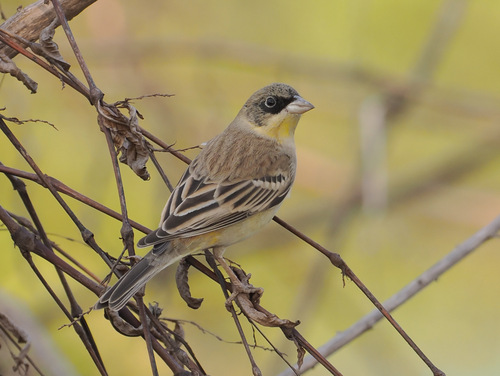 Black-headed Bunting
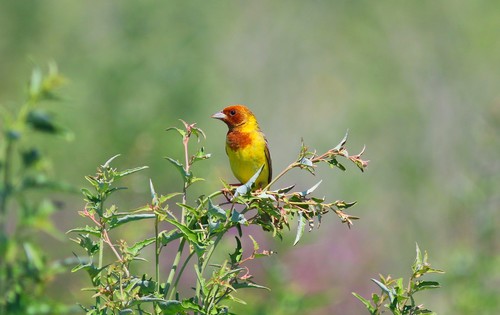 Red-headed Bunting
In short
Separating Black-headed and Red-headed Buntings is straightforward in adult breeding males, but can be extremely challenging in females and immatures, especially outside the breeding season. The most reliable field mark is the head color in adult males: Black-headed Bunting shows a jet-black hood, while Red-headed Bunting has a brownish-red head. For females and juveniles, look for subtle differences in crown streaking, vent color, and cheek contrast, but expect overlap and uncertainty. Both species are similar in structure and behavior, and can only be reliably separated by plumage details in most field situations.
Identification tips
- Adult male head color (breeding season): Black-headed Bunting males have a solid black hood; Red-headed Bunting males have a brownish-red head and face. This is the most reliable field mark when visible.
- Upperparts in adult males: Black-headed shows a chestnut back; Red-headed has greenish upperparts. Check for this in good light.
- Underparts in adult males: Both species have bright yellow underparts, so this is not diagnostic.
- Female and juvenile vent color: Juvenile and female Black-headed Buntings tend to have a yellow vent, which is less pronounced or absent in Red-headed. Use with caution, as overlap exists.
- Cheek vs throat contrast (juveniles): Juvenile Black-headed Buntings often show cheeks darker than the throat; Red-headed juveniles have less contrast. This is subtle and requires close views.
- Crown streaking (first-year females): First-year female Black-headed Buntings have more streaking on the crown than on the lower back; Red-headed females are plainer. This is a minor mark and hard to use in the field.
- First-year male crown: Black-headed Bunting first-year males show a grey crown with chestnut and grey on the back; Red-headed Bunting first-year males are less contrasting. Again, subtle and best seen at close range.
- Overall drabness in females/immatures: Both species' females and juveniles are dull, with washed-out yellow underparts and grey-brown backs. They are extremely similar and often not safely separable.
- Hybrid zone caution: In northern Iran and adjacent areas, hybrids are frequent and may show mixed features, making identification unreliable.
- Size and structure: Both species are similar in size and shape, with long tails and typical bunting structure. Size is not a safe separator.
- Habitat and range: Black-headed Bunting is more westerly (southeast Europe to Iran); Red-headed is more easterly (central Asia). In winter, both occur in India, so range is not always helpful.
- Song and call: Songs and calls are similar and not reliably separable for most birders.
- Flight views: No distinctive wing or flight pattern differences are described for any age; separation in flight relies on plumage details if visible.
- Context: If seen in flocks, check for adult males to help confirm species, as females and juveniles are often inseparable.
- When in doubt: In non-breeding plumage, or with females/juveniles, many individuals cannot be confidently identified to species in the field.
Size
Black-headed Bunting averages slightly heavier (28g vs 24g) but is actually a bit shorter (15 cm vs 17 cm) than Red-headed Bunting. Both have long tails and are larger than Reed Bunting, but the size difference is subtle and not reliable in the field. Structure and proportions are very similar between the two, so size is not a useful separator.
Plumage
In adult breeding males, Black-headed Bunting is unmistakable with its black hood, bright yellow underparts, and chestnut back, while Red-headed Bunting males have a brownish-red head, greenish upperparts, and similarly bright yellow underparts. Females and juveniles of both species are drab, with washed-out yellow underparts and grey-brown backs. Juvenile Black-headed Buntings tend to have a yellow vent and cheeks that are darker than the throat, while Red-headed Bunting juveniles have less cheek contrast and the vent color is less reliably yellow. First-year males of Black-headed Bunting show a grey crown with chestnut and grey on the back, while first-year females have more crown streaking than on the lower back; these details are subtle and often require close views. Both species' females and immatures are extremely similar, and hybrids occur in areas of range overlap.
Behaviour
Both species forage in flocks in open grasslands or agricultural areas, feeding mostly on seeds except when feeding young. They are often seen perched on bushes or flying low over fields. There are no behavioral differences that are useful for field identification.
Habitat
Black-headed Bunting breeds from southeast Europe to Iran, favoring open grasslands, while Red-headed Bunting breeds further east in central Asia, including Kazakhstan, Mongolia, and western China, typically in open scrub and agricultural land. Both winter mainly in India. In areas of range overlap (notably northern Iran), both species and hybrids may occur together, making habitat only weakly diagnostic.
Voice
Both species have similar calls: a single note or soft 'zrit' in Black-headed, and a jerky 'sweet-sweet-churri-churri-churri' song in Red-headed. The songs are not reliably separable in the field for most observers, and calls are not distinctive enough for confident identification.