Birdr

Black-hooded Antshrike vs Russet Antshrike

Thamnophilus bridgesi versus Thamnistes anabatinus

Play a quiz with Black-hooded Antshrike and Russet Antshrike
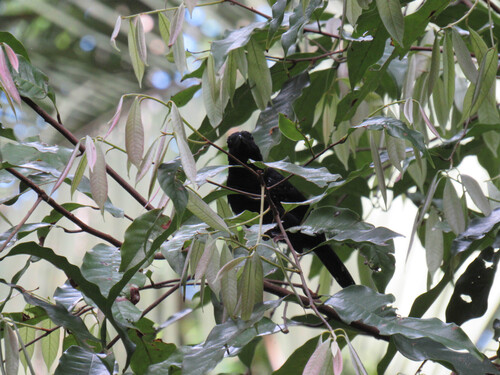
Black-hooded Antshrike (Thamnophilus bridgesi) Black-hooded Antshrike
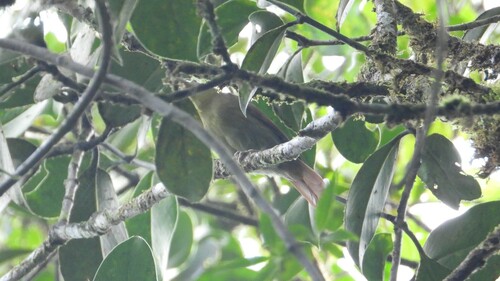
Russet Antshrike (Thamnistes anabatinus) Russet Antshrike

Media

Loading…

In short

The Black-hooded Antshrike and Russet Antshrike can be distinguished by their distinct plumage and habitat preferences. Black-hooded Antshrikes have a striking black hood, while Russet Antshrikes are more uniformly brown and often mistaken for foliage-gleaners. Both species belong to the Thamnophilidae family but differ in their foraging heights and preferred environments.

Identification tips

  1. Look for the black hood and contrasting white underparts of the Black-hooded Antshrike. 2. Note the uniform russet-brown plumage of the Russet Antshrike. 3. Observe the foraging height: Russet Antshrikes are often higher in the canopy. 4. Consider the habitat: Black-hooded Antshrikes prefer denser undergrowth, while Russet Antshrikes are found in foothill forests.

Size

Both species are similar in size, typical of small antbirds.

Plumage

The Black-hooded Antshrike features a distinctive black hood and contrasting white underparts, making it more visually striking. In contrast, the Russet Antshrike is more uniformly brown, with a russet tone that can blend into the foliage, lacking the stark contrast seen in the Black-hooded.

Behaviour

Russet Antshrikes forage at a wider range of heights, often in the canopy and subcanopy, while Black-hooded Antshrikes are typically found lower in the forest strata.

Habitat

Black-hooded Antshrikes are usually found in dense undergrowth of humid forests, whereas Russet Antshrikes prefer evergreen foothill forests and are more common at elevations between 400 m and 1,000 m.

Voice

No specific vocalization differences are noted, but as with many antbirds, vocalizations can be an important identification tool in the field.

Submit a better description

Use the same sections as the comparison. Your text is published immediately.

The Black-hooded Antshrike and Russet Antshrike can be distinguished by their distinct plumage and habitat preferences. Black-hooded Antshrikes have a striking black hood, while Russet Antshrikes are more uniformly brown and often mistaken for foliage-gleaners. Both species belong to the Thamnophilidae family but differ in their foraging heights and preferred environments.

  1. Look for the black hood and contrasting white underparts of the Black-hooded Antshrike. 2. Note the uniform russet-brown plumage of the Russet Antshrike. 3. Observe the foraging height: Russet Antshrikes are often higher in the canopy. 4. Consider the habitat: Black-hooded Antshrikes prefer denser undergrowth, while Russet Antshrikes are found in foothill forests.

Both species are similar in size, typical of small antbirds.

The Black-hooded Antshrike features a distinctive black hood and contrasting white underparts, making it more visually striking. In contrast, the Russet Antshrike is more uniformly brown, with a russet tone that can blend into the foliage, lacking the stark contrast seen in the Black-hooded.

Russet Antshrikes forage at a wider range of heights, often in the canopy and subcanopy, while Black-hooded Antshrikes are typically found lower in the forest strata.

Black-hooded Antshrikes are usually found in dense undergrowth of humid forests, whereas Russet Antshrikes prefer evergreen foothill forests and are more common at elevations between 400 m and 1,000 m.

No specific vocalization differences are noted, but as with many antbirds, vocalizations can be an important identification tool in the field.

Discard your changes?

You have unsaved edits. If you leave now, those changes will be lost.

Black-hooded Antshrike · Russet Antshrike · My Tricky Birds