Birdr

Black Hornbill vs Oriental Pied-Hornbill

Anthracoceros malayanus versus Anthracoceros albirostris

Play a quiz with Black Hornbill and Oriental Pied-Hornbill
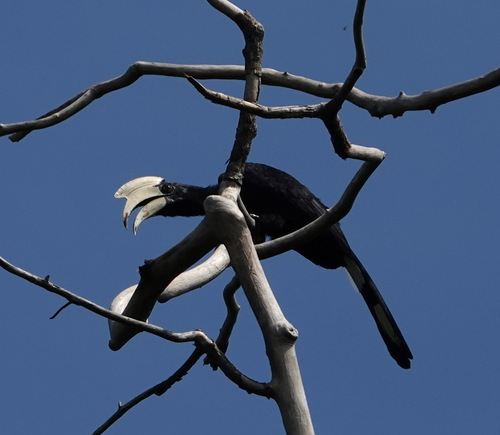
Black Hornbill (Anthracoceros malayanus) Black Hornbill
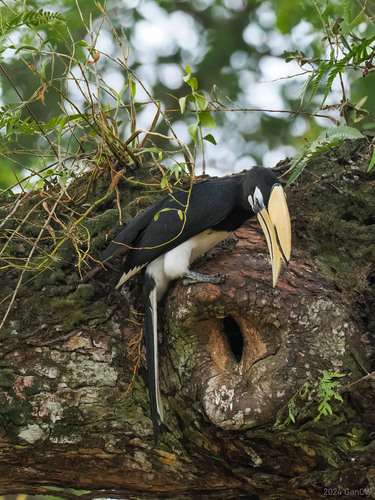
Oriental Pied-Hornbill (Anthracoceros albirostris) Oriental Pied-Hornbill

Media

Loading…

In short

The Black Hornbill and Oriental Pied-Hornbill are both medium-sized hornbills with distinctive bills and similar habitats, but they can be differentiated by their plumage and bill coloration. The Black Hornbill is predominantly black with a white tail tip, while the Oriental Pied-Hornbill has more white on its face and underparts.

Identification tips

  1. Look for the white face and underparts of the Oriental Pied-Hornbill, which contrast with the mostly black plumage of the Black Hornbill. 2. Check the bill coloration: the Oriental Pied-Hornbill often has a more pronounced casque and lighter bill. 3. Observe the tail pattern: the Oriental Pied-Hornbill has a white tail with a black band, while the Black Hornbill's tail is black with a white tip. 4. Note the habitat: if in a more urban or varied environment, it is more likely to be the Oriental Pied-Hornbill.

Size

Both species are similar in size, typical of medium-sized hornbills.

Plumage

The Black Hornbill is mostly black with a white tip on the tail. In contrast, the Oriental Pied-Hornbill has a more prominent white face and underparts, along with a white tail with a black band.

Behaviour

Both species exhibit typical hornbill behavior, such as foraging in pairs or small groups and using their large bills to manipulate food.

Habitat

Both species inhabit similar environments, including forests and forest edges, but the Oriental Pied-Hornbill is more adaptable and can be found in a wider range of habitats, including urban areas.

Voice

Vocalizations are not a primary differentiator in the field, as both species have similar calls typical of hornbills, but the Oriental Pied-Hornbill may be slightly more vocal.

Submit a better description

Use the same sections as the comparison. Your text is published immediately.

The Black Hornbill and Oriental Pied-Hornbill are both medium-sized hornbills with distinctive bills and similar habitats, but they can be differentiated by their plumage and bill coloration. The Black Hornbill is predominantly black with a white tail tip, while the Oriental Pied-Hornbill has more white on its face and underparts.

  1. Look for the white face and underparts of the Oriental Pied-Hornbill, which contrast with the mostly black plumage of the Black Hornbill. 2. Check the bill coloration: the Oriental Pied-Hornbill often has a more pronounced casque and lighter bill. 3. Observe the tail pattern: the Oriental Pied-Hornbill has a white tail with a black band, while the Black Hornbill's tail is black with a white tip. 4. Note the habitat: if in a more urban or varied environment, it is more likely to be the Oriental Pied-Hornbill.

Both species are similar in size, typical of medium-sized hornbills.

The Black Hornbill is mostly black with a white tip on the tail. In contrast, the Oriental Pied-Hornbill has a more prominent white face and underparts, along with a white tail with a black band.

Both species exhibit typical hornbill behavior, such as foraging in pairs or small groups and using their large bills to manipulate food.

Both species inhabit similar environments, including forests and forest edges, but the Oriental Pied-Hornbill is more adaptable and can be found in a wider range of habitats, including urban areas.

Vocalizations are not a primary differentiator in the field, as both species have similar calls typical of hornbills, but the Oriental Pied-Hornbill may be slightly more vocal.

Discard your changes?

You have unsaved edits. If you leave now, those changes will be lost.

Black Hornbill · Oriental Pied-Hornbill · My Tricky Birds