
Black Kite vs Common Buzzard
Milvus migrans versus Buteo buteo
Play a quiz with Black Kite and Common Buzzard
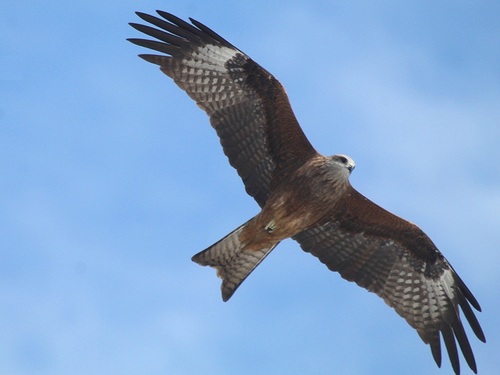 Black Kite
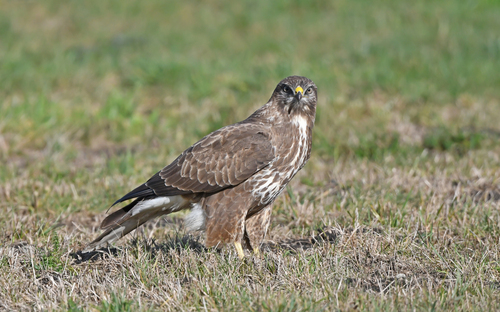 Common Buzzard
In short
The most reliable field mark between Black Kite and Common Buzzard is the tail shape in flight: Black Kite shows a distinctly shallower, less forked tail (almost square or slightly notched), while Common Buzzard has a broad, rounded tail with no fork. Juvenile and adult Black Kites are overall darker and more uniform brown, lacking the variable pale and dark patterning typical of Common Buzzard. In flight, Black Kite’s wings are longer and more angled, with a less pronounced dihedral than the often upturned, broad wings of the Buzzard. When perched, the Black Kite looks sleeker and more slender, while the Buzzard is bulkier and more upright. Both species can be confused at a distance, especially in poor light or with dark morph Buzzards, but careful attention to tail shape and flight style will usually resolve the ID.
Identification tips
- Tail shape in flight: Black Kite has a shallowly forked or almost square tail, never rounded; Common Buzzard’s tail is broad, rounded, and never forked. This is the single most reliable mark, especially in silhouette.
- Flight silhouette: Black Kite is longer-winged, with wings angled slightly back and a more graceful, buoyant flight. Buzzard is broader-winged, with a shorter tail and a more labored, flapping flight.
- Wing posture: Buzzard often soars with wings held in a pronounced dihedral (V-shape); Black Kite’s wings are more level or only slightly angled.
- Plumage uniformity: Black Kite is overall dark brown with little contrast, especially on the underparts; Buzzard is highly variable but usually shows contrasting pale and dark areas, especially on the breast and underwings.
- Underwing pattern (juveniles): Young Buzzards often show pale panels on the underwing and a barred tail; Black Kite juveniles lack these pale panels and have a more uniform dark underwing.
- Head and neck: Black Kite may show a paler head and neck, but never the strong contrast or pale 'U' across the breast seen in many Buzzards.
- Bill and cere: Both have yellow cere, but Black Kite’s bill is black; this is subtle and rarely diagnostic at distance.
- Leg color: Both have yellow legs, not a reliable field mark.
- Perched posture: Buzzard is bulkier, sits upright, and appears more compact; Black Kite is slimmer, often perches with wings drooped or slightly open.
- Behavior: Black Kite is more aerial, often seen gliding or circling for long periods, sometimes in groups; Buzzard is more sedentary, often seen perched or soaring singly.
- Habitat: In urban or scavenging situations, Black Kite is more likely; in woodland or rural farmland, Buzzard is more likely.
- Vocalization: Listen for the Black Kite’s shrill, whinnying whistle versus the Buzzard’s plaintive, mewing call.
- Season and range: In much of Europe, Buzzard is resident and widespread; Black Kite is more common in summer, especially in southern and eastern areas or near water.
- Confusion with dark morph Buzzards: Dark Buzzards can appear very dark, but usually retain some pale patterning or barring, and always have a rounded tail.
- Group behavior: Black Kites may be seen in loose flocks, especially near food sources; Buzzards are rarely social outside migration or communal roosts.
Size
Both species are medium-sized raptors and can overlap in size, but Common Buzzard averages slightly heavier (Buzzard: ~878g, Kite: ~828g [wikidata]). In the field, the Buzzard appears chunkier and more broad-winged, while the Black Kite is slimmer, with longer wings and a more graceful, buoyant flight. These differences are subtle and often masked by posture or distance, so structural and plumage marks are more reliable.
Plumage
Juvenile and adult Black Kites are generally dark brown above and below, with a paler head and neck, and a distinctive streaked appearance from dark feather shafts. The outer flight feathers are black, and the tail is uniformly dark with only a shallow fork. In contrast, Common Buzzard is highly variable but typically shows a mix of pale and dark areas, often with a pale 'U' or crescent across the breast, and barred underparts and tail. Buzzards lack the uniform darkness of the Kite and may show a contrasting carpal patch or paler primary panels, especially in juveniles. Black Kite juveniles do not show the pale underwing panels or strong barring of young Buzzards. In all ages, the Buzzard’s tail is rounded and barred, never forked. Subspecies of Black Kite (e.g., M. m. migrans) may have a paler head, but always lack the rufous or strongly marked patterning of Buzzard.
Behaviour
Black Kite is more aerial, often seen soaring, gliding, and circling with wings held flat or slightly angled, sometimes with a slight dihedral. It is agile, frequently scavenges, and is more likely to be seen in urban or open habitats, sometimes in flocks. Common Buzzard tends to soar with wings held in a pronounced dihedral (V-shape), flaps more heavily, and often perches upright on posts or trees for long periods. Buzzards are less social and more likely to be seen singly or in pairs.
Habitat
Both species can overlap in open country, farmland, and near water, but Black Kite is more tolerant of urban and human-altered environments, often seen scavenging near towns, rubbish dumps, or roads. Common Buzzard prefers mixed woodland, farmland, and open countryside, and is less urbanized. In Europe, Buzzard is often the default medium raptor in rural settings, while Black Kite is more common in southern and eastern regions or near water and settlements.
Voice
Black Kite gives a distinctive shrill whistle followed by a rapid, whinnying call, often heard when circling or near the nest. Common Buzzard has a plaintive, mewing call ('peee-uu'), which is higher-pitched and more drawn out, often repeated and reminiscent of a cat. Calls are useful when birds are vocal, but both can be silent, especially outside breeding season.