
Birdr

Black-legged Kittiwake vs Common Gull

Rissa tridactyla versus Larus canus

Play a quiz with Black-legged Kittiwake and Common Gull
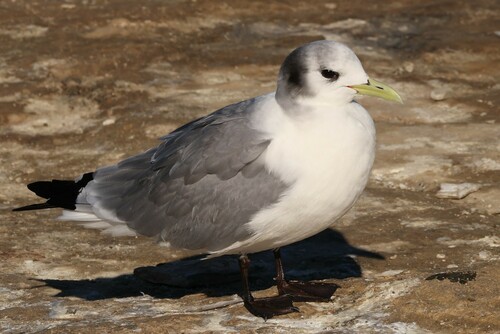
Black-legged Kittiwake (Rissa tridactyla) Black-legged Kittiwake
Common Gull (Larus canus) Common Gull

Media

Loading…

In short

The most reliable field mark for separating Black-legged Kittiwake from Common Gull, especially in flight, is the upperwing pattern in juveniles and immatures: juvenile kittiwakes show a bold black 'W' across the wings, while juvenile common gulls have a more scaly, brownish pattern without a 'W'. Adults are trickier, but kittiwakes have solid black wingtips with no white mirrors, black legs, and a more delicate, tern-like build, while common gulls have yellowish legs, white 'mirrors' in the wingtips, and a chunkier, more typical gull structure. In winter, kittiwakes show a dark smudge behind the eye and a grey hind-neck collar, whereas common gulls have a streaked head and a faint dark bill band. Bill color and leg color are useful but can be misleading in some seasons or ages. Habitat and behavior also help: kittiwakes are strictly pelagic away from breeding cliffs, while common gulls are often inland or in mixed gull flocks.

Identification tips

  1. Juvenile/immature upperwing pattern: Juvenile kittiwakes show a bold black 'W' across the upperwing in flight, with white secondaries and primaries behind it; common gull juveniles have a scaly brown-black pattern without a 'W'. This is the single best mark for young birds.
  2. Tail band in juveniles: Kittiwake juveniles have a solid black terminal tail band; common gull juveniles have a more diffuse, less contrasting tail pattern.
  3. Leg color: Adult kittiwakes have black legs; common gulls have yellowish legs (dull in winter, pinkish in juveniles). However, rare kittiwakes can show pinkish or reddish legs, so use with caution.
  4. Bill color and shape: Adult kittiwakes have a fine, yellow bill (dusky-olive in winter), never with a black band. Common gulls have a thicker, greenish-yellow bill, often with a faint dark band in winter. Juvenile kittiwakes have a solid black bill; juvenile common gulls have a paler, fleshier bill.
  5. Wingtips (adults): Kittiwakes have solid black wingtips with no white 'mirrors'. Common gulls have black wingtips with large white 'mirrors' on p9 and p10. Look for these in perched birds with wings folded or in flight.
  6. Head pattern (winter): Kittiwakes show a dark smudge behind the eye and a grey hind-neck collar in winter. Common gulls have a streaked grey head and no distinct collar.
  7. Structure and jizz: Kittiwakes are daintier, with a more tern-like, buoyant flight, shorter legs, and a finer bill. Common gulls are chunkier, with a more typical gull flight and longer legs.
  8. Habitat: Kittiwakes are almost always at sea or on cliffs; common gulls are often inland, in fields, lakes, or urban areas, and join mixed gull flocks.
  9. Behavior: Kittiwakes rarely scavenge on land and are not seen at dumps or ploughed fields. Common gulls are opportunistic and often feed in such places.
  10. Moult and age progression: Kittiwakes take four years to reach adult plumage, retaining more black in the wings and tail for longer. Common gulls mature in three years (four in some subspecies), with a more rapid loss of juvenile markings.
  11. Voice: If heard, kittiwake's 'kittee-wa-aaake' is unique; common gull's call is a more typical, high-pitched 'laugh'.
  12. Bill mirrors: Absence of white mirrors in kittiwake wingtips vs. prominent mirrors in common gull is a strong adult mark.
  13. Mouth color: Kittiwakes have a rich red mouth lining, sometimes visible in calling birds; not seen in common gull.
  14. Toe count: Kittiwakes have only three toes (hind toe reduced or absent), but this is rarely visible in the field.
  15. Pitfalls: Beware rare kittiwakes with pinkish legs, and that both species can show variable bill and leg color in non-breeding season. Always use a combination of marks, especially for immatures.

Size

Both species are medium-sized gulls, but the Black-legged Kittiwake averages slightly heavier (418 g vs. 386.5 g [wikidata]). In the field, kittiwakes look daintier and more buoyant, with a finer bill and shorter legs, while common gulls appear chunkier and more robust, with a slightly longer wingspan (kittiwake: 91–105 cm, common gull: 100–115 cm [wikipedia]). Size overlap is considerable, so structure is more useful than absolute size.

Plumage

Juvenile and first-winter birds are best separated by upperwing pattern in flight: juvenile kittiwakes have a bold, black 'W' across the wings, with white secondaries and primaries behind the 'W', a black hind-neck collar, and a black tail band. Their bill is solid black. Juvenile common gulls, in contrast, have scaly brown-black upperparts, a neat but less contrasting wing pattern, and pink legs turning greyish in the second year. By first winter, common gulls show a white head and belly with fine streaks, and greyish feathers on the saddle. Adult kittiwakes have white heads and bodies, grey backs, solid black wingtips (no white mirrors), black legs, and a yellow bill (dusky-olive in winter); in winter, they show a grey smudge behind the eye and a grey hind-neck collar. Adult common gulls have a grey mantle, white head (streaked in winter), yellowish legs (duller in winter), and black wingtips with large white 'mirrors' on outer primaries. Bill color is yellowish-green in breeding season, with a faint dark band in winter. Kittiwake bills are finer and lack any black band in adults. Both species take several years to reach full adult plumage, but kittiwake immatures retain more black in the wing and tail for longer.

Behaviour

Black-legged Kittiwakes are almost always seen at sea or on coastal cliffs; they rarely come inland or mix with other gulls at landfills or fields. Their flight is buoyant, tern-like, and often involves gliding with wingtips held slightly downward. Common Gulls are much more versatile: they forage inland, join mixed gull flocks, and have a more typical, direct gull flight with slower, deeper wingbeats. Kittiwakes rarely scavenge on land, while common gulls are opportunistic and often seen feeding on refuse or in agricultural settings.

Habitat

Habitat is often a strong clue: Black-legged Kittiwakes are strictly marine outside the breeding season, found far offshore or on sea cliffs. Seeing a kittiwake inland is rare. Common Gulls breed near water but are frequently seen inland in winter, in fields, lakes, urban parks, and with other gulls. If the bird is inland or with a mixed flock away from the sea, it is almost certainly a common gull.

Voice

Kittiwake's call is a distinctive, shrill 'kittee-wa-aaake', often repeated and easily recognized at colonies. Common Gull has a high-pitched, laughing cry, less shrill and more typical of gulls. Voice is rarely diagnostic at a distance, but the kittiwake's call is unique if heard well.

Submit a better description

Use the same sections as the comparison. Your text is published immediately.

The most reliable field mark for separating Black-legged Kittiwake from Common Gull, especially in flight, is the upperwing pattern in juveniles and immatures: juvenile kittiwakes show a bold black 'W' across the wings, while juvenile common gulls have a more scaly, brownish pattern without a 'W'. Adults are trickier, but kittiwakes have solid black wingtips with no white mirrors, black legs, and a more delicate, tern-like build, while common gulls have yellowish legs, white 'mirrors' in the wingtips, and a chunkier, more typical gull structure. In winter, kittiwakes show a dark smudge behind the eye and a grey hind-neck collar, whereas common gulls have a streaked head and a faint dark bill band. Bill color and leg color are useful but can be misleading in some seasons or ages. Habitat and behavior also help: kittiwakes are strictly pelagic away from breeding cliffs, while common gulls are often inland or in mixed gull flocks.

  1. Juvenile/immature upperwing pattern: Juvenile kittiwakes show a bold black 'W' across the upperwing in flight, with white secondaries and primaries behind it; common gull juveniles have a scaly brown-black pattern without a 'W'. This is the single best mark for young birds.
  2. Tail band in juveniles: Kittiwake juveniles have a solid black terminal tail band; common gull juveniles have a more diffuse, less contrasting tail pattern.
  3. Leg color: Adult kittiwakes have black legs; common gulls have yellowish legs (dull in winter, pinkish in juveniles). However, rare kittiwakes can show pinkish or reddish legs, so use with caution.
  4. Bill color and shape: Adult kittiwakes have a fine, yellow bill (dusky-olive in winter), never with a black band. Common gulls have a thicker, greenish-yellow bill, often with a faint dark band in winter. Juvenile kittiwakes have a solid black bill; juvenile common gulls have a paler, fleshier bill.
  5. Wingtips (adults): Kittiwakes have solid black wingtips with no white 'mirrors'. Common gulls have black wingtips with large white 'mirrors' on p9 and p10. Look for these in perched birds with wings folded or in flight.
  6. Head pattern (winter): Kittiwakes show a dark smudge behind the eye and a grey hind-neck collar in winter. Common gulls have a streaked grey head and no distinct collar.
  7. Structure and jizz: Kittiwakes are daintier, with a more tern-like, buoyant flight, shorter legs, and a finer bill. Common gulls are chunkier, with a more typical gull flight and longer legs.
  8. Habitat: Kittiwakes are almost always at sea or on cliffs; common gulls are often inland, in fields, lakes, or urban areas, and join mixed gull flocks.
  9. Behavior: Kittiwakes rarely scavenge on land and are not seen at dumps or ploughed fields. Common gulls are opportunistic and often feed in such places.
  10. Moult and age progression: Kittiwakes take four years to reach adult plumage, retaining more black in the wings and tail for longer. Common gulls mature in three years (four in some subspecies), with a more rapid loss of juvenile markings.
  11. Voice: If heard, kittiwake's 'kittee-wa-aaake' is unique; common gull's call is a more typical, high-pitched 'laugh'.
  12. Bill mirrors: Absence of white mirrors in kittiwake wingtips vs. prominent mirrors in common gull is a strong adult mark.
  13. Mouth color: Kittiwakes have a rich red mouth lining, sometimes visible in calling birds; not seen in common gull.
  14. Toe count: Kittiwakes have only three toes (hind toe reduced or absent), but this is rarely visible in the field.
  15. Pitfalls: Beware rare kittiwakes with pinkish legs, and that both species can show variable bill and leg color in non-breeding season. Always use a combination of marks, especially for immatures.

Both species are medium-sized gulls, but the Black-legged Kittiwake averages slightly heavier (418 g vs. 386.5 g [wikidata]). In the field, kittiwakes look daintier and more buoyant, with a finer bill and shorter legs, while common gulls appear chunkier and more robust, with a slightly longer wingspan (kittiwake: 91–105 cm, common gull: 100–115 cm [wikipedia]). Size overlap is considerable, so structure is more useful than absolute size.

Juvenile and first-winter birds are best separated by upperwing pattern in flight: juvenile kittiwakes have a bold, black 'W' across the wings, with white secondaries and primaries behind the 'W', a black hind-neck collar, and a black tail band. Their bill is solid black. Juvenile common gulls, in contrast, have scaly brown-black upperparts, a neat but less contrasting wing pattern, and pink legs turning greyish in the second year. By first winter, common gulls show a white head and belly with fine streaks, and greyish feathers on the saddle. Adult kittiwakes have white heads and bodies, grey backs, solid black wingtips (no white mirrors), black legs, and a yellow bill (dusky-olive in winter); in winter, they show a grey smudge behind the eye and a grey hind-neck collar. Adult common gulls have a grey mantle, white head (streaked in winter), yellowish legs (duller in winter), and black wingtips with large white 'mirrors' on outer primaries. Bill color is yellowish-green in breeding season, with a faint dark band in winter. Kittiwake bills are finer and lack any black band in adults. Both species take several years to reach full adult plumage, but kittiwake immatures retain more black in the wing and tail for longer.

Black-legged Kittiwakes are almost always seen at sea or on coastal cliffs; they rarely come inland or mix with other gulls at landfills or fields. Their flight is buoyant, tern-like, and often involves gliding with wingtips held slightly downward. Common Gulls are much more versatile: they forage inland, join mixed gull flocks, and have a more typical, direct gull flight with slower, deeper wingbeats. Kittiwakes rarely scavenge on land, while common gulls are opportunistic and often seen feeding on refuse or in agricultural settings.

Habitat is often a strong clue: Black-legged Kittiwakes are strictly marine outside the breeding season, found far offshore or on sea cliffs. Seeing a kittiwake inland is rare. Common Gulls breed near water but are frequently seen inland in winter, in fields, lakes, urban parks, and with other gulls. If the bird is inland or with a mixed flock away from the sea, it is almost certainly a common gull.

Kittiwake's call is a distinctive, shrill 'kittee-wa-aaake', often repeated and easily recognized at colonies. Common Gull has a high-pitched, laughing cry, less shrill and more typical of gulls. Voice is rarely diagnostic at a distance, but the kittiwake's call is unique if heard well.

Discard your changes?

You have unsaved edits. If you leave now, those changes will be lost.

Black-legged Kittiwake · Common Gull · My Tricky Birds