Birdr

Black-legged Kittiwake vs Sabine's Gull

Rissa tridactyla versus Xema sabini

Play a quiz with Black-legged Kittiwake and Sabine's Gull
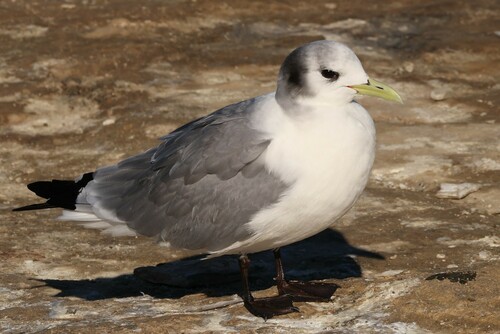
Black-legged Kittiwake (Rissa tridactyla) Black-legged Kittiwake
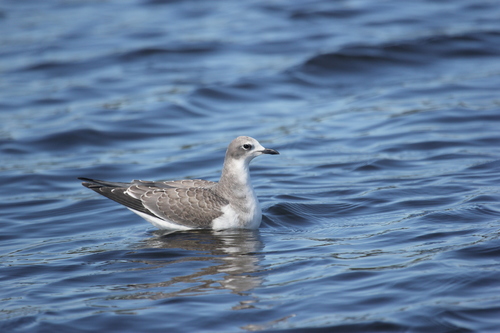
Sabine's Gull (Xema sabini) Sabine's Gull

Media

Loading…

In short

The Black-legged Kittiwake and Sabine's Gull can be distinguished primarily by their tail shape and bill coloration. The Kittiwake has a straight tail and a plain black bill, while Sabine's Gull features a distinctive notched tail and a black bill with a yellow tip.

Identification tips

  1. Look for the tail shape: Sabine's Gull has a notched tail, while the Kittiwake's tail is straight. 2. Check the bill color: Sabine's Gull has a black bill with a yellow tip, unlike the all-black bill of the Kittiwake. 3. Observe the wing pattern: Sabine's Gull has a white triangle on the wings, which is absent in Kittiwakes. 4. Consider the habitat: Kittiwakes are often seen on cliffs or at sea, while Sabine's Gulls are more likely in tundra or during migration over water.

Size

Both species are small gulls, but the Black-legged Kittiwake is slightly larger and more robust than the more delicate Sabine's Gull.

Plumage

Black-legged Kittiwakes have a clean white head and underparts with grey wings and a black wingtip. Sabine's Gulls have a striking black hood during breeding, a grey back, and a distinctive white triangle on the wings.

Behaviour

Sabine's Gull exhibits behaviors more akin to shorebirds and terns, such as distraction displays and feeding on mudflats. Black-legged Kittiwakes are more typical of gulls, often seen in large flocks at sea.

Habitat

Black-legged Kittiwakes are typically found in coastal and pelagic environments, often nesting on cliffs. Sabine's Gulls breed in the Arctic tundra and are seen during migration over open ocean and coastal areas.

Voice

Vocalizations are not well-documented in the sources, but Sabine's Gull is noted for calls similar to terns, while Kittiwakes have a more typical gull-like call.

Submit a better description

Use the same sections as the comparison. Your text is published immediately.

The Black-legged Kittiwake and Sabine's Gull can be distinguished primarily by their tail shape and bill coloration. The Kittiwake has a straight tail and a plain black bill, while Sabine's Gull features a distinctive notched tail and a black bill with a yellow tip.

  1. Look for the tail shape: Sabine's Gull has a notched tail, while the Kittiwake's tail is straight. 2. Check the bill color: Sabine's Gull has a black bill with a yellow tip, unlike the all-black bill of the Kittiwake. 3. Observe the wing pattern: Sabine's Gull has a white triangle on the wings, which is absent in Kittiwakes. 4. Consider the habitat: Kittiwakes are often seen on cliffs or at sea, while Sabine's Gulls are more likely in tundra or during migration over water.

Both species are small gulls, but the Black-legged Kittiwake is slightly larger and more robust than the more delicate Sabine's Gull.

Black-legged Kittiwakes have a clean white head and underparts with grey wings and a black wingtip. Sabine's Gulls have a striking black hood during breeding, a grey back, and a distinctive white triangle on the wings.

Sabine's Gull exhibits behaviors more akin to shorebirds and terns, such as distraction displays and feeding on mudflats. Black-legged Kittiwakes are more typical of gulls, often seen in large flocks at sea.

Black-legged Kittiwakes are typically found in coastal and pelagic environments, often nesting on cliffs. Sabine's Gulls breed in the Arctic tundra and are seen during migration over open ocean and coastal areas.

Vocalizations are not well-documented in the sources, but Sabine's Gull is noted for calls similar to terns, while Kittiwakes have a more typical gull-like call.

Discard your changes?

You have unsaved edits. If you leave now, those changes will be lost.

Black-legged Kittiwake · Sabine's Gull · My Tricky Birds