Birdr

Black-nest Swiftlet vs Asian Palm Swift

Aerodramus maximus versus Cypsiurus balasiensis

Play a quiz with Black-nest Swiftlet and Asian Palm Swift
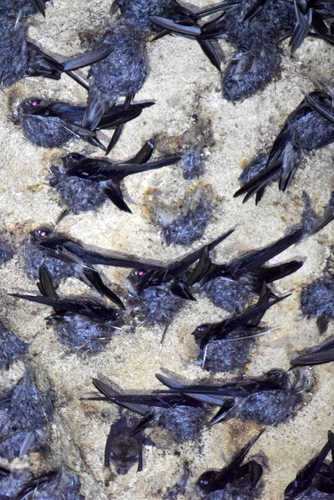
Black-nest Swiftlet (Aerodramus maximus) Black-nest Swiftlet
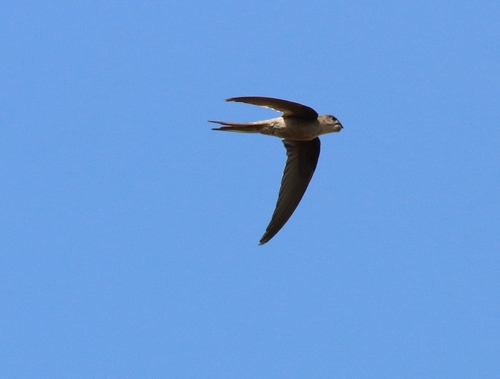
Asian Palm Swift (Cypsiurus balasiensis) Asian Palm Swift

Media

Loading…

In short

The Black-nest Swiftlet and Asian Palm Swift can be distinguished by their tail shape and nesting habits. The Black-nest Swiftlet has a slightly forked tail, whereas the Asian Palm Swift has a deeply forked tail. Both species are similar in size and color, making these structural differences key for identification.

Identification tips

  1. Tail Shape: Look for the tail shape; Black-nest Swiftlet has a slightly forked tail, whereas Asian Palm Swift has a deeply forked tail. 2. Nesting Habits: Observe nesting behavior if possible; Black-nest Swiftlets nest in caves, while Asian Palm Swifts nest in palm trees. 3. Habitat: Consider the habitat; presence near limestone caves suggests Black-nest Swiftlet, while open areas with palms suggest Asian Palm Swift.

Size

Both species are similar in size, typical of small swifts.

Plumage

Both species have dark, uniform plumage, making color a less reliable distinguishing feature.

Behaviour

The Black-nest Swiftlet often nests in caves, while the Asian Palm Swift is known for nesting in palm trees, often weaving its nest into the underside of palm leaves.

Habitat

Black-nest Swiftlets are typically found near limestone caves, whereas Asian Palm Swifts are more associated with open areas with palm trees.

Voice

Vocalizations are not a primary distinguishing feature between these species in the field.

Submit a better description

Use the same sections as the comparison. Your text is published immediately.

The Black-nest Swiftlet and Asian Palm Swift can be distinguished by their tail shape and nesting habits. The Black-nest Swiftlet has a slightly forked tail, whereas the Asian Palm Swift has a deeply forked tail. Both species are similar in size and color, making these structural differences key for identification.

  1. Tail Shape: Look for the tail shape; Black-nest Swiftlet has a slightly forked tail, whereas Asian Palm Swift has a deeply forked tail. 2. Nesting Habits: Observe nesting behavior if possible; Black-nest Swiftlets nest in caves, while Asian Palm Swifts nest in palm trees. 3. Habitat: Consider the habitat; presence near limestone caves suggests Black-nest Swiftlet, while open areas with palms suggest Asian Palm Swift.

Both species are similar in size, typical of small swifts.

Both species have dark, uniform plumage, making color a less reliable distinguishing feature.

The Black-nest Swiftlet often nests in caves, while the Asian Palm Swift is known for nesting in palm trees, often weaving its nest into the underside of palm leaves.

Black-nest Swiftlets are typically found near limestone caves, whereas Asian Palm Swifts are more associated with open areas with palm trees.

Vocalizations are not a primary distinguishing feature between these species in the field.

Discard your changes?

You have unsaved edits. If you leave now, those changes will be lost.

Black-nest Swiftlet · Asian Palm Swift · My Tricky Birds