Birdr

Black Oystercatcher vs Surfbird

Haematopus bachmani versus Calidris virgata

Play a quiz with Black Oystercatcher and Surfbird
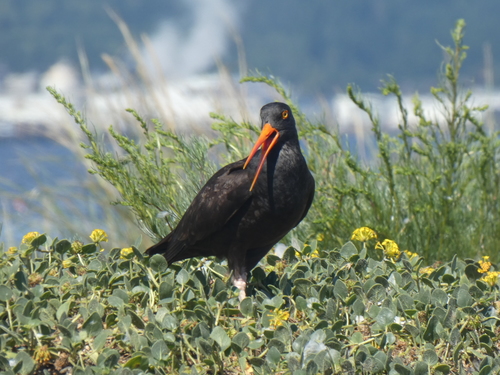
Black Oystercatcher (Haematopus bachmani) Black Oystercatcher
Surfbird (Calidris virgata) Surfbird

Media

Loading…

In short

The Black Oystercatcher and Surfbird are both coastal birds but differ significantly in appearance and behavior. The Black Oystercatcher is easily identified by its entirely black plumage and bright orange bill, while the Surfbird has a mottled gray and white appearance with a shorter, yellowish bill. Both species can be found along rocky shorelines, but their feeding habits and vocalizations also help distinguish them.

Identification tips

  1. Look for the bright orange bill and uniform black plumage of the Black Oystercatcher. 2. Note the mottled gray and white plumage and yellowish bill of the Surfbird. 3. Observe behavior: Black Oystercatchers use their bills to open mollusks, while Surfbirds forage in flocks. 4. Listen for the loud, whistling call of the Black Oystercatcher.

Size

The Black Oystercatcher is larger and more robust than the Surfbird, with a longer bill and legs.

Plumage

Black Oystercatcher is uniformly black with a striking orange bill and pink legs. The Surfbird has a mottled gray and white plumage, with a white belly and a shorter, yellowish bill.

Behaviour

Black Oystercatchers are often seen alone or in pairs, using their strong bills to pry open mollusks. Surfbirds are more likely to be seen in flocks, foraging on rocky shores for invertebrates.

Habitat

Both species inhabit rocky coastlines, but Black Oystercatchers are more strictly tied to these environments, while Surfbirds may also be found on sandy beaches during migration.

Voice

Black Oystercatchers have a loud, whistling call, often heard in flight. Surfbird vocalizations are less distinctive and not as frequently heard.

Submit a better description

Use the same sections as the comparison. Your text is published immediately.

The Black Oystercatcher and Surfbird are both coastal birds but differ significantly in appearance and behavior. The Black Oystercatcher is easily identified by its entirely black plumage and bright orange bill, while the Surfbird has a mottled gray and white appearance with a shorter, yellowish bill. Both species can be found along rocky shorelines, but their feeding habits and vocalizations also help distinguish them.

  1. Look for the bright orange bill and uniform black plumage of the Black Oystercatcher. 2. Note the mottled gray and white plumage and yellowish bill of the Surfbird. 3. Observe behavior: Black Oystercatchers use their bills to open mollusks, while Surfbirds forage in flocks. 4. Listen for the loud, whistling call of the Black Oystercatcher.

The Black Oystercatcher is larger and more robust than the Surfbird, with a longer bill and legs.

Black Oystercatcher is uniformly black with a striking orange bill and pink legs. The Surfbird has a mottled gray and white plumage, with a white belly and a shorter, yellowish bill.

Black Oystercatchers are often seen alone or in pairs, using their strong bills to pry open mollusks. Surfbirds are more likely to be seen in flocks, foraging on rocky shores for invertebrates.

Both species inhabit rocky coastlines, but Black Oystercatchers are more strictly tied to these environments, while Surfbirds may also be found on sandy beaches during migration.

Black Oystercatchers have a loud, whistling call, often heard in flight. Surfbird vocalizations are less distinctive and not as frequently heard.

Discard your changes?

You have unsaved edits. If you leave now, those changes will be lost.

Black Oystercatcher · Surfbird · My Tricky Birds