Black Redstart vs European Stonechat
Phoenicurus ochruros versus Saxicola rubicola
Play a quiz with Black Redstart and European Stonechat
Black Redstart
European Stonechat
In short
The Black Redstart and European Stonechat can be tricky to differentiate, especially in non-breeding plumages. The most reliable field mark is the tail color: Black Redstarts have a distinctive orange-red tail, while European Stonechats have a darker, less conspicuous tail. Both species are small, but their behavior and habitat preferences can also aid in identification.
Identification tips
- Tail color: Look for the orange-red tail of the Black Redstart.
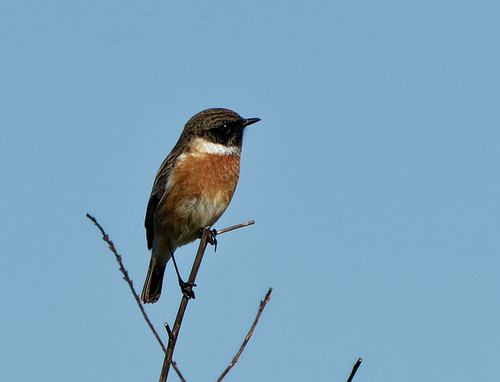
- Head and back color: European Stonechats have a darker head and back with a white collar.
- Habitat: Note the setting; urban areas suggest Black Redstart, while open fields suggest European Stonechat.
- Behavior: Watch for tail flicking in Black Redstarts and wing flicking in European Stonechats.
- Vocalizations: Listen for the scratchy song of the Black Redstart versus the 'chat' call of the European Stonechat.
Size
Both species are similar in size, typical of small passerines, with no significant difference in structure.
Plumage
Black Redstarts have a dark grey to black body with a striking orange-red tail, while European Stonechats feature a darker head and back with a more contrasting white collar and less vibrant tail. Females and juveniles of both species are more subdued in color, making them harder to distinguish.
Behaviour
Black Redstarts often exhibit a distinctive tail flicking behavior and are more likely to be seen on urban structures. European Stonechats are more likely to be seen perched on low vegetation, often flicking their wings.
Habitat
Black Redstarts are frequently found in urban areas, rocky landscapes, and open country with buildings. European Stonechats prefer open fields, heathlands, and scrubby areas, often avoiding urban settings.
Voice
Black Redstarts have a distinctive, scratchy song and a 'ticking' call, while European Stonechats produce a sharp 'chat' call, often likened to two stones being knocked together.