Black Scoter vs Bufflehead
Melanitta americana versus Bucephala albeola
Play a quiz with Black Scoter and Bufflehead
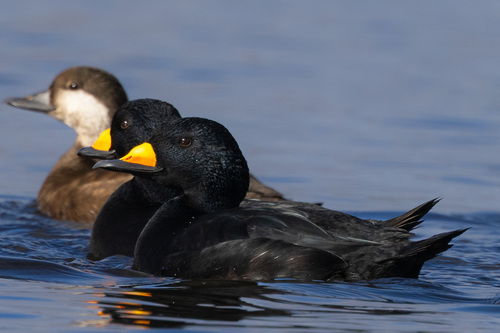
Black Scoter
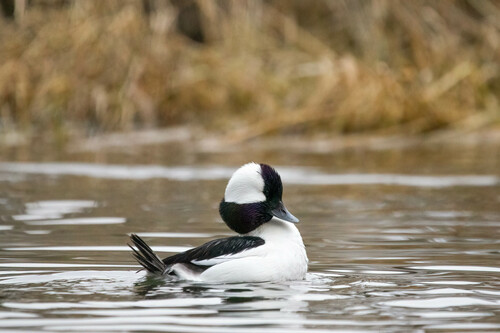
Bufflehead
In short
The Black Scoter and Bufflehead are both small sea ducks, but they can be distinguished by the male Black Scoter's distinctive yellow-orange knob at the base of its bill and the Bufflehead's striking white patch on the head. Both species have different vocalizations, with the Black Scoter males known for their mellow, plaintive whistles.
Identification tips
- Look for the yellow-orange knob on the bill of male Black Scoters. 2. Note the large white head patch on male Buffleheads. 3. Observe the habitat: Black Scoters in coastal waters, Buffleheads in freshwater or coastal areas. 4. Listen for the Black Scoter's distinctive whistling calls.
Size
Black Scoter is slightly larger than the Bufflehead.
Plumage
Male Black Scoters are mostly black with a notable yellow-orange knob on the bill, while females are dark brown with lighter cheeks. Male Buffleheads have a striking iridescent green and purple head with a large white patch, and females are gray-brown with a small white cheek patch.
Behaviour
Black Scoters often form large, monospecific flocks in coastal waters during winter, while Buffleheads are more likely to be seen in smaller groups or pairs.
Habitat
Black Scoters are typically found in shallow coastal waters, especially during winter. Buffleheads prefer smaller bodies of freshwater, such as ponds and lakes, but can also be found in coastal areas during migration and winter.
Voice
Black Scoters are among the most vocal waterfowl, with males producing mellow, plaintive whistles. Buffleheads are generally quieter, with softer calls.