Black Scoter vs Long-tailed Duck
Melanitta americana versus Clangula hyemalis
Play a quiz with Black Scoter and Long-tailed Duck
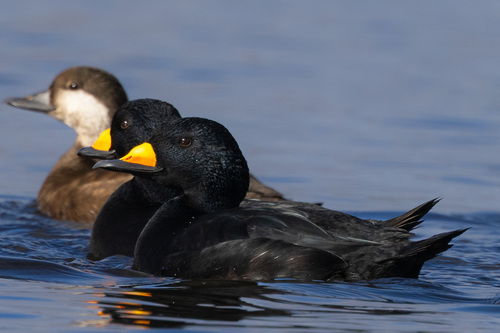
Black Scoter
Long-tailed Duck
In short
The Black Scoter and Long-tailed Duck can be distinguished by the male Long-tailed Duck's distinctive elongated central tail feathers and seasonal plumage changes. The Black Scoter is less variable in plumage and lacks the long tail feathers.
Identification tips
- Look for the male Long-tailed Duck's elongated central tail feathers, especially in winter.
- Note the seasonal plumage changes in Long-tailed Ducks, with a bright-pink band on the bill in breeding males.
- Listen for the nasal call of the Long-tailed Duck, distinct from the Black Scoter's whistling.
- Observe flocking behavior: Black Scoters often form large, monospecific flocks.
Size
Both species are similar in size, but the Long-tailed Duck may appear slightly more slender due to its elongated tail feathers.
Plumage
Male Long-tailed Ducks have striking seasonal plumage changes, with a bright-pink band on the bill and elongated tail feathers in winter. In contrast, Black Scoters are more uniformly dark, with females showing a dark cap and light cheeks.
Behaviour
Black Scoters often form large, monospecific flocks in winter, while Long-tailed Ducks are known for their distinctive nasal calls and can be found in both coastal and tundra habitats.
Habitat
Both species are found in coastal waters during winter, but Long-tailed Ducks also breed in tundra regions, whereas Black Scoters are more coastal year-round.
Voice
Black Scoters are known for their mellow, plaintive whistling, while Long-tailed Ducks have a distinctive nasal call that carries over long distances.