
Birdr

Black-tailed Gnatcatcher vs Black-capped Gnatcatcher

Polioptila melanura versus Polioptila nigriceps

Play a quiz with Black-tailed Gnatcatcher and Black-capped Gnatcatcher
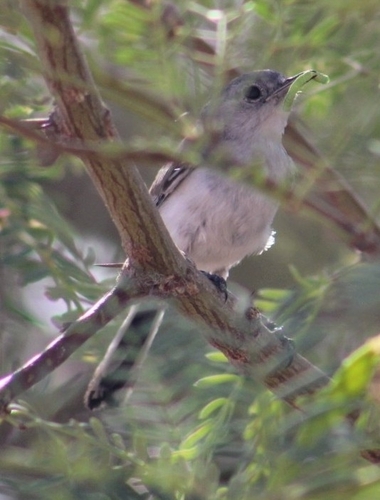
Black-tailed Gnatcatcher (Polioptila melanura) Black-tailed Gnatcatcher
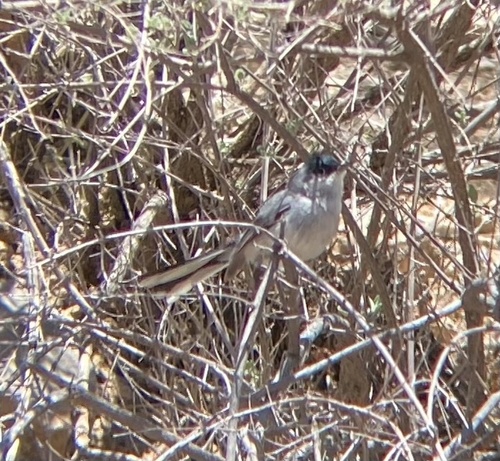
Black-capped Gnatcatcher (Polioptila nigriceps) Black-capped Gnatcatcher

Media

Loading…

In short

The Black-tailed Gnatcatcher and Black-capped Gnatcatcher are small, active birds often found in arid regions. The most reliable field mark is the male Black-capped Gnatcatcher's extensive black cap, which contrasts with its pale eye-ring, unlike the Black-tailed Gnatcatcher.

Identification tips

Size

Both species are similarly small and slender, typical of gnatcatchers.

Plumage

Male Black-capped Gnatcatchers have a glossy black cap extending below the eyes, contrasting with a pale eye-ring. Female Black-capped Gnatcatchers and Black-tailed Gnatcatchers have less distinct head markings, with the latter lacking the extensive black cap.

Behaviour

Both species are active foragers, often seen flitting and darting in search of insects. Black-tailed Gnatcatchers are known for their tail-wagging behavior.

Habitat

Black-tailed Gnatcatchers inhabit dense thorn scrub and thickets in the Desert Southwest. Black-capped Gnatcatchers are found in similar arid habitats but may move south post-breeding.

Voice

The Black-tailed Gnatcatcher is noted for its 'zhee-zhee-zhee' call. Specific vocal differences with the Black-capped Gnatcatcher are less documented.

Submit a better description

Use the same sections as the comparison. Your text is published immediately.

The Black-tailed Gnatcatcher and Black-capped Gnatcatcher are small, active birds often found in arid regions. The most reliable field mark is the male Black-capped Gnatcatcher's extensive black cap, which contrasts with its pale eye-ring, unlike the Black-tailed Gnatcatcher.

  • Male Black-capped Gnatcatcher: Look for the extensive black cap and pale eye-ring.
  • Female and nonbreeding males: More challenging; focus on habitat and behavior.
  • Tail behavior: Black-tailed Gnatcatchers often wag their tails side to side.
  • Habitat: Consider location; Black-tailed Gnatcatchers are more common in the U.S. Desert Southwest.

Both species are similarly small and slender, typical of gnatcatchers.

Male Black-capped Gnatcatchers have a glossy black cap extending below the eyes, contrasting with a pale eye-ring. Female Black-capped Gnatcatchers and Black-tailed Gnatcatchers have less distinct head markings, with the latter lacking the extensive black cap.

Both species are active foragers, often seen flitting and darting in search of insects. Black-tailed Gnatcatchers are known for their tail-wagging behavior.

Black-tailed Gnatcatchers inhabit dense thorn scrub and thickets in the Desert Southwest. Black-capped Gnatcatchers are found in similar arid habitats but may move south post-breeding.

The Black-tailed Gnatcatcher is noted for its 'zhee-zhee-zhee' call. Specific vocal differences with the Black-capped Gnatcatcher are less documented.

Discard your changes?

You have unsaved edits. If you leave now, those changes will be lost.

Black-tailed Gnatcatcher · Black-capped Gnatcatcher · My Tricky Birds