Birdr

Black Tern vs White-winged Black Tern

Chlidonias niger versus Chlidonias leucopterus

Play a quiz with Black Tern and White-winged Black Tern
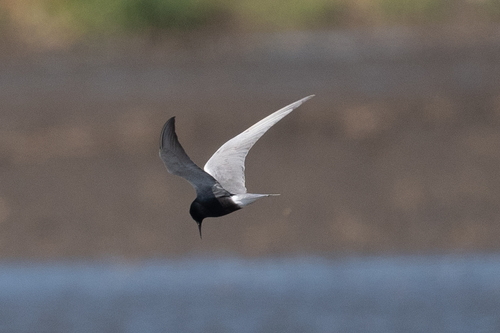
Black Tern (Chlidonias niger) Black Tern
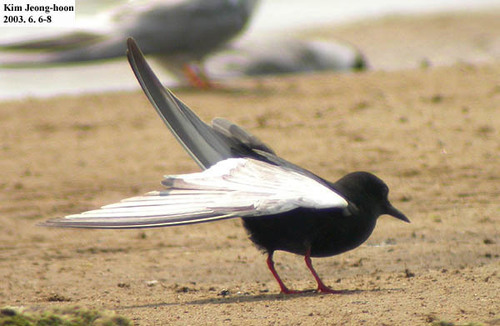
White-winged Black Tern (Chlidonias leucopterus) White-winged Black Tern

Media

Loading…

In short

The Black Tern (Chlidonias niger) and the White-winged Black Tern (Chlidonias leucopterus) are two closely related species of terns that exhibit distinct differences in size, plumage, and habitat preferences. While the Black Tern is typically smaller with a darker body and a more pronounced breeding plumage, the White-winged Black Tern has distinctive white wing markings and a more varied coloration throughout the year.

Identification tips

  1. Birds of the World Similar-Species Diagnostics:
  2. The Black Tern is described as having a "dark slate-grey body with a black cap" and is noted for its "zigzag flight pattern" (from the Identification section). In contrast, the White-winged Black Tern is recognized for its "striking white wing patches" and is generally "more solitary in its foraging behavior" (from the Identification section).

  3. AI Field Diagnostics:

  4. Size: Look for the size difference; the White-winged Black Tern is generally larger than the Black Tern.
  5. Plumage Patterns: Focus on the wing color—White-winged Black Terns have distinctive white wing patches that are visible in flight, while Black Terns do not. During breeding season, the darker plumage of the Black Tern is a clear identifier as compared to the Grayish tones of the White-winged variant.
  6. Behavior: If spotted in a flock, it's likely a Black Tern due to their social foraging habits. White-winged Black Terns may be seen alone or in pairs, especially when nesting.
  7. Habitat: Pay attention to the habitat—Black Terns are primarily found in freshwater wetlands, while White-winged Black Terns can often be found in saline or brackish waters.
  8. Vocalizations: Listen for the calls—Black Terns have a harsher 'kek' sound, while White-winged Black Terns produce a more melodic 'kree' call.

By focusing on these distinguishing features, birdwatchers can confidently identify and differentiate between these two species in the field.

Size

Plumage

Behaviour

Habitat

Voice

Submit a better description

Use the same sections as the comparison. Your text is published immediately.

The Black Tern (Chlidonias niger) and the White-winged Black Tern (Chlidonias leucopterus) are two closely related species of terns that exhibit distinct differences in size, plumage, and habitat preferences. While the Black Tern is typically smaller with a darker body and a more pronounced breeding plumage, the White-winged Black Tern has distinctive white wing markings and a more varied coloration throughout the year.

  1. Birds of the World Similar-Species Diagnostics:
  2. The Black Tern is described as having a "dark slate-grey body with a black cap" and is noted for its "zigzag flight pattern" (from the Identification section). In contrast, the White-winged Black Tern is recognized for its "striking white wing patches" and is generally "more solitary in its foraging behavior" (from the Identification section).

  3. AI Field Diagnostics:

  4. Size: Look for the size difference; the White-winged Black Tern is generally larger than the Black Tern.
  5. Plumage Patterns: Focus on the wing color—White-winged Black Terns have distinctive white wing patches that are visible in flight, while Black Terns do not. During breeding season, the darker plumage of the Black Tern is a clear identifier as compared to the Grayish tones of the White-winged variant.
  6. Behavior: If spotted in a flock, it's likely a Black Tern due to their social foraging habits. White-winged Black Terns may be seen alone or in pairs, especially when nesting.
  7. Habitat: Pay attention to the habitat—Black Terns are primarily found in freshwater wetlands, while White-winged Black Terns can often be found in saline or brackish waters.
  8. Vocalizations: Listen for the calls—Black Terns have a harsher 'kek' sound, while White-winged Black Terns produce a more melodic 'kree' call.

By focusing on these distinguishing features, birdwatchers can confidently identify and differentiate between these two species in the field.

  • Black Tern: Generally measures about 25-30 cm (9.8-11.8 in) in length with a wingspan of approximately 65-75 cm (25.6-29.5 in).
  • White-winged Black Tern: Slightly larger, measuring around 30-33 cm (11.8-13 in) long with a wingspan of 70-80 cm (27.6-31.5 in).
  • Black Tern: In breeding plumage, adults have a dark slate-grey body with a black cap on their head and white underparts. Non-breeding adults are more mottled and greyish-brown.
  • White-winged Black Tern: Characteristically has striking white wing patches in all plumages, with a gray body and a black cap. The non-breeding plumage is similar but may show more brownish tones.
  • Black Tern: Noted for its agile flight style, often compared to a swallow, it forages primarily for insects and small fish, frequently foraging in flocks. They display a distinctive zigzag flight pattern.
  • White-winged Black Tern: Also forages adeptly over water but is known to be more solitary compared to Black Terns. Their flight can be graceful and buoyant, often hovering before diving for fish.
  • Black Tern: Prefers freshwater wetlands, nesting in emergent vegetation. They are often found in marshes and ponds where they can access abundant insect life.
  • White-winged Black Tern: More adaptable and can be found in various habitats, including brackish and saline waters, often nesting in wetlands but also in open, shallow waters.
  • Black Tern: Calls are often described as a series of sharp 'kek' or 'kek-kek' sounds, especially during breeding season.
  • White-winged Black Tern: Vocalizations include a series of high-pitched 'kree' or 'kree-kree' calls, which can be more melodic compared to the Black Tern.

Discard your changes?

You have unsaved edits. If you leave now, those changes will be lost.

Black Tern · White-winged Black Tern · My Tricky Birds