
Black-throated Thrush vs Red-throated Thrush
Turdus atrogularis versus Turdus ruficollis
Play a quiz with Black-throated Thrush and Red-throated Thrush
 Black-throated Thrush
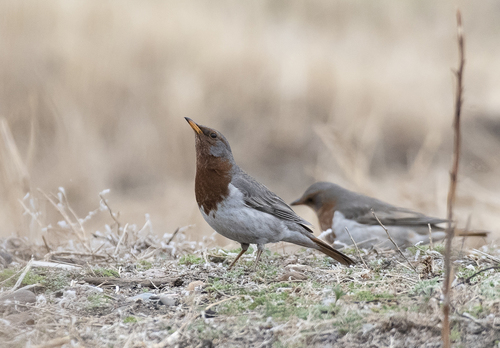 Red-throated Thrush
In short
The most reliable field mark between Black-throated Thrush and Red-throated Thrush is the color of the throat in adult males: Black-throated shows a solid black throat and upper breast, while Red-throated has a rich red throat patch. Females and immatures of both species are trickier, as they lack the bold bibs and instead show dusky or streaked throats, making separation much more challenging. Both species have grey upperparts and pale underparts, but the underwing color is orange-red in Black-throated and reddish in Red-throated. In the field, focus on throat color and pattern first, then check underwing color and overall tone. Watch for age-related variation and beware that immature birds can be especially difficult to separate.
Identification tips
- Adult male throat color: The single best field mark. Black-throated Thrush males have a solid black throat and upper breast; Red-throated Thrush males have a rich red throat patch. This is diagnostic when seen well.
- Female and immature throat pattern: Both lack the bold bibs and instead show dusky or blackish streaking on the throat and upper breast. This makes them very difficult to separate; do not rely on throat color alone in these ages.
- Underwing color: Both species show reddish tones in the underwing coverts, but Black-throated tends toward orange-red, while Red-throated is more reddish. This difference is subtle and not always reliable in the field, especially in poor light or on fast-moving birds.
- Upperparts and underparts: Both have plain grey backs and pale underparts. These features are not useful for separation.
- Tail and bill structure: No consistent differences; both have similar tail shape and bill size typical of Turdus thrushes.
- Flight views: No distinctive wing pattern or panel for either species at any age. Both show reddish or orange-red underwings, but this is not a strong separator.
- Sex and age pitfalls: Only adult males are reliably separated by throat color. Females and immatures of both species are very similar and often not safely identified without close, prolonged views or in-hand examination.
- Seasonal context: In winter, both species can occur together in mixed flocks, especially in southern parts of their range. Do not assume species based on season alone.
- Geographic context: Black-throated is more westerly, Red-throated more easterly in breeding season, but both can occur as vagrants far outside typical ranges.
- Behavior: Both species behave similarly and often join mixed thrush flocks. Behavior is not a separator.
- Habitat: Both use similar habitats, especially in winter and migration. Do not rely on habitat for separation.
- Voice: No distinctive vocal differences are described in the sources; do not use voice for separation.
- Pitfall – overreliance on throat color in non-males: Only use throat color as a separator in adult males. Females and immatures are not safely identified by this mark.
- Pitfall – underwing color: Underwing color is subtle and variable; use only as a supporting mark, not a primary separator.
- Best practice: For adult males, focus on throat color. For all other ages/sexes, exercise caution and consider leaving birds unidentified if views are not definitive.
Size
Both species are large, robust thrushes with similar structure and overall size. There is no reliable size or shape difference in the field between Black-throated and Red-throated Thrush; both have a typical Turdus jizz with a strong, upright stance and similar proportions. Bill, tail, and wing shape are not useful for separation.
Plumage
- Adult males: Black-throated Thrush males have a sharply defined black throat and upper breast, contrasting with grey upperparts and whitish underparts, plus orange-red underwing coverts. Red-throated Thrush males have a distinct red throat patch, with otherwise similar grey upperparts and pale underparts, and reddish underwing coverts.
- Females and immatures: Both lack the bold throat bibs. Instead, they show dusky or blackish streaking on the throat and upper breast, making them much harder to separate. The underwing color remains a subtle clue: orange-red (Black-throated) vs reddish (Red-throated), but this is often hard to judge in the field. Both have plain grey backs. No distinctive juvenile or first-winter upperwing pattern is described for either species, so flight views of young birds are not diagnostic.
- Flight views: Both species show reddish or orange-red underwings, but the difference is subtle and not always reliable. No strong wing pattern differences are noted for any age.
Behaviour
Both species behave similarly, foraging mostly on the ground and often joining mixed thrush flocks in winter. They perch upright and are wary, flushing to trees when disturbed. No behavioral differences are described that would reliably separate the two in the field.
Habitat
Habitat overlap is extensive, especially in migration and winter. Black-throated breeds from eastern Europe to western Siberia and Mongolia, often in mixed or coniferous forest edges, especially near water or swamps. Red-throated breeds farther east, in East Siberia and North Manchuria, but both winter in overlapping regions from West China to Myanmar. Both species can occur as vagrants in Europe. Habitat is not a reliable separator where their ranges overlap.
Black-throated Thrush · Red-throated Thrush · My Tricky Birds