
Black-winged Kite vs Bearded Vulture
Elanus caeruleus versus Gypaetus barbatus
Play a quiz with Black-winged Kite and Bearded Vulture
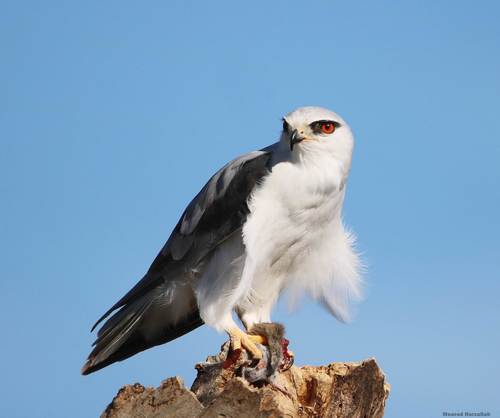 Black-winged Kite
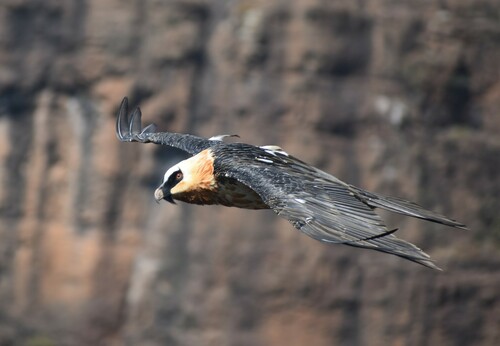 Bearded Vulture
In short
The most reliable field mark to separate Black-winged Kite from Bearded Vulture is size and structure: the vulture is an enormous, long-winged, wedge-tailed bird, utterly dwarfing the small, compact kite. In flight, juvenile Black-winged Kites show reddish-brown upperparts and breast, while juvenile Bearded Vultures are dark black-brown overall with a grey-brown breast. Adults are also unmistakable: Black-winged Kite is pale with striking black wing patches and red eyes, while Bearded Vulture is a massive, long-tailed bird with a pale head, black facial beard, and rusty or orange-washed underparts. Even at a distance, the vulture’s huge size, long wedge-shaped tail, and slow, powerful flight are diagnostic.
Identification tips
- Size is decisive: Bearded Vulture is enormous, with a wingspan up to 2.8 meters; Black-winged Kite is small, barely larger than a kestrel. If you can judge size against landscape or other birds, this is the first check.
- Tail shape: Bearded Vulture has a long, wedge-shaped tail, longer than the width of its wing; Black-winged Kite has a much shorter, squarer tail. In flight, the vulture’s tail is a key field mark.
- Flight style: Black-winged Kite often hovers, with rapid wingbeats and buoyant flight; Bearded Vulture soars with slow, deep wingbeats and rarely hovers. If you see a hovering bird, it is almost certainly the kite.
- Juvenile plumage: Young Black-winged Kites show reddish-brown upperparts and breast; juvenile Bearded Vultures are dark black-brown all over, with no pale or rufous tones. This is critical for separating immatures.
- Adult plumage: Black-winged Kite adults are pale grey and white with bold black wing patches and red eyes. Bearded Vulture adults are darker, with a pale head, black facial beard, and rusty or orange-washed underparts.
- Facial pattern: Bearded Vulture has a black mask and beard; Black-winged Kite has a plain, owl-like face with red eyes and no beard.
- Wing shape: Bearded Vulture’s wings are very long and narrow, giving a falcon-like silhouette at giant scale; Black-winged Kite’s wings are long but not nearly as narrow or pointed.
- Perched posture: Black-winged Kite perches upright on wires or branches, often in open country; Bearded Vulture is rarely seen perched except on cliffs or rocky outcrops, and appears hunched with a long tail trailing.
- Habitat: Open lowland fields, grasslands, or farmland point to Black-winged Kite; high mountains, cliffs, or rocky uplands point to Bearded Vulture.
- Bill and feet: Bearded Vulture has a massive, hooked bill and large, powerful feet; Black-winged Kite’s bill is small and delicate, suited to small prey.
- Behavior at carcasses: Bearded Vulture is a scavenger, often seen near carcasses or bones; Black-winged Kite hunts live prey and is never at carcasses.
- Color wash: Adult Bearded Vultures may show orange or rusty wash on head and underparts from mud-bathing; Black-winged Kite is always clean white and grey.
- Eye color: Black-winged Kite has striking red eyes; Bearded Vulture’s eye is less conspicuous at distance.
- Vocalizations: Not useful for separation; both are mostly silent in the field.
- Season and age: Bearded Vulture takes 5–7 years to reach adult plumage; if you see a very large, dark raptor in the mountains, it is likely a juvenile vulture, not a kite.
Size
There is no overlap in size: Bearded Vulture is one of the world’s largest raptors, with a body mass around 5.5 kg and a wingspan up to nearly 3 meters, while Black-winged Kite is a small raptor, less than a tenth the vulture’s weight. Even at long range, the vulture’s immense size, long wings, and elongated tail are obvious. The kite is compact, with long wings but a much shorter, squarer tail and a small, owl-like head. If you see both in the same area, the vulture is truly gigantic, often described as 'eagle-sized or larger,' while the kite is closer to a kestrel or small hawk in bulk.
Plumage
- Juvenile/immature Black-winged Kite: Shows reddish-brown feathers on upperparts and breast, providing a warm, rusty wash not seen in Bearded Vulture juveniles. The rest of the plumage is pale grey and white, with black on the wings.
- Juvenile Bearded Vulture: Entirely dark black-brown above and below, with a greyer-brown breast. No pale or rufous tones on upperparts; takes 5–7 years to reach adult plumage.
- Adult Black-winged Kite: Clean white underparts, pale grey upperparts, bold black patches on the wings, and striking red eyes. No beard or facial markings.
- Adult Bearded Vulture: Grey-blue to grey-black above, creamy forehead, black eye-stripe and beard, and variable rusty or orange wash on head, breast, and legs (from cosmetic mud-bathing). Long, dark wedge-shaped tail and dark wings. The overall effect is a much darker, more patterned bird than the kite, with a distinctive facial mask and beard.
- Flight: Black-winged Kite is pale and compact with black wing patches; Bearded Vulture is dark-winged with a long, wedge-shaped tail and a pale head.
Behaviour
Black-winged Kite is best known for its hovering flight over open grasslands, reminiscent of kestrels. It often perches on exposed branches or wires, scanning for prey, and is agile and buoyant in the air. Bearded Vulture, in contrast, soars on broad, long wings with slow, powerful beats, rarely hovers, and is often seen gliding along mountain ridges or circling high overhead. Its flight is more reminiscent of a giant falcon: long, narrow wings and a distinctive wedge-shaped tail. On the ground, the vulture has a waddling gait and is rarely seen perched low. The kite is much more likely to be seen actively hunting or perching in open country.
Habitat
Black-winged Kite prefers open grasslands, plains, and sometimes grassy slopes or agricultural areas, often at lower elevations. It is rarely found in mountainous terrain. Bearded Vulture is a specialist of high mountains, cliffs, and rugged uplands, often above the treeline, and is strongly associated with remote, rocky landscapes where large mammal carcasses are available. Seeing a raptor in a high alpine or rocky mountain setting strongly favors Bearded Vulture; open lowland fields or farmland favors Black-winged Kite.
Voice
Neither species is especially vocal in the field. Bearded Vulture is generally silent, but may give shrill whistles in display or a falcon-like 'cheek-acheek' call near the nest. Black-winged Kite is also quiet, with no distinctive calls likely to be heard at a distance. Voice is not a reliable field mark for separation.