Birdr

Black-winged Stilt vs Pied Avocet

Himantopus himantopus versus Recurvirostra avosetta

Play a quiz with Black-winged Stilt and Pied Avocet

Black-winged Stilt (Himantopus himantopus) Black-winged Stilt
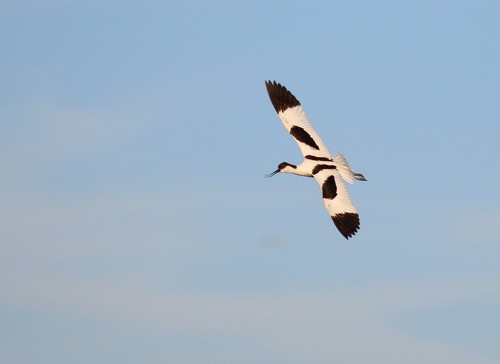
Pied Avocet (Recurvirostra avosetta) Pied Avocet

Media

Loading…

In short

The Black-winged Stilt and Pied Avocet are both long-legged waders, but they can be distinguished by their bill shapes and plumage patterns. The stilt has a straight, slender bill and predominantly black-and-white plumage, while the avocet features a distinctive upturned bill and bold black-and-white patterning.

Identification tips

  1. Look for the bill shape: the stilt has a straight bill, while the avocet's is upturned. 2. Check the plumage pattern: stilts have a simpler black-and-white contrast, whereas avocets have a bold black cap and more intricate patterning. 3. Observe foraging behavior: avocets sweep their bills in the water, a behavior not seen in stilts. 4. Consider the habitat: stilts are more common in freshwater environments, while avocets prefer saline or brackish areas.

Size

Both species are similar in size, but the Pied Avocet is generally bulkier with a slightly longer body.

Plumage

The Black-winged Stilt has a mostly white body with black wings and a black nape, whereas the Pied Avocet displays a more striking black-and-white pattern with a black cap and a white face.

Behaviour

Both species are often seen wading in shallow waters, but the Pied Avocet is more likely to be observed sweeping its upturned bill side-to-side while foraging.

Habitat

Black-winged Stilts prefer freshwater marshes and swamps, often nesting on small islets, while Pied Avocets are typically found in saline or brackish wetlands.

Voice

The Black-winged Stilt is known for its nasal, staccato, yelping 'kek...kek...kek' calls, while the Pied Avocet's calls are less documented but generally softer.

Submit a better description

Use the same sections as the comparison. Your text is published immediately.

The Black-winged Stilt and Pied Avocet are both long-legged waders, but they can be distinguished by their bill shapes and plumage patterns. The stilt has a straight, slender bill and predominantly black-and-white plumage, while the avocet features a distinctive upturned bill and bold black-and-white patterning.

  1. Look for the bill shape: the stilt has a straight bill, while the avocet's is upturned. 2. Check the plumage pattern: stilts have a simpler black-and-white contrast, whereas avocets have a bold black cap and more intricate patterning. 3. Observe foraging behavior: avocets sweep their bills in the water, a behavior not seen in stilts. 4. Consider the habitat: stilts are more common in freshwater environments, while avocets prefer saline or brackish areas.

Both species are similar in size, but the Pied Avocet is generally bulkier with a slightly longer body.

The Black-winged Stilt has a mostly white body with black wings and a black nape, whereas the Pied Avocet displays a more striking black-and-white pattern with a black cap and a white face.

Both species are often seen wading in shallow waters, but the Pied Avocet is more likely to be observed sweeping its upturned bill side-to-side while foraging.

Black-winged Stilts prefer freshwater marshes and swamps, often nesting on small islets, while Pied Avocets are typically found in saline or brackish wetlands.

The Black-winged Stilt is known for its nasal, staccato, yelping 'kek...kek...kek' calls, while the Pied Avocet's calls are less documented but generally softer.

Discard your changes?

You have unsaved edits. If you leave now, those changes will be lost.

Black-winged Stilt · Pied Avocet · My Tricky Birds