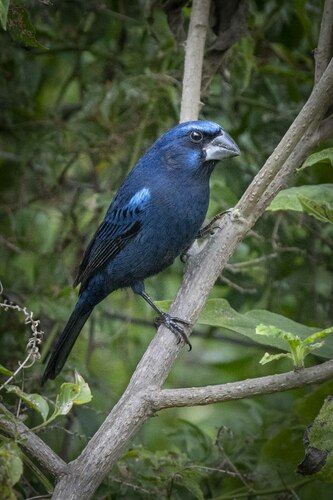
Blackish-blue Seedeater vs Ultramarine Grosbeak
Amaurospiza moesta versus Cyanoloxia brissonii
Play a quiz with Blackish-blue Seedeater and Ultramarine Grosbeak
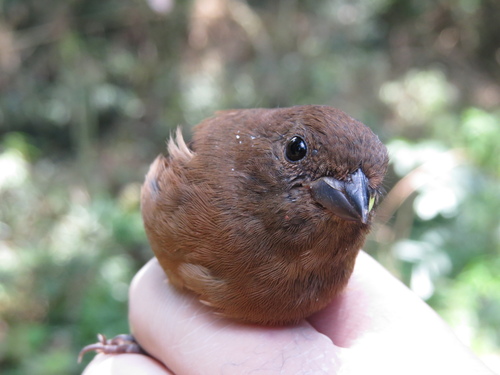
Blackish-blue Seedeater
Ultramarine Grosbeak
In short
The Blackish-blue Seedeater and Ultramarine Grosbeak can be distinguished by their plumage and bill features. The seedeater is slaty blue with blackish tones, while the grosbeak is a deep, rich blue with a pale supercilium and malar. Both species have large, thick bills, but the grosbeak's bill has a pale base to the mandible.
Identification tips
- Look for the pale supercilium and malar on the male Ultramarine Grosbeak. 2. Note the white underwing coverts on the female Blackish-blue Seedeater. 3. Observe the bill color: the Ultramarine Grosbeak has a pale base to the mandible. 4. Consider habitat: seedeaters are often near bamboo, while grosbeaks are in varied scrub and forest habitats.
Size
Both species are similar in size, typical of small to medium-sized grosbeaks.
Plumage
Male Blackish-blue Seedeaters are slaty blue, almost blackish from face to breast, while females are tawny-brown with white underwing coverts. Male Ultramarine Grosbeaks are deep blue with a pale supercilium and malar, and females are uniformly chocolate-brown.
Behaviour
The Blackish-blue Seedeater is often seen during bamboo seeding events, usually in pairs. The Ultramarine Grosbeak is more reclusive, often heard more than seen, inhabiting thick scrub.
Habitat
The Blackish-blue Seedeater is found in southeast Brazil, northeast Argentina, and eastern Paraguay, often during bamboo seeding. The Ultramarine Grosbeak ranges throughout eastern South America, from the Amazon basin to the Patagonian steppe, with disjunct populations in Venezuela and Colombia.
Voice
The Ultramarine Grosbeak is known for its loud, far-reaching song, while specific vocalization details for the Blackish-blue Seedeater are less documented.
Blackish-blue Seedeater · Ultramarine Grosbeak · My Tricky Birds