
Blackpoll Warbler vs Pine Warbler
Setophaga striata versus Setophaga pinus
Play a quiz with Blackpoll Warbler and Pine Warbler
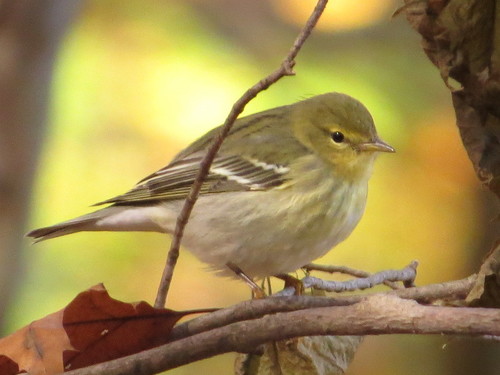 Blackpoll Warbler
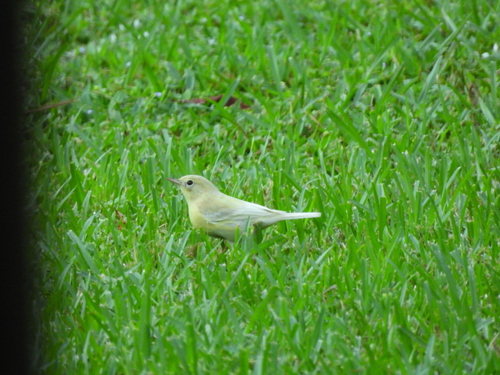 Pine Warbler
In short
The most reliable field mark to separate Blackpoll and Pine Warblers is leg color: Blackpolls (all ages and seasons) have bright orangish-pink legs, while Pine Warblers have dark legs. In spring, male Blackpolls show a striking black cap and white cheeks, unlike any Pine Warbler. In fall and for immatures, both can appear olive or greenish above with pale underparts and two white wing bars, but Blackpolls always retain their pale legs and often look slimmer and more sharply marked. Bill color and structure, as well as subtle differences in face pattern and habitat, help clinch the ID when plumage is ambiguous.
Identification tips
- Leg color is the single most reliable field mark: Blackpoll Warblers (all ages and seasons) have bright orangish-pink legs; Pine Warblers always have dark legs. Always check leg color when visible.
- Breeding male Blackpolls are distinctive: Look for a black cap, white cheeks, and sharply streaked white underparts—never shown by Pine Warbler.
- Face pattern in fall and immatures: Blackpolls have a more contrasting face, sometimes with a hint of a pale cheek patch, while Pine Warbler faces are more uniform olive or olive-brown with yellowish 'spectacles.'
- Bill color and shape: Blackpolls have a pale lower mandible, giving a two-toned look; Pine Warbler bills are all dark and slightly longer and more pointed.
- Underpart streaking: Blackpolls (especially in spring) have bold black streaks on the flanks and sides; Pine Warblers are much less streaked, usually plain below.
- Wing bars: Both species have two white wing bars, but Blackpolls' are often sharper and more contrasting, especially in fall.
- Upperpart color in fall/immature birds: Blackpolls are greenish with dark streaks; Pine Warblers are olive or olive-brown and less streaked.
- Throat and breast color: Pine Warbler males have a bright yellow throat and breast, fading to white on the belly; Blackpolls are never this bright yellow below, even in fall.
- Habitat context: If the bird is in a pine-dominated habitat, especially in the Southeast, Pine Warbler is more likely. Blackpolls are more likely in mixed or deciduous woods during migration.
- Foraging behavior: Pine Warblers may be seen probing pine cones or feeding on the ground for seeds—unusual for Blackpolls.
- Migration timing: Blackpolls are late spring migrants and peak in the Northeast in late May; Pine Warblers arrive earlier and can be resident in the Southeast.
- Overall jizz: Blackpolls are slimmer and more active, while Pine Warblers can look bulkier and more methodical.
- Sex and age pitfalls: Female and immature Blackpolls can look very similar to Pine Warblers in fall, but always check leg and bill color for confirmation.
- When in doubt: If you can't see the legs or bill, be cautious—fall Blackpoll and Pine Warbler can be nearly indistinguishable on plumage alone, especially in poor light.
- Voice: Not diagnostic with the provided notes, but Pine Warbler song is a musical trill, while Blackpoll's is a high, thin series of notes (not detailed here).
Size
Both species are very similar in size and mass, with Blackpoll Warbler averaging 12.3 g and Pine Warbler 11.9 g [wikidata]. In the hand or with direct comparison, Blackpoll may appear very slightly larger or longer-winged, but this is rarely useful in the field. Structurally, Pine Warbler can look a bit bulkier with a longer, more pointed bill, but overall size is not a reliable separator.
Plumage
Juvenile and first-fall Blackpoll Warblers are greenish above with streaked backs, yellowish breasts, and always show two white wing bars—similar to Pine Warbler immatures. However, Blackpolls (all ages) have orangish-pink legs, while Pine Warblers have dark legs. In breeding plumage, male Blackpolls are unmistakable with a black cap, white cheeks, and heavily streaked white underparts. Female Blackpolls are duller but still have pale legs and a more contrasting face than Pine Warbler. Pine Warbler males are olive above with a bright yellow throat and breast, fading to white on the belly, and lack any black cap or strong facial contrast. Females and immatures are duller olive-brown above and paler below, with a faint yellowish wash and always dark legs. Both species show two white wing bars, but Blackpolls tend to have a cleaner, sharper-edged look, especially in fall. Bill color is also useful: Blackpolls have a pale lower mandible, while Pine Warblers' bills are all dark.
Behaviour
Pine Warblers often forage slowly on pine branches and trunks, sometimes probing into cones or even feeding on the ground for seeds—behavior unusual for Blackpolls. Blackpoll Warblers are more active, typically gleaning insects from foliage and rarely seen on the ground. Pine Warblers may appear more methodical and less restless than Blackpolls, especially outside migration.
Habitat
Pine Warblers are closely tied to pine-dominated habitats, especially in the southeastern US, and are often resident year-round there. Blackpoll Warblers breed in northern forests and are seen in a wide range of habitats during migration, but are rarely found in pure pine stands outside migration. In fall, Blackpolls are common in the Northeast and rarely seen south of Cape Hatteras, while Pine Warblers are more widespread in the Southeast and can be found in pine woods year-round.