Blue Bustard vs Karoo Bustard
Eupodotis caerulescens versus Heterotetrax vigorsii
Play a quiz with Blue Bustard and Karoo Bustard

Blue Bustard
Karoo Bustard
In short
The Blue Bustard and Karoo Bustard can be distinguished by their contrasting plumage and habitat preferences. The Blue Bustard has a striking black-and-white face, while the Karoo Bustard features a large black patch on the foreneck. Both species are found in open areas but prefer different substrates.
Identification tips
- Look for the black-and-white face of the Blue Bustard versus the black neck patch of the Karoo Bustard.
- Note the habitat: grasslands for Blue Bustard, karoo country for Karoo Bustard.
- Listen for the Blue Bustard's distinctive call, which can carry over long distances.
Size
Both species are similar in size, typical of medium-sized bustards.
Plumage
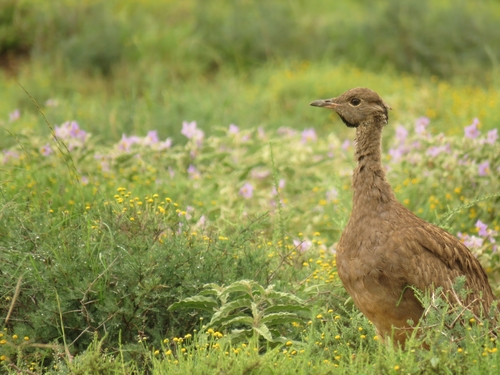
The Blue Bustard has a high-contrast black-and-white face, whereas the Karoo Bustard shows a large black patch from the chin to the foreneck, with a pinkish suffusion above and an off-white belly. Female and juvenile Blue Bustards are duller with tawny ear coverts, while female Karoo Bustards have a smaller, browner neck patch.
Behaviour
Both species are often seen in pairs or small groups and exhibit some cooperative breeding behavior, though this is more documented in the Blue Bustard.
Habitat
The Blue Bustard is typically found in open grasslands, while the Karoo Bustard prefers dry, open karoo country with scattered shrubs and a stony or gravelly substrate.
Voice
The Blue Bustard's call is unrhythmical and discordant, audible up to 3 km away. The Karoo Bustard's vocalizations are similar to those of Rüppell's Bustard, but specific differences are not well-documented.